

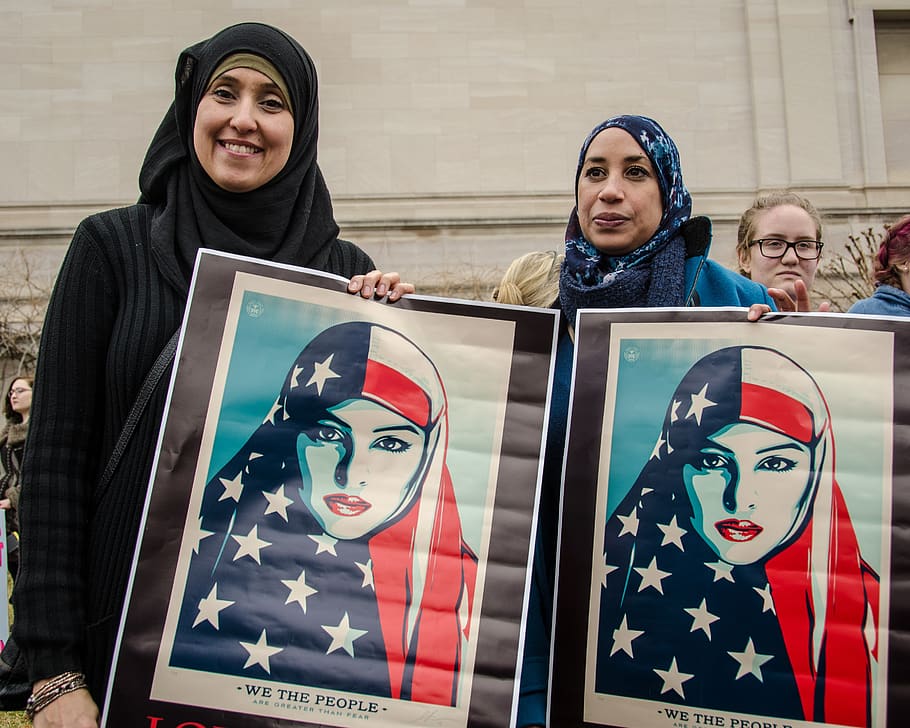
It has been almost two months now since news of several girls in Karnataka being denied entry in their school because of their hijabs hit in the headlines in India. I sat scrolling on my phone, oceans and continents away, reading headlines of opinion pieces, feminist tirades, and enraged updates by Muslims. I was nowhere close to everything that was happening, yet not feeling any calmer than I would have if I was in India. I left India in the August of last year, to fly to the US, with no expectations, only hoping to get a break from dealing with the incessant attacks on my identity. If the news of the Hijab ban in India shocks anyone, they are naïve at best and deliberately ignorant at worst. The news did not shock me, it was only triggering, because what was now official had always been happening. As a Hijabi Muslim woman, I had been actively dealing with this hatred in one form or the other for a long time. From blatant rejections at job interviews to covert hatred and sly remarks, I have dealt with it all, and talked about it. I raised the issue when it happened, not in a school in some remote part of the country, not with young girls who could be heckled, but in elite central universities and with an adult woman seeking a job. I am in the unfortunate position of almost seeing a silver lining in its blowing up because it is now at least visible. Perhaps if the action of injustice is more concrete, the reaction to it would also be more substantial than just words of sympathy.
When you have spent the largest part of your conscious years dealing with the constant defamation of your core belief system(s), you develop a defense instinct. I have had to spend the last couple of years actively defending my faith and my religious identity to the point of absolute exhaustion. When I was heading to the US, I was prepared to give up the defense. I had no idea how but I knew I had to escape for self-preservation. What I did not foresee was how the supposed escape would soon take the form of guilt.
Muslim identity has been a global debate ever since the US launched its ‘War on Terror’. I was a Muslim in India and we were apparently not directly hit – neither by the debate nor by the War on Terror. But if you were a Muslim in India, you would know that no towers had to be decimated for you to be thrown off even the margins that were yours. What was decimated and turned to rubble was also yours, and yet you were the one who could not walk without shame in your eyes. The Babri Masjid was demolished a year before I was born, yet its memory is as fresh in my mind as an open wound without an embrocation. As a good and acceptable Muslim, I had grown up pretending I felt nothing for the Masjid and all I wanted was for us to forget it ever happened and build a school or a hospital in its place. We had learned to gulp injustices and let them turn to stone in our throats. It is no surprise that Muslims never felt safe voicing their true beliefs out in public- we have lived suspiciously even in our private quarters, eyeing each other, hoping/not hoping that someone else would say what you have been holding up inside of you forever – “I hate the US”, “9/11 is being used as an excuse to unleash an Islamophobic war on the Muslim world”, “I am not sad when Pakistan wins a cricket match”, “I rejoice harder when India wins only to avoid any suspicious glances”. But we kept it all inside, till it became too much and then we burst open. The events of 2002 in Gujarat, one of the worst massacres of Muslims in India, followed at the heel of 9/11 and it could be carried out with such impunity partly also because the Muslims were now greater suspects, each one of us an imposter. It was as if we had collectively failed at hiding our Muslim selves.
I was soon going to be in the country that was at the forefront of always keeping the machinery of Islamophobia well oiled. In the global political discourse, no two things have been posited to be as incompatible as Islam and the West and now I was moving towards the West. On my way here, at Paris airport, I had a small brush with suspicion when I was called out to be checked separately; I could see it coming after I had offered namaaz at the airport during the long layover. Though they swiftly let me go since my visa was sponsored by the US government and the rest of the way was unhindered. I crossed the border with my hijab intact, and I was surprised at how nothing and no one around made me conscious of the identity I was carrying. Eventually, when I started moving around, I realized how my hijab was in fact the first point of contact with anyone I came across. Still, it only elicited indifference, sympathy or solidarity- sympathy being my least favourite. Any hijab-wearing women I crossed would instantly say assalamualaikum to me, and after being a little surprised I would happily say walekumassalam back. I am not surprised anymore, but these innocent greetings always say more than what they literally convey. It is an establishment of solidarity, a gesture of comfort telling the other that we know what it is like to uphold this identity here, and that we are proud of each other. In India, Muslims have been suspicious of each other, trying to distance themselves from the next Muslim fearing that they may be too Muslim. I remember how all of us tried to pass ourselves off as lesser Muslims than we perhaps were. Everything from our vocabulary to what we ate to how we dressed was an attempt to sanitise our Muslim-selves— the more non-Muslim you appeared, the more acceptable you were. My mother wears an abaya/burqa and it took me the longest time to come to terms with her going for the PTMs at school. I did not just fear the non-Muslim kids giving up on me if they saw me with my mother, but that even the Muslim kids might in order to retain their carefully curated image. Recently, the entire community collectively discarded Sharjeel Imam (the student leader of Shaheen Bagh) when he stood up as a Muslim and not a secular-sanitised-Indian-Muslim per se because it made us uneasy. The feelings were familiar, our collective responses reflecting the embarrassed responses of our younger selves but now some of us could see through our insecurities. It took several blows for Muslims in India to come together in bonds of unconditional solidarity, and there it is still a work in progress. Here in the US, it is not just the visible Muslims who have extended unspoken solidarity towards me; I have had strange but warm encounters with Black Americans. They have walked up to me in stores and if they saw me confused, I have seen them go out of their way to help me. One time a store employee came up to me at the Apple store and said straight up that he was really hoping he would get to assist me because he knows what it feels like to be different. He told me he was Christian but had an aunt and a cousin who had converted to Islam. He said wearing the hijab for his cousin was the same as his black skin, she was judged and hated for it, but she could not take it off. He said he always made it a point to serve all people of colour and/or women in hijabs because he knew what it feels like to be refused service for your identity. This happened months ago but I have not been able to shake this off my memory, not that I want to, not that I ever will be able to but what especially stuck with me was the idea that the hijab as your identity is like your skin – “you cannot take it off”.
All the debates that talk of the hijab as being a matter of choice, are not reducing it to the idea of choice but are robbing it off its nature, its essentiality. For those who wear the hijab, it is not just a piece of cloth; instead it is a matter of being Muslim. The US has given me this added perspective and even though I can see that the absolute liberal environment accepts and tolerates everyone, a visible Muslim, especially a woman, will always be an impasse in the discourse. I have realized that so long as we keep defending our faith through the western liberal paradigm, we will keep failing. While in the US the liberals are at the stage of graciously tolerating Islam and its markers under the ambit of choice, in India it has become unacceptable despite the baseless arguments about choice. It is ironical that Islam has to defend itself as the most “liberal” faith to be accepted in a country like India that is not even mockingly liberal.

Related Blogs

Reflections on Islam, Muslimness and Decolonisation – I
*Yasin Aktay’s four-part series is a contribution to Critical Muslim Studies that critically engages with S. Sayyid’s Recalling the Caliphate as a means of reflecting on the contemporary manifestations of the Muslim Question.Image credit: photographs by Johanna Loock,...
Reflections on Islam, Muslimness and Decolonisation – II
*Yasin Aktay’s four-part series is a contribution to Critical Muslim Studies that critically engages with S. Sayyid’s Recalling the Caliphate as a means of reflecting on the contemporary manifestations of the Muslim Question.Image credit: photographs by Johanna Loock,...

Reflections on Islam, Muslimness and Decolonisation – III
*Yasin Aktay’s four-part series is a contribution to Critical Muslim Studies that critically engages with S. Sayyid’s Recalling the Caliphate as a means of reflecting on the contemporary manifestations of the Muslim Question.Image credit: photographs by Johanna Loock,...