

by Shvetal Vyas Pare
Blog 64
14 October 2022
India | Hijab ban | Hijab in context
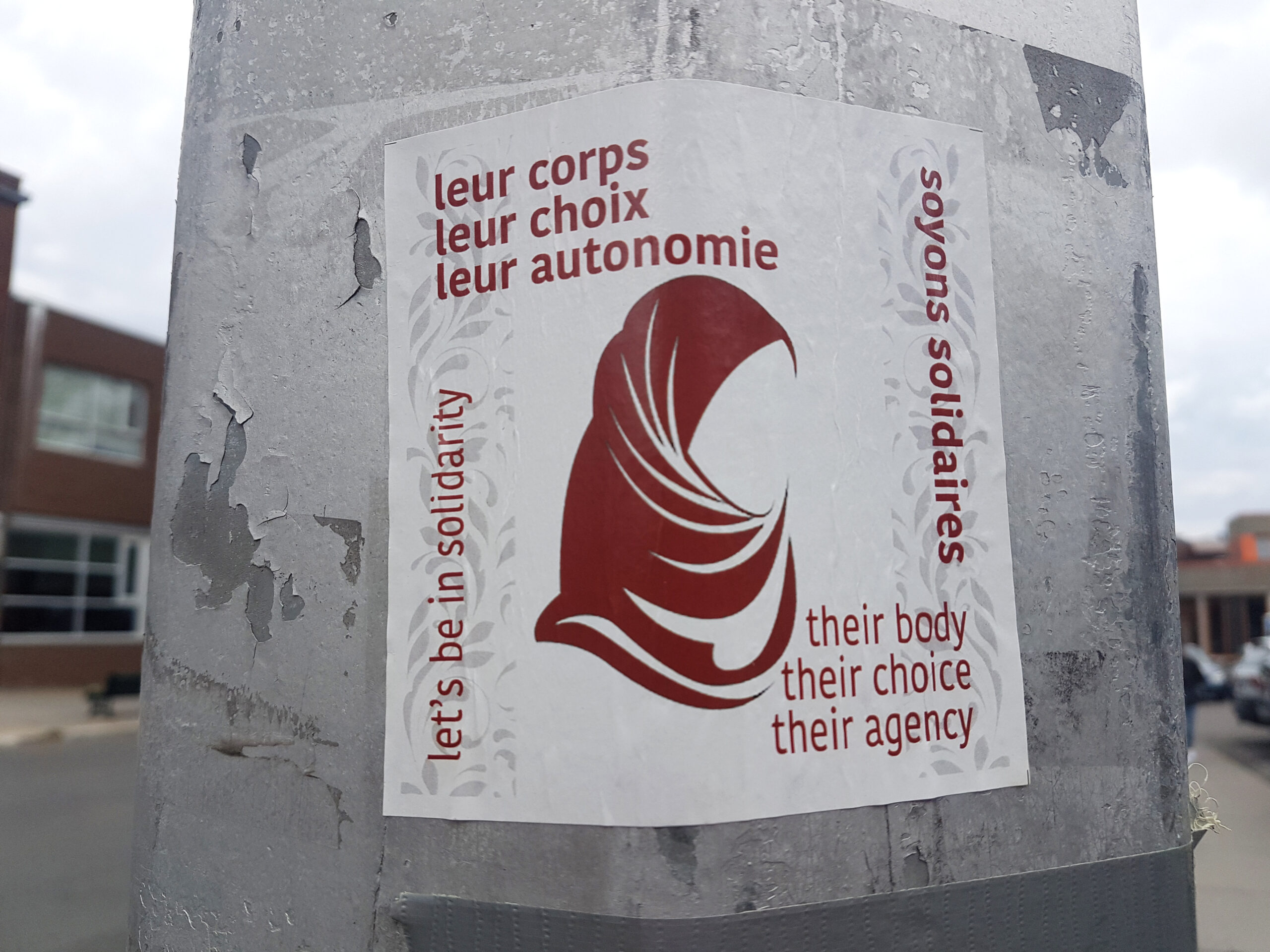
Iranian women and men have come out on the streets to protest against the enforcement of compulsory hijab. This in turn has evoked support from many parts of the world. This blog post however is not about Iranian women. Rather, it is about the debates around this protest in India. There is an attempt underway in India to ban women wearing the hijab from attending educational institutions. There were protests in India against this imposition. The matter went to court, and the Supreme Court of the country has recently delivered a split verdict on the issue. Indian Muslim women are fighting for the right to wear the hijab and still be treated like proper citizens, deserving of an education, access to public places, safety and respect. Some thinkers have supported Indian Muslim women’s right to wear the hijab as well as the Iranian women’s right to oppose it. To right-wing and centrists, this duality is essentially unsustainable: how can you support the hijab in one situation but oppose it in other?
The most common argument made is that this shows that there is appeasement of minorities in India, and this is seen as an injustice to the majority community, as this newspaper article argues. The right to follow the tenets of your religion is turned by this verbal sleight-of-hand into appeasement. The idea of appeasement inherently carries within it the idea that the minority has to live according to the idea and ideals of the majority and whatever rights they get they have only through the pleasure of the majority. If they get any rights, you can turn a section of the majority against it by using the term ‘appeasement’ and creating the idea that any right given to a minority is an injustice to the majority. Thus, the very fact of having a right is no longer a natural guarantee of being a citizen. Instead, the few selective rights that you have – to wear a hijab or a turban, to celebrate your festival in a public place and so on – are no longer rights but appeasement. From the default, they become conditionally approved and grudgingly given.
To some people, the issue is not appeasement but the hijab itself. It is the boundary at which the notion of choice breaks down. In this argument, the hijab represents oppression and simply cannot be the woman’s voluntary choice. There are quite a few people who have spoken about women’s choice, but seemingly well-meaning people have responded to that with the argument that choice happens in a context, and so just using choice is not enough to understand this decision. They assure others that some women are forced by their families to choose the hijab and this discourse of choice erases their pain.
Yes, it must be the case that in a population of 200 million, some women indeed are pressured by their families and communities to wear the hijab and this is wrong. But this is not unique to the hijab. Families police their female members over what they wear, what time they go out and return, who they marry, whether they are straight or gay, whether they should have male friends or not, if they are trans and so on. The oppression of women and children by their family members and relatives occurs worldwide across classes: what religion does is provide the language it is done in, but the fact of oppression is about power. We do not need to specifically indulge in Islamophobia to criticise these situations and to support the women fighting these battles. Just as one can support Iranian women in their battle against the hijab and American women in their battle against restrictions on abortion.
But there also exist women who choose the hijab as a political and ethical choice. It is here that the idea of context comes into the picture. These women are aware of the context of the hijab. In a history of colonialism that goes back almost 200 years, the coloniser turned the hijab into a symbol of the oppression of the brown woman by the brown man. The veil was a contested symbol during the Algerian war of independence when French colonisers held a public unveiling ceremony celebrating the emancipation of Algerian women. Imagine a public ceremony where British colonisers were to celebrate Indian women changing from saris to skirts, and proclaiming that this showed their civilizational superiority. Naturally for female Algerian freedom fighters the veil became something to reclaim.
It is not just historically that the hijab became a politically volatile symbol. Western feminists wrote articles justifying the invasion of Iraq framing it in terms of rescuing the women. A lot of feminists of colour have called out Western feminism for its complicity in neo-colonialism and the inflicting of unnecessary violence around the globe. The hijab has been politicised over and over again. In Western countries where hijab-wearers are less than 1% of the population, bills have been introduced and passed banning the hijab. Not because it is a problem, but because politicians perceived as being tough on Muslims win elections.
It is this exploitation and oppression that Muslim women in the West and in India fight against when they wear the hijab. They make being Muslim a visible aspect of their identity, and share the problems faced by the Muslim men in their family who have beards: the routine harassment, the shouted slurs, the being called out for being checked over and over again. What they are challenging is the notion that countries the West which has benefitted from the colonisation of Muslim lands subsequently does not want visible Muslims in their spaces.
This brings me back to India. Again, context is key. The ban that certain state governments and state-backed social organisations seek to impose on Muslim women wearing the hijab in schools and colleges, and thereby make it more difficult for them to get an education, is not a ban that comes from a critique of patriarchy. The same set of actors, for example, want Hindu women to be less feminist. It comes in a country where Sikhs routinely wear turbans. It comes from the same impulse to make the Muslim conform by making their Muslim-ness invisible as in the Western countries. It is impelled by the same discourse of hatred, and driven by the same political impulses of strengthening a vote base. It is state-sanctioned oppression and persecution of Muslims to dilute their rights as citizens and force them into situations where they have to give up certain parts of themselves in order to get something as basic as an education. Context, therefore, is indeed a crucial component of choice, but context need not be only about the absence of agency. Context could also be about the presence of choice. That is why we need to center the women in both sets of situations and listen to them: what are the Iranian women protesting on the road saying? And what are the Indian hijab-wearing women saying?
Let me suggest a thought experiment to you. Because the sari has not been politicised, it is thought that it can never be. But the discourse about power is never about covering or not covering. Nuns cover themselves in habits but never have Western governments sought to ban that. Authoritarian governments need internal enemies to hold on to their power and Hindus could become the discursively created enemies in a country where they are not in a majority. Magazine articles abound calling Hindus uncivilised and oppressive for making their women wear saris, and governments start passing legislation to ban saris, though only a very few Indian women wear them routinely. In such a scenario, I shall start wearing a sari daily, and march against such legislation. Where will you be in such a scenario? If you would be marching alongside me, you could also march alongside women wearing the hijab in India.
Author’s bio
Shvetal Vyas Pare is one of the editors of ReOrientations. She is a PhD student at the School of Culture, History and Language at the Australian National University. Her areas of interest are critical discourse analysis, decolonial studies, Indian history and Indian literature. She has published academically in Modern Asian Studies and in South Asia, as well as a variety of commentaries and blog posts on diverse platforms. Her preferred methods of procrastination are reading detective fiction and watching political comedy. You can follow her on Twitter at: https://twitter.com/Shvetal04
Image Source
“Leur corps / Leur choix / Leur autonomie – Their body / Their choice / Their agency” by Indrid__Cold is licensed under CC BY-SA 2.0.

Related Blogs

Of Those who Don’t get to be Cockroaches
Image credit: Photo taken by Shaheen Abdulla, July 2026. Photo used with permission. Since 2014, India has been governed by Hindutva ethnonationalism, intensifying decades of structural marginalization of Muslims through state-sanctioned impunity and systematic...

The Rebel Team: Football and Algeria’s Liberation
Image credit: Wikimedia: https://commons.wikimedia.org/wiki/File:Jubilee_FLN_soccer_team_1974.jpg (Mustapha Zitouni standing, 5th from the right; Rachid Mekhloufi sitting, 2nd from the right) History reminds us that, like literature and art, football can embody a...
Reflections on Islam, Muslimness and Decolonisation – I
*Yasin Aktay’s four-part series is a contribution to Critical Muslim Studies that critically engages with S. Sayyid’s Recalling the Caliphate as a means of reflecting on the contemporary manifestations of the Muslim Question.Image credit: photographs by Johanna Loock,...