

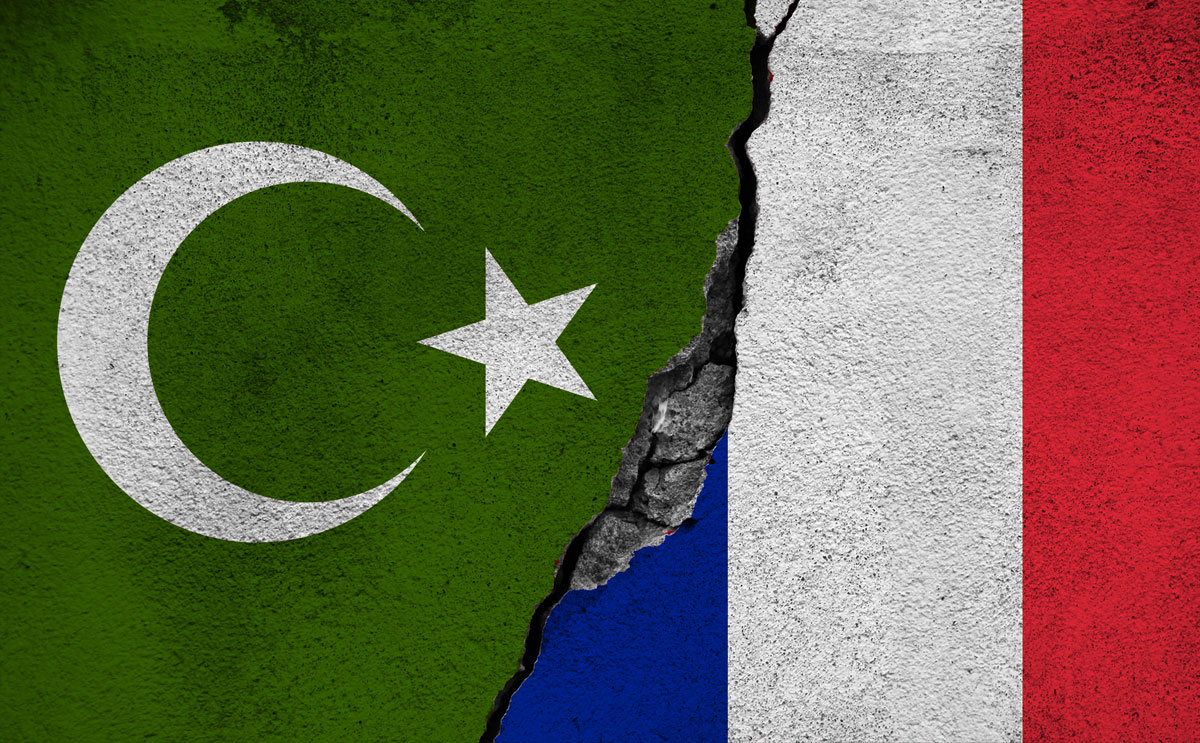
In late October 2020 French authorities raided the homes of suspected ‘Islamists’ – a term that is hardly distinguished from anyone that practices or speaks out for Islam, and police held children aged ten without clear reasoning other than the notion that these children might be radicalised. Clearly, even children are not exempt from Islamophobia in France.
In the midst of the global pandemic, France still finds time to continue its intense focus on Muslimness in the country. Following his earlier comments around alleged Islamic separatism, on 4th November 2020 French President, Emmanuel Macron, wrote in the Financial Times “Visit the districts where small girls aged three or four are wearing a full veil, separated from boys, and, from a very young age, separated from the rest of society, raised in hatred of France’s values.” Not only has ‘covering one’s face’ been made illegal in France since 2010, the claims made by Macron quite simply are unsubstantiated, rather the FT piece shows the flawed assumptions and lack of understanding of Islam and Muslimness in France held by Macron, and furthermore that this is something upon which he is prepared to act in order to further ostracise Muslims in France.
This ‘fake news’ comes as the Financial Times removed a previously published article written by Mehreen Khan critical of the French Islamophobic positioning allegedly due to errors (or perhaps due to her criticisms of France?) – highlighting the way in which those who are critical of the French position are silenced or told, without adequate basis, we simply don’t understand the French position. These comments by the French President are also indicative of the nation’s longstanding obsession with Muslim women’s bodies and particularly their visible Muslimness.
Attempts to regulate French Muslim women’s visible Muslimness are numerous, and range from legislative measures, political and normative discourse – often echoed in the media and are borne out in the rising gendered Islamophobic hate crimes in France. In 2010 France implemented the popularly dubbed Loi anti-niqab. Previously, 2004 saw the implementation of the Loi Stasi aimed at prohibiting ‘ostentatious faith symbols’ in schools, which in reality saw young Muslim girls being unable to wear hijab to school. Additionally, Muslim girls have been excluded from schools on the grounds that their skirts are too long (something which spilt over into neighbouring Belgium). Visibly Muslim mothers have been stopped from collecting their children from school or accompanying them on school trips. French Muslim women have been forced by police to strip on beaches since the burkini is somehow seen as anti-French, again this hysteria was imitated across the continent. French women who dare to display their Muslimness have been excluded from work and politics.
These measures which restrict the presence of gendered Muslimness in France are often legitimised through the framework of laïcité, which loosely translates to secularism. However, whilst the ideological principles of laïcité sought to lessen the influence of the Catholic church in France, today it has become weaponised as an Islamophobic tool and as such betrays its foundations. Laïcité holds a normative incontestability and the framing of Muslimness as being contrary to this, means that this branch of liberal Islamophobia in the country goes unquestioned.
Furthermore, whilst the French obsession with women’s bodies and visible Muslimness is in contradiction with French feminist principles (or perhaps it underlines the notion of multiple feminisms and the hegemony of white feminisms), it also echoes the French colonial project vis-à-vis Muslim women. Overall the French colonial project can be best understood through the Mission Civilisatrice, or Civilising Mission via which the French colonisers marked their own perceptions of their alleged cultural superiority and sought to bring the colonised in-line with this model. As such, there was strong emphasis on ‘unveiling’ the Muslim woman and concealing her visible Muslimness, something that seemingly significantly irked the coloniser. Arguably, the new forms of French gendered Islamophobia are simply an extension and continuation of this colonial project. Recent legislation simultaneously plays the white saviour narrative and as such infantilises Muslim women, whilst also more recently constructing these women as a source of threat both to ‘Republican values’ and their being linked to rising violent threat.

Beyond its gendered dimensions, French Islamophobia continues at alarming rates. French Interior Minister, Gerald Darmanin, called for the dissolution of Muslim-led and Muslim-centred organisations, including BarakaCity and the Collectif contre l’Islamophobie en France (CCIF). Regarding the latter, the CCIF focuses on the monitoring, reporting and advocating for those impacted by Islamophobia in France. Here, it is increasingly clear that if the French government can silence those who define and highlight the scale and extent of Islamophobia in the country, they may subsequently ignore the severity of the issue, in which it is complicit.
Darmanin also reignited the nation’s fixation on halal produce in his criticisms of a halal and kosher food aisle in a mainstream supermarket. The comments were followed by remarks conflating the practice with extremism and separatism. The fixation on halal products in France like in many other European nations typically comes from a place of limited knowledge of the Islamic (or Jewish) concept of ritual slaughter, but also involves the invocation of animal rights by individuals who themselves eat meat – is non-Halal or non-kosher meet somehow not killed? Here it is important to note that ritual slaughter (both halal and kosher) has been banned in Wallonia and Flanders in Belgium.
Similarly, and explicit since the Sarkozy era, there is a clear desire to create a ‘French Islam’, – a version of Islam that is ‘moderate’ and palatable for the allegedly secular French state – apparent in the arguably complicit Conseil Français du culte Musulman. Yet, as I found in my recently published book Muslim Women’s Political Participation in France and Belgium, politicians seem oblivious to the fact that such an inorganic formulation of Islam driven by out of touch politicians is unrealistic and unwelcome.
In short, the examples of Islamophobia in France are too numerous to cover in full. However, in addition to these examples the wider French Islamophobic discourse recall the French colonial desire to regulate the formerly colonised and Islam through Islamophobia this time within the French geographical space. Importantly, however, arguably the French brand of traditional right-wing and the liberal left brand of Islamophobia set precedence and signal acceptability globally. Looking forward, given its ambiguity Macron’s separatism law looks set to further legitimise and legalise the Islamophobic targeting of Muslimness and the practice of Islam in general in France – a clear infringement of Muslims’ freedom of faith. Furthermore, the events of recent weeks in France signal an intensification in the struggles of French Muslims in the face of the rising tide of French Islamophobia. With the 2022 French Presidential elections and the associated campaigns looming, coupled with the growth of far right Rassamblement National, Macron is pandering to the populist vote and Muslims will likely suffer the consequences of this. Clearly the French motto Liberté, Égalité, Fraternité applies less and less to Muslims in France.
Notes:

Related Blogs

After the War on Terror
Image credit: Pixabay (Free to use)Twenty-five years after 11 September 2001, the Global War on Terror (GWOT) appears, at first sight, to belong to another political moment. The occupations of Afghanistan and Iraq no longer organise Western political discourse in...

Of Those who Don’t get to be Cockroaches
Image credit: Photo taken by Shaheen Abdulla, July 2026. Photo used with permission. Since 2014, India has been governed by Hindutva ethnonationalism, intensifying decades of structural marginalization of Muslims through state-sanctioned impunity and systematic...

The Rebel Team: Football and Algeria’s Liberation
Image credit: Wikimedia: https://commons.wikimedia.org/wiki/File:Jubilee_FLN_soccer_team_1974.jpg (Mustapha Zitouni standing, 5th from the right; Rachid Mekhloufi sitting, 2nd from the right) History reminds us that, like literature and art, football can embody a...