

By Shvetal Vyas Pare
Blog 80
15 August 2023
Islamophobia | Racism | Colonialism | India | Independence
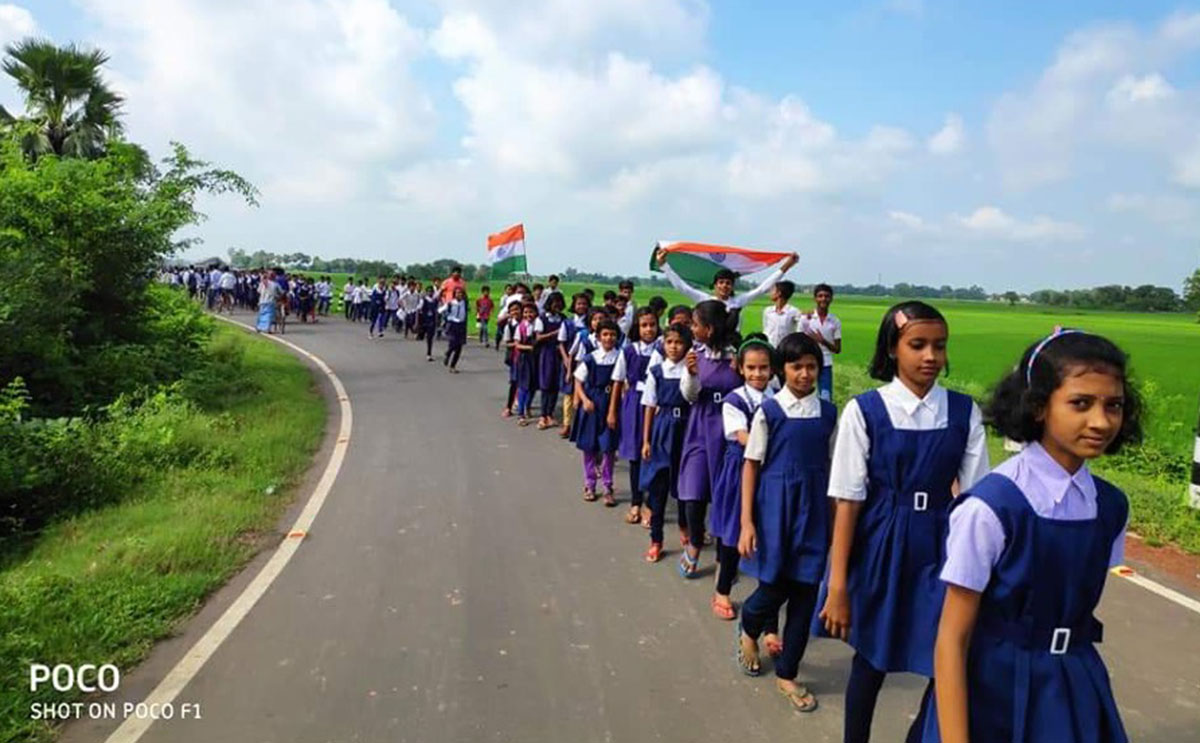
Image Credit: 15 August. Happy Independence Day
(https://commons.wikimedia.org/wiki/File:15_August,_Happy_Independence_Day.jpg) by Big Zone Sonu (https://commons.wikimedia.org/wiki/User:BigZone_Sonu) under licence https://creativecommons.org/licenses/by-sa/4.0/deed.en

On the 15th of August, India marks its Independence Day. As a child, I felt the usual emotions of happiness and pride on this day, bolstered by the nationalist sentiment in music and film. Growing up and becoming a student of colonial history, I felt happiness and pride again, but this time from a far clearer perspective of what independence meant, and what it had meant to those who had taken on racism and colonialism and dreamt of a different world. Today, as I see what is happening in India, I feel that while India is nominally independent, certain crucial lessons of the struggle for independence have been lost. In this blogpost I identify two such threads: one, the acceptance of the colonial construct of the Muslim as other, and two, an acceptance of a hierarchical world where some citizens are inherently lesser citizens than others.
To start with my first point, namely the creation of Muslims as the other, I am not simply saying that the British used ‘divide and rule’ as a ploy. Before the idea of nation-states as independent entities, equal in law even when unequal in size, took root across the globe, the usual political formations included empires, kingdoms and city-states among others. Rulers undertook war to expand their territories, exacting tribute or plunder from those weaker than them. When men in armies or royal-military families in central Asia ran out of space or lost battles closer home, they ventured forth and conquered polities further away. Some were good rulers in addition to being good conquerors, some were not. They enforced good and bad policies. Some were indeed oppressive, some were not. Some consolidated the kingdoms founded by their ancestors, some lost regions and weakened the authority of their throne. What was common to these “alien” rulers though was that once they had a kingdom to rule, it was the kingdom which had their attention, occupation and loyalty, however limited these may have been in some cases. In the contemporary nation-state system, territorial expansion through force is no longer deemed acceptable, though whether such aggression is punished or ignored depends on the specific circumstances of the world in general and of the nation-states in particular.
The difference between such rule and colonial rule is racism. The British saw themselves as morally superior to those they ruled. Prejudice against those different from one’s self was not new, but the institutionalisation of such prejudice was new. The loyalty of the British in India was to England, and the wealth that they extracted from the colonies went to making England more prosperous. British men routinely married British women (with a few notable exceptions) and sent their children “back home” to study. Indian subjects of the queen understood this racism, sometimes even if they could not consciously put their finger on it. Hence it is that the Gujarati poet Narmad visualised the resolution of the problems of colonialism in a future when a child of Queen Victoria would settle in India, marry a woman here and have children, who would in turn be emperors of India.[1] While not consciously articulated, the longing is exactly for what the Mughals were. But for the British in India, India could never quite become the motherland, because that already existed elsewhere, even for those who had spent minimal time in it.
This imaginative homeland existed as much for the British intellectual, be he writer, thinker, historian or academic, as for the colonising bureaucrat and for the conquering soldier. This worldview then permeates the way in which they talked about the current dispensation and those that preceded it. Like all governing entities, whether coloniser or democratically elected government, the British narratively cast themselves as saviours and those preceding them as solely oppressors. Moreover, they conflated historical identity in order to create a singular Muslim identity, whereas historically people thought of themselves in diverse ways, sometimes identifying themselves through ethnicity or community, sometimes as followers of a particular leader and sometimes through even more local networks and identities. Conquerors coming from what is modern-day Turkey, Afghanistan or Iran did not see themselves as similar or only as representatives of their religion.
Creating an undifferentiated ‘Muslim’ ruler also allowed the retrospective creation of the idea of an ancient India that could then be argued as pristine and Hindu. Again, this Hindu identity was an anachronism: it ignored the fact that people in older times have referred to themselves in their writing as Vaishnav, Shaivite, worshippers of devi, followers of one sect or another, owing allegiance to one feudal lord or another, and did not think of themselves as parts of a whole labelled ‘Hindu’. It is therefore quite normal to read in historical texts of lords who align with kings of religions different from theirs, and it is only a modern eye that will see this as being a ‘traitor.’
What these conflations did was allow British historians and intellectuals to justify the colonial project as emancipatory. It also perpetuated the idea that ‘India’ had always consisted of an indigenous population ruled by ‘outsiders’, and the British as just another instance of the same. It is no surprise that many historians of the time also talked about how the British were ‘unwilling’ rulers who just happened to tumble into governing the country. It was in this manner that the history of a nation, then itself in the process of being created, was written, understood and normalised.
Indian subjects also internalised the idea of the Muslim as other, and this anger at the Muslim king of yore translated into an antipathy towards the Muslim co-subject of the British queen. In writings in the various vernacular languages of the time one can see a slippage between Hindu identity and Indian identity, where the Hindu stands in as the default for an Indian. The slogan “Hindi, Hindu, Hindustan”, a way of popularising the Hindi language and distinguishing it from Urdu, also reflects such an understanding of India. Even authors who are normally seen as not polarising routinely create fiction in which Muslims feature as the villains, while calling for peace and amity between communities in their non-fiction.
This racism also therefore created two classes of subjects, wherein the natives were lesser subjects than the British. To give a common example, Indian judges in British courts could not rule cases where the accused was British; only white judges could try white people. Such a convention can only exist in a system where notionally a British subject, even a possible law-breaker, was superior to an Indian judge, no matter how learned or honoured. It was precisely such a two-tier system of subjecthood, and the racism underlying it, that those who fought for freedom sought to challenge. They wrote revolutionary, anti-colonial and anti-racist books and tracts, and spoke of creating a nation where no subject would be discriminated against because of the colour of their skin. Or their religion.
In present-day India, discrimination against Muslims is so deeply embedded that it has become naturalised. To be a Muslim to be cloistered in from every direction: most places across the country will not rent to Muslims or let them buy houses, so they are restricted to specific areas, which are then demonised in the national imagination as “mini Pakistan”; you may study in any school or university but will not be able to be friends with Hindus, and the heavens will fall down if you were to fall in love with one. Workplaces are similar to schools; in that you will be isolated again. A few exceptions serve to highlight the norm, ranging from active dislike to apathy. You cannot pray in public or privately, and no one can save you if you have expressed any dissenting opinions. Lynching of Muslims in the name of cow protection have become routine. Not all of them have the option of leaving. Events difficult to ignore, such as being selected and shot on public transport and killed for being Muslim, evoke some hand wringing before disappearing from public memory. Perhaps they will become the new normal in a couple of years.
Today in India the Muslim is the other and the enemy. At the same time, the Muslim is a lesser citizen, not just to have fewer rights but subject to more persecution and greater punishment. We had attained Independence to a certain extent on the 15th of August 1947, and the founding fathers of the nation and its Constitution were clear that we had some way to go before we could attain equality. But instead of moving towards that ideal, we have lost essential aspects of the freedom that we had gained, and are regressing to a colonial worldview. Under such circumstances, another Independence Day is a reminder of how we are colonising ourselves all over again, and this time we are doing it ourselves, no external coloniser required. We get less and less independent each day. The freedom that we had found so ephemerally at midnight on 15th August 1947 is in danger of being lost forever.
————–
[1] Quoted in Tridip Suhrud, Writing Life: Three Gujarati Thinkers (Delhi: Orient BlackSwan, 2009), 36.
Author’s bio
Dr. Shvetal Vyas Pare is one of the editors of ReOrientations. She recently got her PhD from the Australian National University. She currently works as a freelance researcher, writer and editor.

Related Blogs
Reflections on Islam, Muslimness and Decolonisation – I
*Yasin Aktay’s four-part series is a contribution to Critical Muslim Studies that critically engages with S. Sayyid’s Recalling the Caliphate as a means of reflecting on the contemporary manifestations of the Muslim Question.Image credit: photographs by Johanna Loock,...
Reflections on Islam, Muslimness and Decolonisation – II
*Yasin Aktay’s four-part series is a contribution to Critical Muslim Studies that critically engages with S. Sayyid’s Recalling the Caliphate as a means of reflecting on the contemporary manifestations of the Muslim Question.Image credit: photographs by Johanna Loock,...

Reflections on Islam, Muslimness and Decolonisation – III
*Yasin Aktay’s four-part series is a contribution to Critical Muslim Studies that critically engages with S. Sayyid’s Recalling the Caliphate as a means of reflecting on the contemporary manifestations of the Muslim Question.Image credit: photographs by Johanna Loock,...