

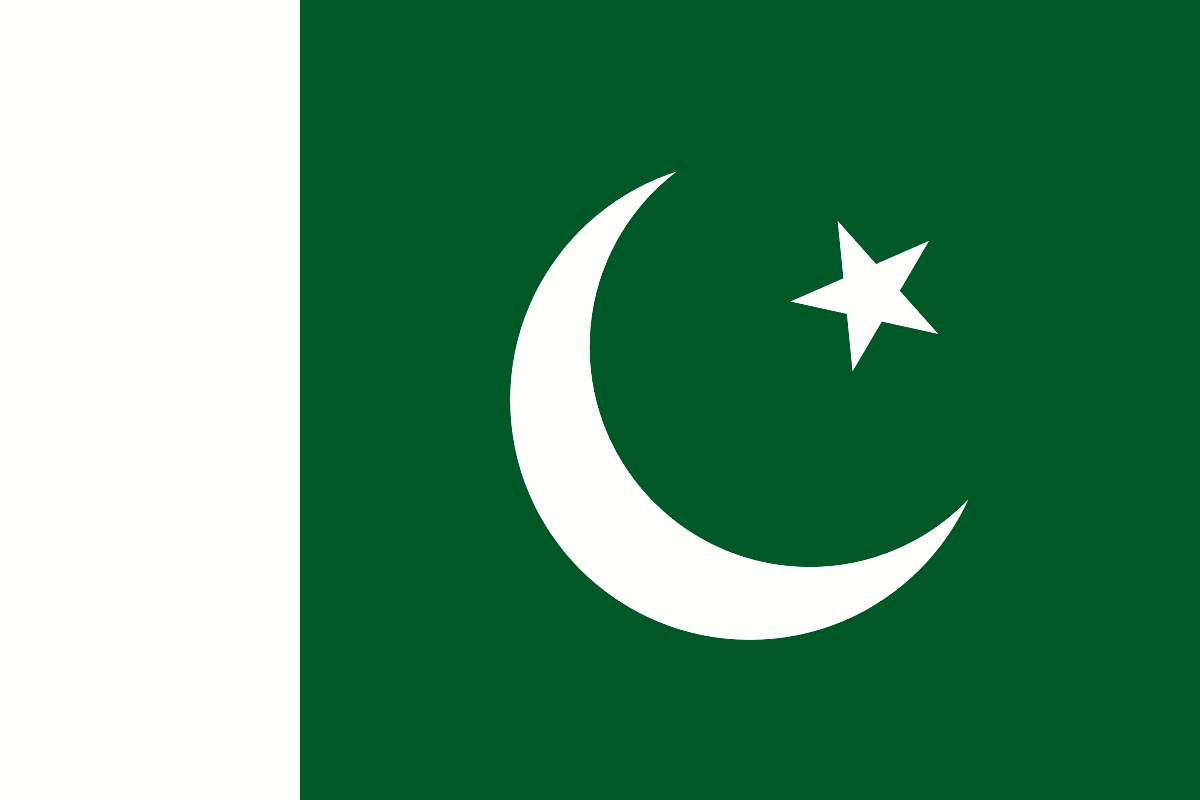
Image credit: Flag of Pakistan. In Wikimedia Commons. Retrieved 14 April, 2026 from https://commons.wikimedia.org/wiki/File:Flag_of_Pakistan.png

The Situation
Pakistan is effectively under martial law. The ruling regime has deliberately discarded the popular will of the people by refusing to hold constitutionally mandated elections in the provinces of Punjab and Khyber Pakhtunkhwah, comprising around seventy percent of the country’s population. The Supreme Court had also ordered that these elections must be held by May 14th, a ruling that was floundered with abrasive alacrity. Meanwhile, in collaboration with servile political puppets, the military elite has unleashed torture and violence of horrific proportions and modalities on the workers, elected officials, and general supporters of Imran Khan’s Pakistan Tehrik-i Insaf (the Pakistan Justice Movement or PTI), widely believed to be the most popular political outfit in the country by some distance. In the last year, more than twenty PTI workers have been killed, a young autistic man was tortured and murdered in police custody, leaders have been coerced through violence and harassment to quit the PTI or politics altogether, more than ten thousand political workers (including several women) languish in jails on flimsy charges, forced disappearances are daily news, and Imran Khan himself, after surviving an assassination attempt last November and state abduction on May 8th, has been physically and politically cornered, with even the mention of his name banned in the country’s media. The icing on top of this torrid cake is that the state is all set to try him in a military court on an absurd charge of murder. Tactics and measures of violence and suppression long practiced by the deep state in peripheries like Balochistan and the Tribal areas have surged the mainland with disturbing ferocity.
Thinking Beyond a Spat between Lovers
Yet the paradox of the current moment is this: the more the state expends power through violence, the more it exposes and highlights its moral fragility, and the more it fortifies Imran Khan’s moral argument, centered on the political goal of achieving what he calls Haqiqi Azadi or true freedom. Commentaries in English on the current political moment and crisis in Pakistan have largely engaged in rather shallow analysis invested in either the silly question of whether this situation is unprecedented or in proffering the seductive but misguided argument that Imran Khan’s standoff with the military is simply the case of an internal “lovers’ spat” that is otherwise politically inconsequential. The end of a love affair or the “lovers’ spat” narrative, regurgitated most recently by the well-known novelist cum journalist Mohammed Hanif, has emerged as the most comforting framing of the situation for Imran’s detractors. This is so because the explanation of a lover-beloved relationship gone awry works to empty Imran’s politics of any productive meanings or capacities. It limits his politics to the theatrics of power grabbing, further cementing the caricatured view of Imran as nothing but a self-absorbed and power-hungry former cricketer with a cult following. And as the scholar Salman Sayyid has argued, “it also replays Orientalist readings of Pakistani politics as being nothing more than the machinations of individuals, with no place for structure or ideologies. From Jinnah to Imran, Pakistan is simply the conjuration of singular personalities.”
Moreover, other than its excessive simplification of a much more complex narrative of the relationship between Imran Khan and the military establishment, the major conceptual problem with this framing is that it wrongly assumes reciprocal and symmetrical power relations between the so-called lovers at hand. It thus eviscerates the option of even imagining the possibility of troubling and reconfiguring the gross unevenness and asymmetry of those power relations through popular mobilization across ideological divides that in turn might open avenues for a more just future.
The Power of Sovereignty
Indeed, a question that has hardly received the analytical attention it deserves, is this: what makes Imran Khan’s message of popular sovereignty at the heart of his call for Haqiqi Azadi or true freedom so viscerally attractive for a majority of Pakistanis? In a country marked by the predominant perception and indeed reality that decisions of politics are ultimately made elsewhere, whether that elsewhere were the corrupt and compromised political elite, the colonial minded military elite or the US empire, Imran Khan has emerged as a powerful symbol and synecdoche for sovereign power. In his recent speeches, Khan has constantly advanced the theological argument that submitting to divine sovereignty, encapsulated by the foundational pillar of Islam “There is no God but God” (La Illaha Illa-Allah), renders the human subject fearless of all seemingly mighty non-divine entities, a not so veiled reference to the military establishment. According to this illiberal formulation, absolute submission to God grants the human subject absolute freedom and agency. The push to channel divine sovereignty in the service of cultivating popular sovereignty is of course a staple of Islamic modernism, more complex articulations of which are found in the thought of thinkers like Muhammad Iqbal (d. 1939) to whom Imran is heavily indebted.
But though not novel, it is precisely this political theology of popular sovereignty that resonates deeply with large segments of the Pakistani public famished for any hint of sovereign agency over their futures. It has also informed key features of Imran’s politics such as his critique of the War on Terror and his general pacifist stance that military solutions only exacerbate conflicts, his refusal to grant the US military bases in Pakistan captured in his iconic exclamation “absolutely not,” his refusal to even ponder the acceptance of Israel, his bitingly critical discourse on Hindu nationalist violence in Kashmir, his eloquent elaboration of the problem of Islamophobia pivoting on the untranslatability in Western societies of the pain caused to Muslims by insults against the Prophet (pbuh), and more generally, his long running campaign against the moral and financial corruption of the political elite, and less frequently, that of the military elite.
Certainly, with each one of these points one can identify limits and contradictions. Making a case for or extolling the purity of Imran’s politics is not the point here. Rather, notice the narrative contrast between the discourse of a figure like Imran saturated in the promise of rescuing and restoring sovereign agency and power, and the public image of a political and military elite enraptured by a westoxified vision of surrendering to the global allure and piercing pressure of liberal secular progress. The narrative contrast could not be starker. It holds the key to any serious analysis of Imran’s popularity within Pakistan, in Indian Occupied Kashmir, or among diaspora communities world over. To be sure, Imran is a thorough modernist; his belief in such signature modernist ideas as the rule of law, nationalism, free market economy, and a strong military makes that evident. But though a modernist he is not a secularist who thrives on the abdication of religion to the private sphere, or on the cultivation of good/moderate Islam that might assuage the Islamophobic anxieties of Western pundits and states always eager to manage and moderate the political aspirations of Muslim actors.
The Original Sin
Take for instance Imran’s trademark call for the creation of a welfare state modelled on the principles of justice and hospitality for the dispossessed (primarily the economically downtrodden and religious minorities) that animated Prophet Muhammad’s (pbuh) polity of Madina (riyasat-i madina). “The Prophet’s (pbuh) state of Madina was a modern state,” Imran has often argued, while valorizing contemporary Scandinavian welfare states that to him have most faithfully implemented the prophetic mandate of socioeconomic justice. One can of course quarrel with this argument on the grounds that it romanticizes Scandinavia and perhaps also the state of Madina. But notice how this invocation of Madina charts a vision of politics that seeks to replicate modern values of equality but that is yet not rooted in Europe, thus interrupting the West’s monopoly over its own modernity. This kind of a political vision is not so easily captured through secular binaries like moderate/fundamentalist. Imran frustrates the power of secularity. As a Muslim subject and political figure, this is his original sin that has rendered him so unpalatable and unacceptable for a range of actors within and outside Pakistan for whom belief in the virtues of secular power and the global dividends that belief brings are foundational to politics, most notably the military elite for whom securing the empire’s nod has always represented a desire of existential significance. What else could explain the military establishment’s plainly obvious current plan of installing Bilawal Bhutto, a trusted stooge of Uncle Sam’s with little popular support, whose crowning achievement in life is the collision of parental chromosomes, as Pakistan’s next Prime Minister.
The critic might object at this point that this is all abstract discourse, the cohesion of which is not sustained by all the outcomes of Imran’s politics on the ground. But what this objection would miss is that discourse is always embedded in power; power does not precede discourse. If nothing else, through this brief analysis I wish to make the case that the current standoff in Pakistan must be seen as a battle of competing ideas regarding what it means to be a sovereign subject and nation, rather than an ideologically unmoored scramble for power, a politically meaningless spat between former lovers, a theater of anger and despondency reducible to economic malaise, or the manifestation of political games played by a cult leader and his followers. One does not need to uncritically embrace or celebrate all aspects of Imran Khan’s politics to at least try to consider with some nuance the power, promise, and attraction of his battle for sovereignty.
Author’s bio
SherAli Tareen is Associate Professor of Religious Studies at Franklin and Marshall College. He is the author of the award-winning book Defending Muhammad in Modernity (University of Notre Dame Press, 2020) and the forthcoming book Perilous Intimacies: Debating Hindu-Muslim Friendship after Empire (Columbia University Press, 2023).

Related Blogs

The Rebel Team: Football and Algeria’s Liberation
Image credit: Wikimedia: https://commons.wikimedia.org/wiki/File:Jubilee_FLN_soccer_team_1974.jpg (Mustapha Zitouni standing, 5th from the right; Rachid Mekhloufi sitting, 2nd from the right) History reminds us that, like literature and art, football can embody a...
Reflections on Islam, Muslimness and Decolonisation – I
*Yasin Aktay’s four-part series is a contribution to Critical Muslim Studies that critically engages with S. Sayyid’s Recalling the Caliphate as a means of reflecting on the contemporary manifestations of the Muslim Question.Image credit: photographs by Johanna Loock,...
Reflections on Islam, Muslimness and Decolonisation – II
*Yasin Aktay’s four-part series is a contribution to Critical Muslim Studies that critically engages with S. Sayyid’s Recalling the Caliphate as a means of reflecting on the contemporary manifestations of the Muslim Question.Image credit: photographs by Johanna Loock,...