


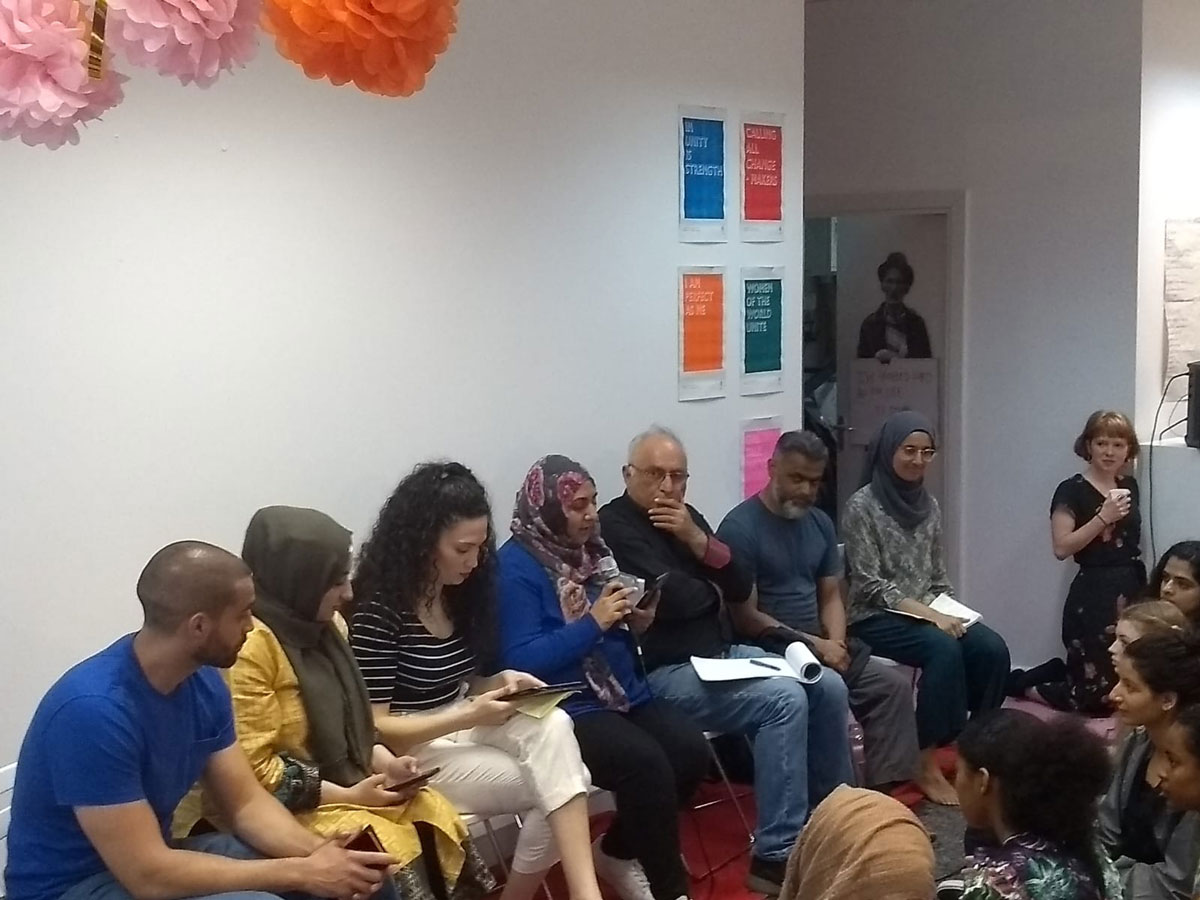
On a sweltering Sunday afternoon (30 June 2019), a hundred or so people, mostly young, were packed in together at the Speakers Corner Collective [1] on Ivygate in the centre of Bradford. They came to discuss the withdrawal from the Bradford Literature Festival 2019 by a number of writers, artists and speakers.[2] This withdrawal was sparked by the news that a pre-festival project promoting the literacy and education of British Pakistani women had been funded by a Home Office counter-extremism fund, established in 2016, called Building a Stronger Britain Together (BSBT).
Some Background on BSBT
Not too much is known about BSBT, but there is some basic information in the public domain. The purpose of the fund is to “support civil society and community organisations who work to create more resilient communities, stand up to extremism in all forms and offer vulnerable individuals a positive alternative”. It came out of the government’s 2015 counter-extremism strategy, which focuses on non-violent extremism, which itself grew out of and builds on the Prevent strand of the CONTEST counter-terrorism policy. Grant bids for BSBT are administrated by the UK Community Foundation in partnership with the advertising agency M&C Saatchi, famous for its party political campaigns for the Conservative Party. Recipients may receive grants, training or in-kind services, e.g. social media training or professional website design.
Launched in 2016/17, over £4m was spent in the first year, with over £9m in total as of the end of June 2019. The total budget allocation for the scheme is £63m, although it has not been clarified over what period of time this is to be spent. This is larger than the £45m committed in 2008–11 to Prevent spending on local Muslim community organisations under New Labour before the austerity cuts.[3] It has similarities with New Labour’s version of Prevent in the dispersal of grants to civil society organisations that allied counter-terrorism with community cohesion projects at local and national levels. The counterargument rehearsed back then was that laudable aims (community cohesion, capacity building, etc.) were being securitised, and the counterargument being rehearsed now is not so different, namely that counter-extremism is being allied to very similar laudable aims, which are being securitised again. When the Coalition came into power in 2010, they recognised that securitizing these public goods was deleterious and so they were separated, but that lesson has clearly been forgotten or ignored.
Since 2011, Prevent and later on the counter-extremism policy after 2014 in all its various manifestations like BSBT, the Commission for Countering Extremism or the Charity Commission, have operated under same the working definition of extremism.[4]
Some 233 projects have so far been supported through BSBT since its inception, including over fifty dedicated to tackling far-right extremism. Some notable Muslim organisations that receive funds under this scheme include: Bolton Council of Mosques, Dawatul Islam UK & Eire, Muslim Women’s Network UK, The Salam Project (London), and the Association of British Muslims, alongside many other local ones. Some other notable organisations include: Faith Matters, Hope Not Hate, INFORM, Institute for Strategic Dialogue, and Nisa-Nisham.[5]

Some General Reflections on the Event
This event showed that British Muslims across three generations have been able to sustain a healthy radical tradition that speaks truth to power, building on decades of activism and cultural expression that has roots in anti-colonialism, trade unionism, anti-racism, anti-war activism and civil liberties and human rights struggles after 2001, both in communities and on campuses. We have yet to do justice in setting down and teaching this valuable aspect of British Muslim history. These various strands were represented by a distinguished panel, many of whom had not only bowed out of the festival because of this issue, but also came up to Bradford to educate and inspire. The panellists were Suhaiymah Manzoor-Khan, Moazzam Begg, Tariq Mehmood, Malia Bouattia, Samayya Afzal, and Lowkey. The organisation of this event was also initiated and led by Muslim women, yet another sign of how they are now starting to set the agenda for Muslim community life in general.
The panellists affirmed their support for the festival as a whole, and the importance of cultural spaces as free zones in which British Muslims (and people of colour more generally) can think and dream and dissent and imagine out aloud as a profound public good in its own right. The linkage to a counter-extremism rationale, they averred, is profoundly racializing, and their criticism came from a place of personal commitment to the transformative power of the arts and its importance in the empowerment of individuals and communities. While the commitment from the festival to abstain from BSBT funding next year was welcomed, the panel rightly highlighted that this did not go far enough.[6] Firstly, there had been a breach of trust in not making this funding clear and transparent, particularly to participants whose criticism of these policies was already a significant strand in their work. Secondly, there has been no recognition from the festival that acceptance of these funds is wrong; in fact, all their public statements to date have defended the decision.[7]
So this is going to be a long, drawn-out public argument. A considerable number of Muslim community organisations, both national and local, have taken the calculated risk since 2016 that the BSBT fund might be seen as sufficiently differentiated from the toxic Prevent brand to be accepted, alongside buying into the rationale that it is meant to apply equally to all forms of extremism. Clearly BSBT is leveraged against the background of austerity cuts and the generally parlous financial state of the Muslim voluntary sector in this country, which has still to adapt the Islamicate endowment (waqf) institution to its advantage, despite its compatibility with existing English charity law. Yet such pragmatism or opportunism or naiveté (whichever applies) to opt for BSBT support still does not address its complicity in the further securitization of Muslim community life and its institutions to deleterious effect. Yet again, Bradford has led the way in calling out the dangers of this short-sighted approach. Let us hope that this can now be widened out nationally to look well beyond the festival, which was, after all, only one of many recipients.
The Bradford Literature Festival is a rare cultural space ‒ established and led by Muslim women ‒ for everyone in the city, yet it is also inclusive of various shades of Muslim cultural life in a unique way. It needs to preserve the breadth and generosity of its spirit in future years, and this can only be protected by seeing how pernicious it is that cultural life, literacy and education aren’t valued as public goods in their own right but as antidotes for a community stigmatised as at risk of extremism or political violence, misconstrued as always in need of such remedial measures. Why should we put up with the Bradford Literature Festival being singled out (among hundreds of literature festivals around the country) for counter-extremism funding? We should not take these monies to endorse the rationale that only further strengthens the well-established counter-extremism and counter-terrorism industry in this country. We can and must do better.
(Reposted with permission from Yahya Birt’s Medium blog: https://medium.com/@yahyabirt/british-muslims-cultural-freedom-and-the-counter-extremism-industry-d41d1faf96b9.)
Notes
All URLs were live and correct when accessed on 30 June 2019.
[1] Speakers Corner Collective (Bradford), Facebook, n.d., https://www.facebook.com/speakerscornerc/.
[2] Maya Wolfe-Robinson, ‘Six Pull Out of Bradford Festival over counter-extremism funding’, Guardian, 20 June 2019, https://www.theguardian.com/uk-news/2019/jun/20/six-pull-out-bradford-literature-festival-counter-extremism-funding; Suhaiymah Manzoor-Khan and Saima Mir, “Does Bradford festival’s counter-extremism funding warrant a boycott?”, Guardian, 24 June 2019, https://www.theguardian.com/commentisfree/2019/jun/24/bradford-literary-festival-counter-extremism-funding-boycott.
[3] Radicalism:Written question – 3848, Hansard, 10 July 2017, https://www.parliament.uk/business/publications/written-questions-answers-statements/written-question/Commons/2017-07-10/3848/; Radicalism:Written question – 237186, Hansard, 26 March 2019, https://www.parliament.uk/business/publications/written-questions-answers-statements/written-question/Commons/2019-03-26/237186/; Radicalism:Written question – 3848, Hansard, 10 July 2017, https://www.parliament.uk/business/publications/written-questions-answers-statements/written-question/Commons/2017-07-10/3848/; Sajid Javid, “Countering Extremism Views”, Hansard, 1 April 2019, https://hansard.parliament.uk/commons/2019-04-01/debates/D6EDE7B8-25FD-4F20-86AE-B95532B6FDAE/CounteringExtremistViews; FACT SHEET: Building a Stronger Britain Together programme, Home Office, 28 June 2019, https://homeofficemedia.blog.gov.uk/2019/06/28/fact-sheet-building-a-stronger-britain-together-programme/.
[4] Defined as “vocal or active opposition to fundamental British values, including democracy, the rule of law, individual liberty and mutual respect and tolerance of different faiths and beliefs. We also include in our definition of extremism calls for the death of members of our armed forces, whether in this country or overseas.” Cited in PM’s Task Force on Tackling Radicalisation and Extremism, “Tackling Extremism in the UK”, December 2013, https://assets.publishing.service.gov.uk/government/uploads/system/uploads/attachment_data/file/263181/ETF_FINAL.pdf, p.1; Ismail Patel, “Emergence of Institutional Islamophobia: The Case of the Charity Commission, ReOrient, Vol. 3, №1 (Autumn 2017), pp. 23–49, which notes that Muslim charities were seven times more likely to be investigated than other religious charities (p.35).
[5] “BSBT Supported Groups”, June 2019, https://assets.publishing.service.gov.uk/government/uploads/system/uploads/attachment_data/file/809584/BSBT-list-of-groups-jun-19-v2.pdf.
[6] Mentioned en passant by the local Labour MP Naz Shah, but with no word directly from the festival itself, in this article, Naz Shah, “An Islamophobic security agenda shouldn’t mix with arts funding”, Guardian, 26 June 2019, https://www.theguardian.com/commentisfree/2019/jun/26/government-arts-funding-islamophobic-bradford-literature-festival.
[7] “Statement on withdrawal of speakers from this year’s festival”, Bradford Literature Festival, 20 June 2019, https://www.bradfordlitfest.co.uk/statement-withdrawal-speakers-years-festival/.

Related Blogs
Reflections on Islam, Muslimness and Decolonisation – I
*Yasin Aktay’s four-part series is a contribution to Critical Muslim Studies that critically engages with S. Sayyid’s Recalling the Caliphate as a means of reflecting on the contemporary manifestations of the Muslim Question.Image credit: photographs by Johanna Loock,...
Reflections on Islam, Muslimness and Decolonisation – II
*Yasin Aktay’s four-part series is a contribution to Critical Muslim Studies that critically engages with S. Sayyid’s Recalling the Caliphate as a means of reflecting on the contemporary manifestations of the Muslim Question.Image credit: photographs by Johanna Loock,...

Reflections on Islam, Muslimness and Decolonisation – III
*Yasin Aktay’s four-part series is a contribution to Critical Muslim Studies that critically engages with S. Sayyid’s Recalling the Caliphate as a means of reflecting on the contemporary manifestations of the Muslim Question.Image credit: photographs by Johanna Loock,...