

by Sayed Hamid
Blog 61
17 August 2022
Afghanistan | Education | Neo-Colonialism | UNICEF
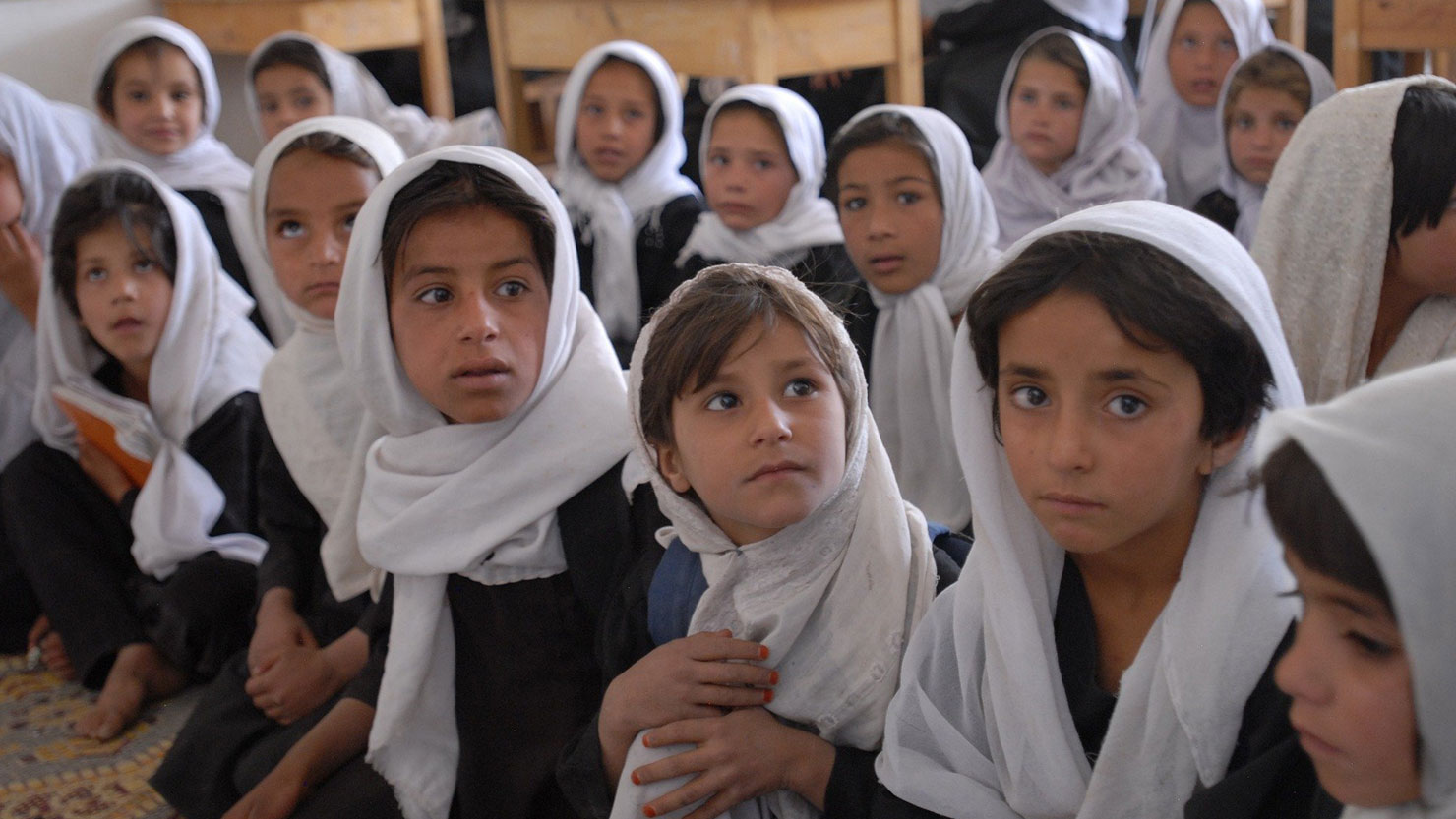
Image Source: David Mark, Pixbay
Western humanitarianism has long been critiqued as a form of preserving neo-colonial structures. A clear example of this can be seen with the funds that were made available for female education within Afghanistan. UNICEF has been developing the education programmes that have been rolled out across Afghanistan over the last twenty years, since the original invasion by the US. However, these programmes have been greeted with scepticism and hesitance from sections of the Afghan public.
Having worked on the ground in Afghanistan, one of the most common concerns exhibited by Afghanis centres around the promotion of the epistemology of the West in the country, which remains embedded within the work UNICEF and others are promoting. While Dari and Pashto are the national and official languages in Afghanistan, many of the programmes emphasise the importance of English. Being literate in the English language, as well as IT skills, are considered the primary route to be shortlisted for many jobs, especially for women. Those who speak English and have basic IT skills attained high-ranking jobs known as ‘super skilled workers’ in Afghan government departments and earned almost ten times more that the ordinary employees.
There is a long history of colonial powers using particular languages to privilege those, who promote their worldviews and policies. In these types of instances, education is less focused on empowering communities, and more strongly aimed at moulding and domesticating sensibilities and customs. This type of linguistic apartheid does not bring communities closer together; rather, it serves to drive a wedge between people.
Indeed, almost all policies, including the five years education strategy were designed and developed by UNICEF, promote this outlook. This is one of the main factors that led to women, mostly in the rural areas, being discouraged to attend the government literacy programme. It was considered a manipulative tool deployed by Western nations in a bid to win the war against the Taliban.
Additionally, many community leaders feared that the programme was not simply providing women with requisite skills to succeed in life; moreover, these projects were geared towards changing their attitude towards their culture and religion and promoting Westernisation. Consequently, given the failure of the government adult literacy programme in the last twenty years and context of the country, including insecurity, poverty, and attitudes towards Eurocentric models; it was realised that an autonomous and participatory approach with religious and traditional resources would gain the trust and support of local communities.
This was one of the reasons behind the Education – the Lifelong Mission project (ELM). ELM is a project focused on promoting literacy amongst Afghan women, whose literacy rate is less than 17% across the country. As a pilot project, we started with one centre in 2017 and the number of learning circles have increased to five in a year based on the need and request of communities in one of the remote districts in Kabul. Circles were established in the houses of local facilitators, who are literate and have skills such as tailoring, embroidery and weaving with background in traditional religious studies.
Given the traditional and religious approach to literacy and learning skills that ELM circles currently utilise, imams and community leaders encourage women to attend the circles, which challenges the idea that religious authorities seek to delimit female education. Furthermore, this complicates simplistic narratives that proclaim a rejection of UNICEF programmes is underpinned by a patriarchal worldview, in which women’s primary roles are seen as homemakers, and therefore education for women is viewed as an unnecessary distraction.
To give context to the work we do, I would like to highlight the case of Bibisha. Bibisha is a 37 year old widow. She attends two different ELM circles in order to have daily participation (the circles run three days a week). Like many other young girls, she had to marry her relative at the age of 17 and gave birth to her first child after a year, when the Americans invaded Afghanistan and removed Taliban from power. Bibisha had a deep desire of going back to school and continuing her education, however her husband and father-in-law opposed it. “It wasn’t only the school issue, but the imam in the local mosque had informed people including my father-in-law not to let their women to attend the government literacy classes as it was a foreign plot to exploit Muslim women and deviate them from their religion and culture” Bibisha said.
Bibisha had no opportunity to go out to learning until the first learning circle of ELM was established in her area in 2017. ELM introduced a new approach to learning literacy and livelihood development skills using REFLECT (Re-generating Freirean Literacy through Empowering Community Techniques). Unlike the Eurocentric approach of UNICEF, in which carefully selected textbooks were taught, ELM learning circles used autonomous and participatory approach of learning, where women decide what to learn and how to learn and the circle facilitators play the role of guides, not teachers or superior authority. Bibisha said “I believe, ELM came especially for me and people like me, who couldn’t attend school, but still love to learn.” Besides literacy through Qur’an recitation, Bibisha learned tailoring skill and within two years after joining the learning circles, she established her own local business in the area.
ELM was set up with the idea that education should be used to empower people and communities, and knowledge should not be used as a tool of manipulation or exploitation. Sadly, the education of Muslim women in Afghanistan has long been utilized as political football, often to justify the need for foreign occupation. We hope to continue working with women like Bibisha and exploring non-Eurocentric models of education that will ultimately help these women to succeed in their lives.

Related Blogs

Of Those who Don’t get to be Cockroaches
Image credit: Photo taken by Shaheen Abdulla, July 2026. Photo used with permission. Since 2014, India has been governed by Hindutva ethnonationalism, intensifying decades of structural marginalization of Muslims through state-sanctioned impunity and systematic...

The Rebel Team: Football and Algeria’s Liberation
Image credit: Wikimedia: https://commons.wikimedia.org/wiki/File:Jubilee_FLN_soccer_team_1974.jpg (Mustapha Zitouni standing, 5th from the right; Rachid Mekhloufi sitting, 2nd from the right) History reminds us that, like literature and art, football can embody a...
Reflections on Islam, Muslimness and Decolonisation – I
*Yasin Aktay’s four-part series is a contribution to Critical Muslim Studies that critically engages with S. Sayyid’s Recalling the Caliphate as a means of reflecting on the contemporary manifestations of the Muslim Question.Image credit: photographs by Johanna Loock,...