

By Celsabil Hadj-Cherif
Blog 101
31 January 2025
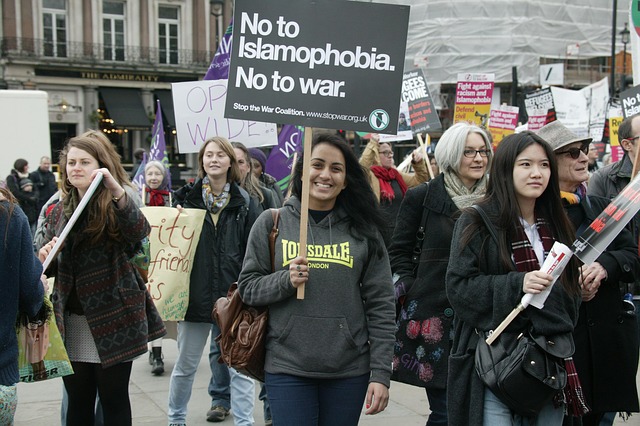
Debates over the APPG on British Muslims’ definition of Islamophobia have centred on a key tension: while conceptualising Islamophobia as ‘a form of racism’, clarifies legal and policy tools for addressing it, critics worry that this framing conflates race and religion, potentially neglecting the diversity of Muslim identities. Criticisms, albeit weak, include discussions ranging from claims from commentators from outside the Muslim community that it prevents a legitimate criticism of Islam to claims from within a small section of the Muslim community that Muslims are not a ‘race’ and so on. It is this latter misconception of Muslims and race that I wish to dwell upon in this article, as such critiques often misunderstand the sociological process of racialisation. Far from redefining Muslims as a race, approaching Islamophobia as racism illuminates how social structures, media discourses, and state policies treat Muslims as a monolithic and suspect “other,” subjecting them to systemic scrutiny that operates in the same way as every other form of racism.
The APPG’s definition emphasises that Islamophobia is not confined to overt acts of violence or abuse; it is embedded in institutional mechanisms and cultural practices that racialise Muslims. The inclusion of “expressions of Muslimness” recognises the complexity of Muslim identities, extending beyond visible religious markers to encompass cultural practices, political solidarities, and everyday life informed by Islamic values. This expansive framing acknowledges the multi-dimensional ways Muslims are cast as cultural or security threats, irrespective of their ethnic backgrounds or levels of religious observance.
Recent scholarship views racism as endemic rather than sporadic, arguing that power and inequality are structurally embedded, normalised, and perpetuated through laws, policies, and cultural practices. Within this framework, racialisation involves socially defining and categorising groups based on perceived cultural or religious characteristics—rather than any biological basis—and attributing racial meaning to these markers, thereby constructing “others” and perpetuating inequality, discrimination, structural and physical violence.
Applying this framework to Islamophobia reveals how Muslims, regardless of internal diversity, are treated as a racialised “other,” their religious affiliation transformed into a racial category. Historically, Western societies have marginalised religious minorities—evident from the Spanish Inquisition to today’s border regimes and security measures—and the post-9/11 era has further entrenched such biases, with policies like the UK’s Prevent strategy intensifying surveillance and suspicion. Conceptualising Islamophobia as a form of racism places it on the continuum of systemic injustices critiqued by anti-racist scholars, inviting more robust legal, social, and cultural interventions. Aligning Islamophobia with broader anti-racist struggles strengthens collective efforts to expose, challenge, and dismantle the structural conditions that sustain it as an enduring form of injustice in Western contexts.
The concept of “expressions of Muslimness” challenges narrow interpretations of Muslim identity as solely defined by visible markers like the hijab or beard. It includes political activism, cultural beliefs, educational initiatives, and solidarities formed around global Muslim issues. The APPG definition had the potential to recognise these as expressions of Muslimness and in doing so, recognises that Islamophobia does not simply target religious symbols – it also polices the political and cultural dimensions of Muslim identity. For example, in the UK, Prevent’s focus extends beyond visibly devout Muslims, encompassing those whose scholarship, public engagement, or activism is informed by Islamic ethics and concerns. Such strategies expose attempts to shape a compliant Muslim subject, redrawing the boundaries of “acceptable” Muslimness by framing Muslim political engagement as inherently suspicious.
A central function of Islamophobia is to redefine what it means to be an “acceptable” Muslim. Through state policies, media rhetoric, and public discourse, specific characteristics, particularly political consciousness and critiques of Western or authoritarian policies, are constructed as illegitimate. This process yields the archetypes of the “good Muslim,” who remains politically quiescent and publicly compliant, and the “bad Muslim,” whose activism or global solidarities are seen as threatening. By encouraging Muslims to adopt a secular, depoliticised stance, Islamophobia narrows the range of acceptable Muslim identities and penalises those who resist these constraints.
The Prevent strategy exemplifies this dynamic. It does not only target openly religious Muslims but also those whose political activism is rooted in Islamic values. Criticism of Western foreign policy, support for Palestinian rights, or challenges to authoritarianism abroad (such as in Egypt) are rebranded as dangerous extremism, not due to any intrinsic violence, but because they are perceived to emanate from a “Muslim” viewpoint. In this discourse, the term “Islamist” is weaponised to erase distinctions between democratic Muslim political actors and violent extremists, allowing both Western governments and authoritarian regimes to delegitimise Muslim political expression wholesale.
By foregrounding the structural racism underpinning Islamophobia, the APPG definition provides a framework for contesting this re-engineering of Muslim identity. Rather than reinforcing the idea that “acceptable” Muslimness must be apolitical or detached from global issues, the definition exposes how institutions and discourses collaborate to restrict Muslim agency. Recognising that Islamophobia racialises “expressions of Muslimness” clarifies that individuals are often targeted not for who they are, but for what they do, say, or symbolise in a politicised environment.
By including “perceived Muslimness,” the definition extends protections to those targeted on the basis of stereotypes, assumptions, and prejudicial interpretations of their identity. It disrupts the binary of “good” versus “bad” Muslims, challenging the notion that Muslim identities must be trimmed to fit narrow, state-sanctioned categories. Instead, it reclaims space for Muslims to fully express their cultural, religious, and political identities, pushing back against the forces that seek to curtail their participation in public life.
The APPG definition not only lends itself to policy innovations and anti-racist legal applications; it also holds the potential to influence cultural understandings of Islamophobia. Cultural shifts have historically underpinned legislative progress in addressing other forms of racism, as changed social norms and public opinion pave the way for more robust legal protections. Similarly, by revealing Islamophobia as a racialising process that constrains Muslim identity, the APPG definition equips educators, activists, journalists, and cultural producers with conceptual tools to challenge dominant narratives.
This reframing encourages societies to interrogate the assumptions that render certain expressions of Muslimness unacceptable. Over time, such cultural shifts can contribute to reshaping how the public understands Islamophobia, fostering critical reflection on the underlying power dynamics and prejudices that define the boundaries of inclusion. In this way, the APPG definition may serve as a catalyst, guiding public discourse towards more pluralistic, equitable, and respectful visions of what it means to be Muslim.
Defining Islamophobia as racism and highlighting the broad sphere of “expressions of Muslimness” are not merely theoretical exercises. They clarify how Islamophobia operates structurally, informing policies that surveil, stigmatise, and silence Muslim voices. By exposing the “good Muslim/bad Muslim” dichotomy, the APPG definition reveals the underlying ambitions of Islamophobic narratives—to restrict Muslim identity, limit Muslim agency, and render political resistance suspect.
Such a definition can be mobilised to hold institutions accountable, inform policy reforms, and—importantly—stimulate new ways of understanding Islamophobia at a cultural level. Historical examples show that enduring legal protections often follow on from shifts in the collective imagination. As the APPG definition circulates in public debate, it may help communities to redefine what it means to be Muslim in a context free from the coercive constraints of Islamophobia. In doing so, it points towards a future in which Muslims can participate in political, cultural, and religious life without having to negotiate narrow and imposed standards of acceptability.
Author’s bio
Celsabil Hadj-Cherif holds an MA in Law and Politics from SOAS University of London. She is an independent political analyst, community activist and organiser.

Related Blogs

The Rebel Team: Football and Algeria’s Liberation
Image credit: Wikimedia: https://commons.wikimedia.org/wiki/File:Jubilee_FLN_soccer_team_1974.jpg (Mustapha Zitouni standing, 5th from the right; Rachid Mekhloufi sitting, 2nd from the right) History reminds us that, like literature and art, football can embody a...
Reflections on Islam, Muslimness and Decolonisation – I
*Yasin Aktay’s four-part series is a contribution to Critical Muslim Studies that critically engages with S. Sayyid’s Recalling the Caliphate as a means of reflecting on the contemporary manifestations of the Muslim Question.Image credit: photographs by Johanna Loock,...
Reflections on Islam, Muslimness and Decolonisation – II
*Yasin Aktay’s four-part series is a contribution to Critical Muslim Studies that critically engages with S. Sayyid’s Recalling the Caliphate as a means of reflecting on the contemporary manifestations of the Muslim Question.Image credit: photographs by Johanna Loock,...