
Wallah, what a Weekend: ReOrienting the Post-Western in Enriching, Versatile, and Open Conversation

by Sophia Yasmine Steel
Blog 71
17 March 2023
Conference | Interdisciplinarity | Critical Muslim Studies
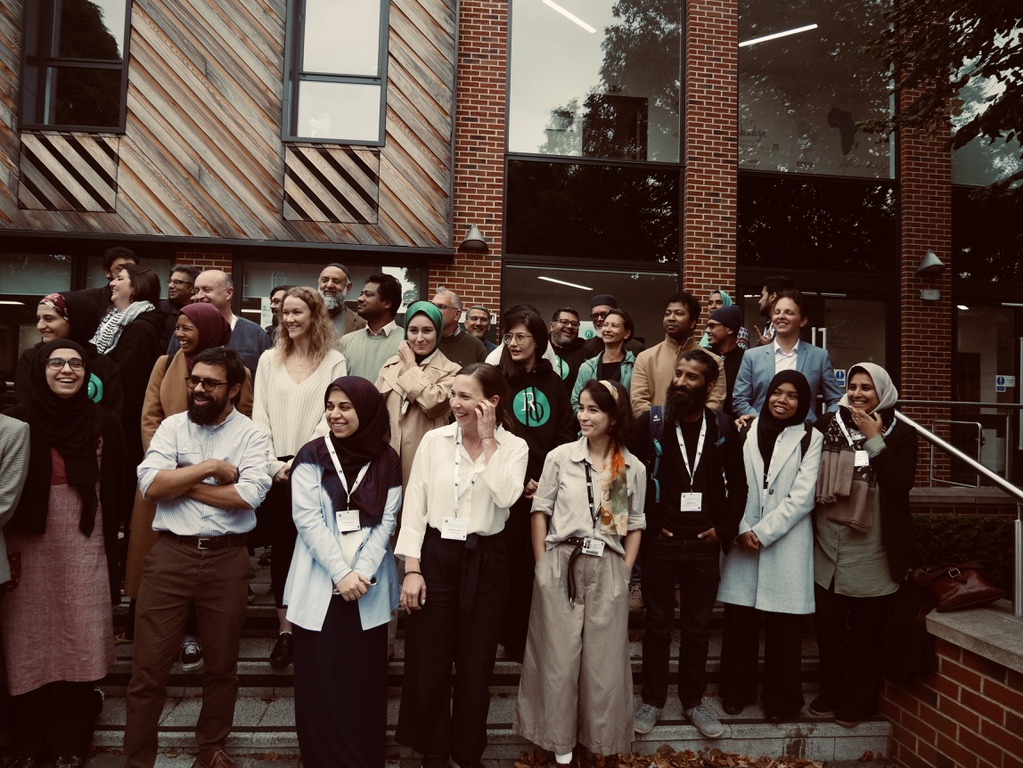
Image credit: Photo taken by the author.
One year ago, I would have been surprised to know that my future would involve assisting in organizing and attending ReOrienting the Post-Western, the first international Critical Muslim Studies Conference, at the University of Leeds. This is not because I would not have been interested. My awareness of Critical Muslim Studies was limited. Most formal education I received on critical theory and post-colonialism rarely discussed the Islamicate beyond the works of Edward Said and geopolitical perspectives on the War on Terror. That said, the feminisms which inform my worldview, as well as experiences with Muslim family while raised in the Arabic speaking world, made some skills easier to transfer into accessing elements of the field when immersed. This immersion when I began working at Leeds, doing research related to Critical Muslim Studies and helping to plan the Conference, was only the very start of my surprise.
ReOrienting the Post-Western was staggeringly interdisciplinary. That is not to say that prior to the Conference, I did not know that it would be interdisciplinary. It was in the Conference’s description, after all, and having read all abstracts while preparing Conference materials (a helpful primer for somebody from outside of the field) I understood that the scope – while faithful to the critical and to centring the Islamicate – would be broad. With each week that passed, the growing list of presenters and presentation titles made it clearer that we were not at all in the business of paying lip service to the value of involving people from multiple academic and professional disciplines. This is particularly important for an event under the banner of a specific stream of thought, which can easily become an echo-chamber without a variety of distributary subjects and approaches through which that stream becomes channelled. However, no behind-scenes “sneak peek” could truly have allowed me to grasp how many branches of this body of knowledge I would be journeying down – all in one weekend. The presentations I have chosen to discuss here are not representative of the Conference in its entire spectrum, but of those which I found memorably exemplified its spirit of varied unity.
This was a spirit truly apparent an hour into day one, once the confetti cloud of pre-conference panic settled, no longer obstructing my vision and instead allowing me to enjoy its colours. Presentation topics I had prior knowledge of made the kaleidoscope less overwhelming. One would be hard pressed to live in England for any period without being able to recite “See it. Say it. Sorted” eerily in tune. Thus, Claudia Radiven’s presentation about the many racialised, Orientalist, Islamophobic elements of Prevent policy rang a bell (especially in the mention of Prevent-adjacent staff training at schools, which I have experienced first-hand). As did the discussion of “Godfather” Islamophobia by Saeed Khan, which used a popular culture metaphor to draw the line between pathological mistreatment of Muslims and that which primarily has incentive beyond the individual, as well as discussing instances where these two motivations dance. And in the final panel, Enaya Hammad Othman’s talk about the complex and fluid activism led by Palestinian women through creation, reformulation, and proliferation of their cultural garb interested me so much that, with caffeinated courage that I had steadily built up throughout the day, I felt emboldened enough to ask a question.
Little did I know, this would not be my last question for the day. Following the third panel, M.G. Khan took the stage to begin coordinating what those familiar with conferences would recognise as the “icebreaker”. In honesty, I was apprehensive, because icebreakers tend to force the kind of socialisation which becomes performative in its superficiality, as the rifts of discomfort push participants further apart on their blocks of floating ice. To my surprise, again, this did not happen. The bingo sheet format – which contained various questions to ask, some more relevant to Critical Muslim Studies and some less so, but all with humour – gave participants some autonomy in choosing how many people we spoke to, how we asked the questions, and how seriously we took the competition for finishing first. At the same time, needing a different person’s story for each square certainly pushed me to speak to people I would’ve been too timid to approach organically. It struck a balance for compelled social interaction that still felt light, fun, and like a tightening of community bonds in real time.
This light end to the day, and a good night’s sleep, made the second day less intimidating. Moreover, having established a rhythm throughout the first day, day two felt more fluid. The morning started strong. Hearing Houria Bouteldja speak about her activism, and hearing – about French secularism, laïcité – the words “it is a question of policing the principle of justice, the major demands of any social movement, by that of secularism, which is anything but innocent” in an impassioned voice that felt almost familiar was invigorating. Then, in the second panel, seeing Yunis Alam explain the politics of his work through the relation between people and their cars in Bradford brought me back into fascination with the unfamiliar, through a presentation that drew many laughs but was also very memorable. Closer to the day’s end, in the penultimate panel, I enjoyed the pride and creative insights in Razwan Ul-Haq’s talk about his calligraphic art. Having admired his works displayed in the room throughout the day, the opportunity to speak with him about them was invaluable.
Towards its end, the Conference felt like it had lasted both an entire week and a single day, the former due to the amount of information taken in over the weekend, and the latter thanks to the conversations which seemed so new and unfinished. As the final day gained momentum, Johanna Loock drew on Ludwig Wittgenstein to inspect the German Integration Act, while Iskandar Ahmed Abdalla’s talk offered a window into perceptions of Muslimness in Germany from a more experiential point of view. In a final session, Hatem Bazian, Sümeyye Sakarya, and Salman Sayyid returned to the core of what Critical Muslim Studies means through windows into their research and propositions about the parameters of the field. This transitioned well into the round table, during which the panellists invited all to contribute questions and comments in the Conference’s final session. That the microphone was seldom left unheld speaks to the degree of engagement we saw throughout the Conference, which will hopefully carry on beyond its end.
Enriching, versatile, and open are three words which describe my experience of our ReOrienting the Post-Western Conference. To note, firstly, I have limited myself to three, the same number of talks mentioned in this article for most Conference days. This does not mean that I only have three words to describe the Conference with, but rather that in the name of clarity, I have opted for some conciseness. Now, to elaborate, I should mention something about my experience of the weekend. Throughout it, I photographed some participants. Through this perspective, I not only listened to what presenters were saying, but observed participants for nods of agreement, smiles of communion, frowns of thought, gestures of energy. The first two words I chose to describe the conference refer to enrichment of my knowledge pertaining to the field and to its interdisciplinary, unpredictable variety as I have elucidated through this blog post. However, the third had to do with this comment, with what I saw looking through my lens. Participants’ vitality and enthusiasm did not falter on the third day, leaving the Conference’s potential open. Its most fruitful and enduring surprise will be what comes out of this potential in enriching, versatile and open conversation.
Author’s bio
Sophia Yasmine Steel is currently a Research Assistant in Social Sciences at The University of Leeds. She completed a BSocSc (Hons) in Politics and International Relations at The University of Manchester, during which she worked as an Editor for The University of Manchester Undergraduate Politics Journal, Juncture. She then started an MA in International Relations (Research) at The University of Manchester in September 2020, working for think tank The Peterloo Institute as Communications and Marketing Director in November 2020. After finishing her MA, she moved to Norfolk to work as GBA and Cover Teacher at Wymondham College for a year. Research interests: Gender Studies, Feminist Political Theory, Queer Theory, Critical Theory, Cultural Theory and Popular Culture, Poststructuralism, Subjectivity.

Related Blogs
Reflections on Islam, Muslimness and Decolonisation – I
*Yasin Aktay’s four-part series is a contribution to Critical Muslim Studies that critically engages with S. Sayyid’s Recalling the Caliphate as a means of reflecting on the contemporary manifestations of the Muslim Question.Image credit: photographs by Johanna Loock,...
Reflections on Islam, Muslimness and Decolonisation – II
*Yasin Aktay’s four-part series is a contribution to Critical Muslim Studies that critically engages with S. Sayyid’s Recalling the Caliphate as a means of reflecting on the contemporary manifestations of the Muslim Question.Image credit: photographs by Johanna Loock,...

Reflections on Islam, Muslimness and Decolonisation – III
*Yasin Aktay’s four-part series is a contribution to Critical Muslim Studies that critically engages with S. Sayyid’s Recalling the Caliphate as a means of reflecting on the contemporary manifestations of the Muslim Question.Image credit: photographs by Johanna Loock,...