
*Yasin Aktay’s four-part series is a contribution to Critical Muslim Studies that critically engages with S. Sayyid’s Recalling the Caliphate as a means of reflecting on the contemporary manifestations of the Muslim Question.

By Yasin Aktay
Blog 135
26 June 2026
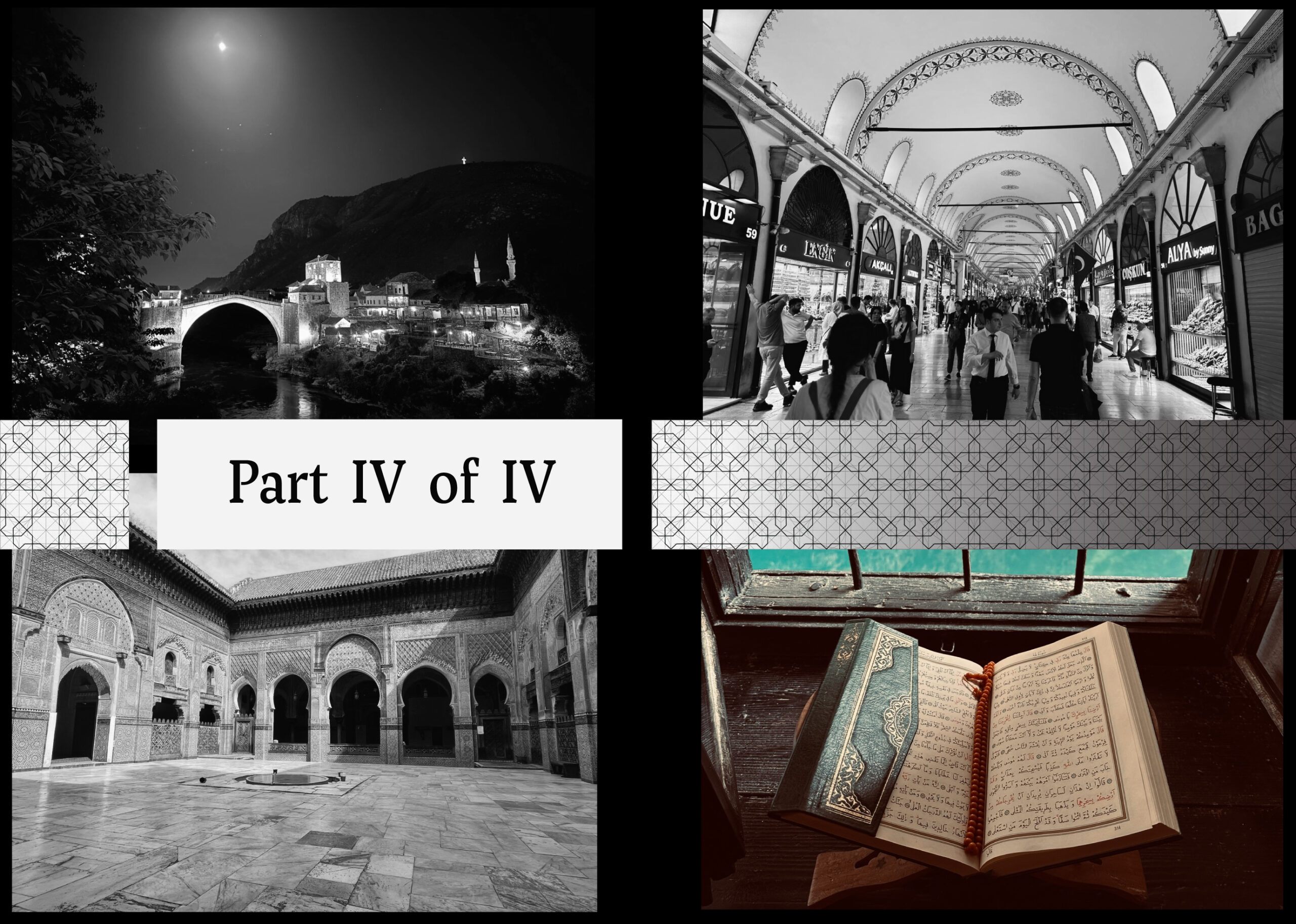
Image credit: photographs by Johanna Loock, design by Mona Makinejad
“The Qur’an Is the Needle, Our Readings Are the Thread” / The Construction of Muslim Subjectivity
The relationship established with the Qur’an lies at the very center of what it means to become and remain a Muslim. For every Muslim, the Qur’an is not simply a text among texts; it is a message revealed personally from God and directed specifically to oneself. For this reason, questions concerning the understanding of the Qur’an are approached on a completely different level from the way they are approached by those who read it without belief. What may appear to a nonbeliever as an ordinary text is, for the Muslim, a uniquely intimate form of communication between oneself and the Owner of the message. This grants the Muslim a distinctive privilege in relation to understanding the Qur’an.
In fact, throughout history there have been countless stories of people who were not Muslims but who read this Book, were profoundly affected by it, and ultimately embraced Islam. This remains a frequently repeated experience even today. At this point, every individual encounters the truth toward which the Qur’an points in a uniquely personal way. Yet from the very moment such an encounter occurs, the relationship between the reader and the Qur’an ceases to be an ordinary reader-text relationship.
The greatest handicap of theology, and, in the Islamic world, of kalam as theology translated into Islamic intellectual language, is that it constantly speaks about God, treating God as an object, subject, or topic of scientific inquiry. Yet before and beyond being an entity to be spoken about, God is One to be felt, turned toward, worshipped, confided in, prayed to, befriended, and spoken with.
Not speaking about God, but speaking with God. Reading the Qur’an is precisely a way of transcending abstract metaphysical speculation about God and instead entering directly into conversation with Him. This Book speaks not only about God but also about the human being. Thus, as the reader comes to know God, the reader simultaneously comes to know himself. In this way, the profound circle connecting self-knowledge and knowledge of one’s Lord begins to operate in its most powerful form. Naturally, all of this depends upon reading the Qur’an according to its proper method and etiquette.
Of course, it may also be pointed out that differences of language, historical distance, social and experiential differences, and insufficient knowledge regarding the Qur’an’s own distinctive characteristics can all constitute obstacles to this ground of understanding. Yet at the same time, one must not withdraw from the effort to become more familiar with the Qur’an and to approach a more effective horizon of understanding with it. In fact, we had previously remarked, on the occasion of the publication of Hüseyin Kazım Kadri’s translation Nûru’l-Beyan (published by Vadi Yayınları), that the Qur’an today is being read far more widely than in the past, even, surprisingly, more than during the Ottoman period itself.
For many people, the relationship between modernization and the increasing reading of the Qur’an may appear contradictory or paradoxical. Yet once one understands both the nature of modernization and the nature of the Qur’an itself, this development ceases to be surprising.
Naturally, as the practice of reading the Qur’an becomes more widespread, knowledge and consciousness concerning the Qur’an also increase. Today’s Qur’an readers, who engage not only with a single translation but with multiple translations, commentaries, lessons, and interpretations, can increasingly reach a point where they feel they are overcoming the linguistic distance separating them from the Qur’an. Of course, this is not a level that can be generalized equally to everyone at the same time.
Perhaps one dimension of what Anthony Giddens describes in The Consequences of Modernity as the reflexivity of modern humanity also manifests itself here in relation to the Muslim subject. Fields such as medicine, economics, law, and physics, which were once accessible only to specialists, have increasingly become domains in which ordinary individuals can participate in the modern and postmodern world. This situation can be applied even more easily to the sphere of religion and theology, and indeed corresponds closely to the kind of relationship the Qur’an itself seeks to establish with the individual.
The relationship with the Qur’an has always stood at the center of the construction of Muslim subjectivity throughout history. This point also carries a special warning for those who attempt to explain the emergence and development of Islamism solely through the lens of relations with the West. Islamism cannot be reduced merely to a reaction against Westernization or Western colonialism. In fact, the earliest Islamist discourses opposed not Westernization itself as much as they opposed deviation from the essence of Islam, the neglect of the relationship with the Qur’an, the transformation of Islam into a religion of innovations and superstitions, and the corruption of religion by intermediaries inserted between God and the believer.
This opposition cannot be confined to the context of Islam’s relations with the West. Throughout every period of Islamic history, movements have emerged against such forms of religious degeneration, calling Muslims back to the essence of Islam centered upon the Qur’an and the authentic Sunnah. Any reading that ignores this continuity reveals an inclination to trivialize Islamism as an artificial, rootless, or externally generated movement.
In my view, one of the most important problems in Salman Sayyid’s book Recalling the Caliphate, despite its Islamist perspective, is that it places excessive emphasis on Islamism’s position vis-à-vis a Western-centered world, even if that position is treated as privileged. Yet, in another chapter of the same book titled “Hermeneutics,” Sayyid also offers highly valuable analyses demonstrating that the relationship with the Qur’an has always occupied the center of the construction of Muslim subjectivity.
In these analyses, despite the existence of different approaches, levels of understanding, and disagreements concerning Qur’anic interpretation, Sayyid successfully reveals the hermeneutical conditions through which the Qur’an can nevertheless remain the most important unifying element of the entire Muslim ummah.
Perhaps we may continue this discussion elsewhere another time. But before concluding, let us end with a brief quotation from Sayyid capable of evoking countless associations and images:
“The Qur’an is the needle, and our readings are the threads that stitch the ummah together.”
Human Beings Are Diverse in Parts, How Could the Path Be One?
Human beings differ from one another in countless ways; their paths, experiences, and levels are endlessly diverse. Given this diversity, does the Qur’an, whose central emphasis is Tawhid (Divine Unity), aim to eliminate all these differences entirely in the literal sense we usually understand? After all, through its persistent calls to reason, reflection, contemplation, and understanding, how can the Book’s invitation to Tawhid unite a humanity whose very essence contains difference?
Yet the Qur’an itself repeatedly emphasizes the differences among people and states that these differences arise by God’s own will and decree, constituting both a “sign” (ayah) and a “test” for humanity. Human beings exist as different communities, branches, tribes, languages, understandings, and abilities. At the same time, the Qur’an strongly warns against turning these differences into grounds for superiority over one another.
The different forms of knowledge, talents, wealth, and possessions given to people are all merely adornments and contingent attributes of this world, which is itself described as nothing more than “play and amusement.” To become fixated upon what God has or has not granted people in terms of language, race, color, wealth, or poverty, to absolutize and eternalize these distinctions, to boast about them or despair because of them beyond what this transient play of worldly life warrants, constitutes one of the deepest motivations of idolatry itself.
The discourse of the Qur’an is therefore a call that relativizes all these differences, not by denying them, but by recognizing them, giving them their due, establishing their proper jurisprudence and ethics where necessary, and ultimately binding them all to a greater principle of unity. Historicism, by making comparisons from the present backward into the past, tends to perceive differences in such a way that it effectively buries the Qur’anic message within history itself. Yet in doing so, it overlooks the fact that similar differences also existed among the people to whom the Qur’an was originally revealed, and that the Qur’an addressed precisely those differences from the very beginning.
Differences among people inevitably generate different perceptions of the Divine address and therefore different interpretations. Even though the Qur’an comes from a divine source that is itself the source of absolute knowledge, the human being to whom it is addressed remains a finite creature, conditioned by temporality, forgetfulness, historical limitations, space, time, emotions, and all the fragility of human existence.
The attempt to historicize the Divine address encountered by humanity in its historical condition is therefore, above all, an attempt to step beyond human limits and enter a domain inaccessible to human finitude. If one possesses the power to do so, no one can prevent it, but it is obvious that the epistemic capacities available to human beings are insufficient for such an undertaking. Indeed, the very diversity of Qur’anic readings itself manifests humanity’s limitations in precisely this way.
As Salman Sayyid expresses it:
“The gap between reading the Qur’an and understanding the Qur’an cannot be closed. We can never claim that our internal mental state is identical with the mental state of the Creator of the Qur’an.”
In fact, the desire in Qur’anic interpretation to capture what is supposedly “in the mind of God” brings historicist efforts dangerously close to a kind of psychoanalysis of God. This tendency can even seep, to certain degrees, into studies conducted in the name of maqasid al-shari’a, that is, inquiries into the ultimate purposes, wisdoms, and benefits underlying Qur’anic rulings. For this reason, the discipline of maqasid must be pursued with an authentic humility appropriate to the limits of the relationship between God and humanity. Otherwise, it inevitably becomes vulnerable to ideological instrumentalization serving political demands under the guise of modernizing Islam and the Qur’an.
The fact that the Qur’an can be subjected to different readings and interpretations is not evidence of its historicity; rather, it is precisely a sign of the richness and depth of meaning corresponding to the order of diversity that God Himself created. The Qur’an’s capacity to become a source of illumination for every individual according to their own experiences, emotions, struggles, and level does not mean that it is therefore the source of every contradictory meaning whatsoever.
The Qur’an itself states that some verses are muhkam, firm, definitive in meaning, and meant to be understood in essentially the same way by everyone, while others are mutashabih, ambiguous, allegorical, metaphorical, or impossible for everyone to understand in exactly the same way (Āl ‘Imrān 3:7).
At the same time, however, there is no explicit indication specifying which verses are muhkam and which are mutashabih. When the Qur’an points to something without elaborating its details, Muslims generally turn to the explanatory authority of the Prophet ﷺ. Yet even there, no detailed classification identifying which verses are ambiguous can be found. Moreover, among the scholars who have addressed the issue, there has never been consensus regarding which verses should be considered mutashabih. In other words, ambiguity itself has become a subject of debate, precisely as a manifestation of the productive ambiguity to which Thomas Bauer points in his book A Culture of Ambiguity: An Alternative History of Islam (Müphemlik Kültürü ve İslam), recently translated into Turkish by İletişim Yayınları.
God knows best, of course, as the verse concerning the mutashabih itself states. Yet I believe that ambiguity largely points to an open-ended field of meaning arising from differences of level and understanding among people. Thus, as Allameh Tabatabai also concluded, what is mutashabih for one person may be muhkam for another.
Despite all the fragmentation produced by differences of level, history, temperament, school, sect, and countless other distinctions, the Qur’an nevertheless remains, in its own unique way, a unifying text for all Muslims. Exactly as Salman Sayyid’s metaphor suggests:
“The Qur’an is the needle, and our readings are the threads that stitch the ummah together.”
Conclusion
In conclusion, Recalling the Caliphate is not merely a theoretical work about the idea of the caliphate; it is a profound civilizational inquiry into how the modern world order positions Muslims and how Muslims might once again become subjects within that order. This is precisely where the book’s most important contribution emerges. Sayyid does not interpret the crisis experienced by Muslims merely through political failures, authoritarian regimes, or economic backwardness. At a deeper level, he demonstrates that this is fundamentally a crisis of meaning, language, memory, and representation. For a society is defeated not only when it loses its territory, but also when it loses the ability to narrate its own story.
For this reason, Sayyid’s call to “recall” the caliphate is not a nostalgic invitation to return to the past. Rather, it is an attempt to recover a fragmented historical consciousness and to enable Muslims to speak once again in their own names. The greatest achievement of the modern Western-centered order has not been merely its military or political dominance, but its ability to present its own historical experience as the only legitimate horizon of humanity. Correspondingly, the fundamental problem faced by Muslims is not simply the loss of power, but also the erosion of the epistemological self-confidence necessary to defend their own conception of truth.
The discussions throughout the book concerning names, secularization, jahiliyya, hermeneutics, the Qur’an, and Muslim subjectivity all converge around one central question: under what name, through what language, and with what historical consciousness will Muslims exist in the world today? For naming is not merely a conceptual activity; it is also a way of constructing reality itself. Societies that lose their own names gradually lose their ability to interpret the world as well.
Thus, what Sayyid offers is not merely a critique of the West. He simultaneously calls Muslims to return inward and to think again from within their own intellectual and spiritual horizons. This is why the centrality of the Qur’an, the shared field of meaning that binds the ummah together, and the possibility of unity within difference become so important throughout the work. Ultimately, the book seeks the future of Muslims not merely in the pursuit of political power, but in a process of re-subjectification capable of producing meaning once again, recovering its own language, and retelling its own history. Perhaps this is precisely what is most urgently needed today: for Muslims to speak once more not through the names given to them by others, but through their own names.
Author’s bio
Yasin Aktay is a Professor of Sociology in the Faculty of Humanities and Social Sciences at Ankara Yıldırım Beyazıt University. He is the editor-in-Chief of Tezkire Journal. Additionally, Aktay is a former Deputy Chairman of the AK Party and a former Member of Parliament.

Related Blogs
Reflections on Islam, Muslimness and Decolonisation – I
*Yasin Aktay’s four-part series is a contribution to Critical Muslim Studies that critically engages with S. Sayyid’s Recalling the Caliphate as a means of reflecting on the contemporary manifestations of the Muslim Question.Image credit: photographs by Johanna Loock,...
Reflections on Islam, Muslimness and Decolonisation – II
*Yasin Aktay’s four-part series is a contribution to Critical Muslim Studies that critically engages with S. Sayyid’s Recalling the Caliphate as a means of reflecting on the contemporary manifestations of the Muslim Question.Image credit: photographs by Johanna Loock,...

Reflections on Islam, Muslimness and Decolonisation – III
*Yasin Aktay’s four-part series is a contribution to Critical Muslim Studies that critically engages with S. Sayyid’s Recalling the Caliphate as a means of reflecting on the contemporary manifestations of the Muslim Question.Image credit: photographs by Johanna Loock,...