
Joining Forces Against Islamophobia
This blogpost is part of: Islamophobia Awareness Month

by Johanna Loock
Blog 66
25 November 2022
Islamophobia Awareness Month | IISRA | Islamophobia
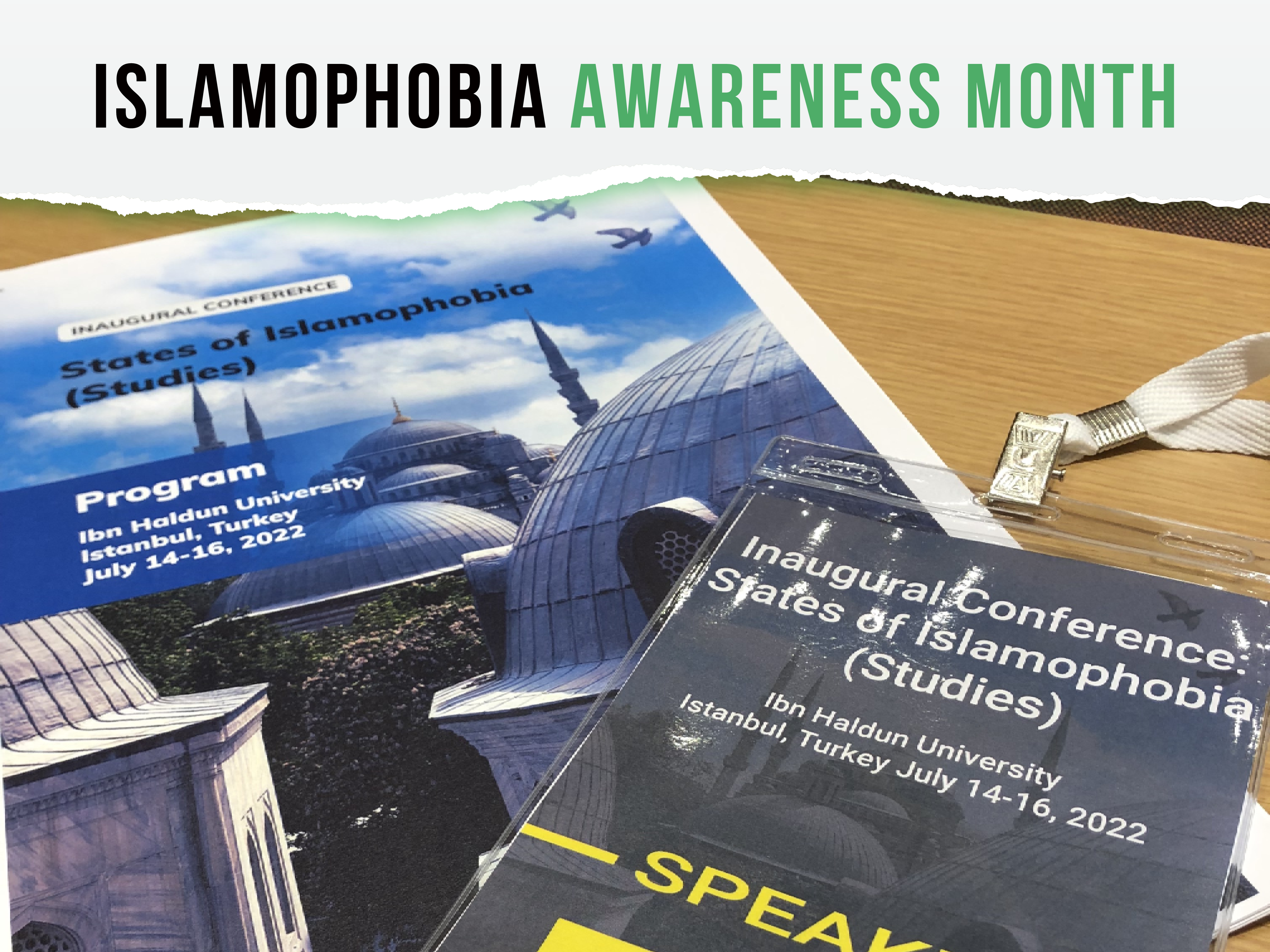
Image credit: Photograph taken by the author.
The inaugural conference of the International Islamophobia Studies Research Association (IISRA) took place on 14-16 July 2022 at Ibn Haldun University in Istanbul and brought together a number of international scholars working on and against Islamophobia around the world. The conference was organised by Hatem Bazian, Salman Sayyid, and Jasmine Zine and carried the title “States of Islamophobia (Studies)”. While being the inaugural conference of IISRA, the conference also follows on from the annual Islamophobia Conference which Hatem Bazian has been organising at the University of California, Berkeley, for several years. Although the Islamophobia Conference has always been international, the decision to hold the inaugural conference of IISRA in Istanbul this year facilitated the attendance of participants for whom travelling to the U.S. might be difficult.
The range of expressions of Islamophobia which have been addressed at the conference reached from discourses normalising Islamophobia across the political spectrum to recurring verbal and physical attacks against people marked by Muslimness and up to genocide. Thus, contributions were concerned to facilitate the recognition of Islamophobia in variable shapes and unexpected places, such as liberal democratic politics of inclusion, for instance. Furthermore, examples from different geographical contexts revealed the global character of contemporary Islamophobia.
The demonstration of Islamophobia in a variety of contexts linked the different panels and also supported the argument I was proposing together with my colleagues. In the panel “Family Resemblance of Global Islamophobia”, we argued that to connect different manifestations of Islamophobia should not be misunderstood as claiming that all expressions of Islamophobia follow the same pattern. Instead, we suggested that David Theo Goldberg’s notion of ‘relationality’ together with Ludwig Wittgenstein’s concept of ‘family resemblance’ are helpful to understand how despite a “complicated network of similarities [and dissimilarities] overlapping and criss-crossing” (Wittgenstein, 2009[1953], p.36e), ties connecting a matter – here expressions of Islamophobia – become identifiable.
Rather than being bound by a finite list of compulsory features, not all possible elements of a family resemblance need to be activated to manifest an instance of Islamophobia. Thus, the notion of family resemblances facilitates to understand how different conditions and multi-layered manifestations of Islamophobia belong to the same global logic. Examples provided by conference participants ranged from liberal to far-right ideologies, from politics of inclusion to claims of white fragility, from dietary considerations in kindergartens to the killing of people in actual genocides. To collectively create connections between various manifestations of Islamophobia and to accept this connectedness despite differences through the concept of family resemblances has been crucial for my thinking about Islamophobia as a global grammar.
Scholars who attended the conference are not just working on but rather against Islamophobia in the sense of mobilising knowledge to counter Islamophobia. Thus, the academic endeavour goes beyond gathering information about various expressions of Islamophobia in order to establish and expand a specific field of research. Instead, a focus lies on steps such as rendering Islamophobia visible in order to name and challenge it, writing alternative histories and developing strategies for subversion. Consequently, while the inaugural conference of IISRA has been framed as an academic conference contributing to the field of Islamophobia Studies, it does not have to be seen as separate from participating in political mobilisation or supporting activism.
Overall, the conference showed the shared problem we face on different levels and in different places, which unites us in the fight against Islamophobia. Building alliances and cooperation might require a certain level of openness to avoid getting caught up in disputes about details or clear-cut definitions restricting what counts as Islamophobia. Instead, the aim should be to build a social movement which goes beyond (separate) communities. The need to join forces in the struggle against Islamophobia is reinforced by an imbalance between the enormity of the task and the lack of resources vis-à-vis a huge industry behind Islamophobia.
It has been an extraordinary experience to attend the inaugural conference of IISRA in Istanbul, for it has a connecting strength to be part of the beginning of something new and meaningful. In order to envision a shared endeavour, it has been helpful to meet colleagues who work on related issues in a different context – especially after working in isolation and attending online events due to the COVID-19 pandemic. Conversations which started in Istanbul, have already been carried forward to the 1st International Conference of Critical Muslim Studies on “ReOrienting the Post-Western” (September 25-27, 2022, at the University of Leeds) and may be resumed at the next IISRA Annual Conference on “Islamophobia and Knowledge Production” (May 5-7, 2023, at the University of California, Berkeley).
In conclusion, the aim of IISRA is to help eliminate Islamophobia and thus become dispensable itself. However, in the face of ever-increasing Islamophobia as well as a growing literature expressing doubts about its existence or justifying it as a response to wrongdoing, there is an unfortunate contemporary need for IISRA and similar organisations. The conference functioned as the inauguration of a platform for collaboration in a shared global struggle and as a place to create alliances and to expand the impact of our work. Consequently, this blog post is not just a report about an inaugural conference, but also a call to join the fight against Islamophobia – together with IISRA or other initiatives.
Additional Reference
Wittgenstein, L. 2009 [1953] Philosophische Untersuchungen/Philosophical Investigations. Translated by G. E. M. Anscombe, P. M. S. Hacker and Joachim Schulte. Revised fourth edition by P. M. S. Hacker and Joachim Schulte. New Jersey: Wiley-Blackwell.
Author’s bio
Johanna Loock is one of the editors of ReOrientations. She is a PhD candidate at the University of Leeds (School of Sociology and Social Policy) working on issues of German citizenship, investigated through an analysis of integration politics, its entanglement with Islam politics, and its role in the reconstruction of a national identity. Johanna associates her work with the field of Critical Muslim Studies and has an academic background in Islamic Studies, Political Studies, Religious Studies, and Geography.

Related Blogs

Reflections on Islam, Muslimness and Decolonisation – III
*Yasin Aktay’s four-part series is a contribution to Critical Muslim Studies that critically engages with S. Sayyid’s Recalling the Caliphate as a means of reflecting on the contemporary manifestations of the Muslim Question.Image credit: photographs by Johanna Loock,...

Reflections on Islam, Muslimness and Decolonisation – IV
*Yasin Aktay’s four-part series is a contribution to Critical Muslim Studies that critically engages with S. Sayyid’s Recalling the Caliphate as a means of reflecting on the contemporary manifestations of the Muslim Question.Image credit: photographs by Johanna Loock,...

India’s Dominance is Ruining Cricket Internationally
*A version of this blog was previously published under the same title in the Sunday Times.Image credit: Cricket ball on field, free to use from pexels: https://www.pexels.com/photo/red-cricket-ball-on-lush-green-grass-field-34563722/. World cricket is in crisis...