

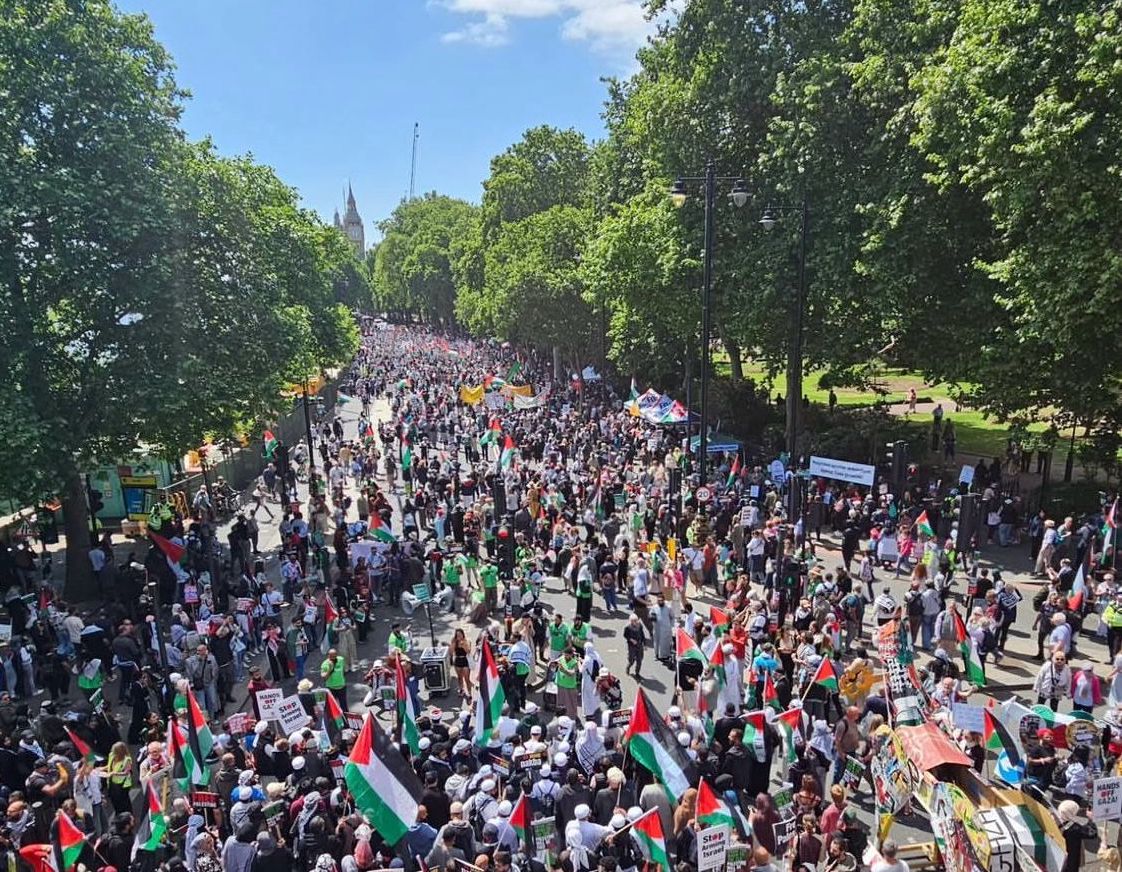
Image Credit: FOA
Britain’s response to pro-Palestine protest indicates the illusion that political rhetoric, legislation and policing are merely a neutral set of procedures. Instead, they are a network of knowledge, institutions and practices that produce particular kinds of subjects, constructing the protestors as “dangerous” in relation to the rest of the “respectable citizen”. What is projected as “public order” is better understood as a regime that disciplines bodies, controls speech and secures the government’s epistemic and moral authority.
One of the central distinguishing marks of liberal democracy is said to be freedom of assembly and expression. But freedom is never simply present or absent; it is produced through discursive boundaries that determine who may speak, how they may speak and which forms of suffering count as politically legible. The very rules about where to protest, what images may be shown and which slogans are permitted function as techniques of governance. These issues demarcate the limits of acceptable subjectivity and institute a politics of non-recognition for those outside the sanctioned frame.
My practice of organising protests for more than twenty-five years, including being part of more than thirty national London protests against the genocide in Gaza, shows how this policing of dissent operates not merely by commands but through productive constraint. The state’s interventions instil habits of self-regulation, activists internalise the norms of what a “lawful” protest looks like, trimming their repertoire of speech and action so as to avoid sanction. This is governmentality in action, power that governs not only by force but by shaping conduct and desire.
Since October 2023, political rhetoric has discursively framed pro-Palestinian solidarity as an internal threat, a securitised Other. Words matter. When political leaders like the former Home Secretary Suella Braverman infamously label our peaceful marches as “hate marches” and when the then Prime Minister Rishi Sunak warned that “mob rule is replacing democratic rule” they are performing a speech act that redescribes a collective of varied subjects of different ages, faiths and ethnicities as an undifferentiated menace. This discursive othering is the precondition for juridical measures. The rhetoric of the political class constructs the protester as a figure in need of containment. It is this that Starmer, as Prime Minister, continued to implement and extend police powers.
Legislation and administrative measures that started under the Conservative government and followed pathologised pro-Palestinian protests. In February 2024, the Home Office announced it would give police the power to arrest anyone wearing face coverings at a protest. A measure criminalising Muslim women, people who are unwell and those who want protection from the prying eye of Israeli defenders. Thereafter, the police set rally routes and start and finish times and even banned marches “in the vicinity of a place of worship”. In January 2025, for example, the police banned pro-Palestine campaigners from assembling outside the BBC’s London headquarters, citing the proximity of a synagogue. Similarly, prohibition was placed on organisers to avoid the Israeli embassy. In June 2025, a Member of Parliament warned that phrases like “vicinity” and “reasonable firmness” were being left deliberately vague, amounting to a new “hostile environment” for free assembly.
Crucially, these orders do not simply regulate conduct they enact an epistemic hierarchy. Pro-Palestinian protestors’ bodies are rendered hypervisible as “threats” while the suffering of Palestinians is simultaneously made unintelligible within official moral grammars. In effect, the protester is reconstituted as a suspect subject whose very presence justifies surveillance and pre-emptive control.
The disciplinary apparatus extends into everyday protest praxis. During the 6 September 2025 rally, police restricted beating pots-and-pans (symbol of Gaza’s starvation), chanting and using megaphones until the officially sanctioned start time. All these become sites where state power inscribes limits. Meanwhile, a new stop-and-search power has been deployed almost exclusively against Gaza protesters. The police have used the anti-protest stop-search 47 times, 40 of them on protestors at a pro-Palestine rally, yet made zero arrests. This shows stop-and-search policy functions less as evidence of danger and more as a ritual of discipline, a performative demonstration of state control that attempts to condition protestors’ behaviour.
Surveillance amplifies this disciplinary effect. The riot police routinely video record protestors, and a Kent police officer threatened a woman under the Terrorism Act for holding “Free Gaza” placards. When phrases like “Free Gaza” or a placard with coconuts are treated as suspect speech, it suggests that even solidarity signs might be read through counter-terror frameworks. This creates a surveillant assemblage in which gestures, garments and words are continually subject to reclassification. This collapses humanitarian speech into criminal culpability, converting political solidarity into evidence of affiliation with undesirable actors. This is an epistemic violence. It is the denial of meaningful political language to a collective experiencing and protesting atrocity.
Here, power and knowledge co-produce one another. The political rhetoric and the resulting legal architecture do not merely coerce; they produce truths about who is legitimate and who is suspect. Those truths become internalised. Protesters begin to police themselves, adopting corrective measures that domesticate dissent and preserve the appearance of a functioning liberal society. In this dynamic, protest risks being recuperated as a safety release valve rather than a site of transformative rupture, a way the state manages rather than resolves its contradictions.
Yet, my experience shows such disciplining is never total. The British public, over the last two years, confronted the disciplining and provided a counter-narrative. Polling shows this clearly. By July 2025, some 62% of Britons sympathised with the Palestinians, the highest level since the conflict and discipling mechanisms began. Meanwhile, hundreds of thousands of people keep turning out to the monthly London marches in addition to local protests around the country. On 6 September 2025, an enthusiastic crowd boldly gathered in Parliament Square to protest the ban on the group Palestine Action; police responded with mass arrests. They detained almost 900 people that day. The expansion of solidarity for Palestinians and the persistence of monthly marches show how the public is galvanising and contesting the government’s narrative. The mass uprising, including civil disobedience, exposes the limits of securitising narratives and demonstrates that the disciplinary mechanisms can be resisted, disrupted and delegitimised.
This resistance is not merely formal or procedural. It is epistemic and existential. It shows the British public refuses the erasure of Palestinian life and contests the forms of knowledge that justify state violence. It performs a different grammar of legitimacy, one grounded in shared humanity, in historical consciousness, and in a refusal to accept state-sanctioned amnesia about allies (a Western-centric coalition) and its contemporary consequences.
If the state doubles down, expanding surveillance, normalising stop-and-search, and invoking counter-terror frameworks, it will only make explicit what has long been implicit. The liberal polity contains within it a post-colonial Western-centric imaginary that regulates citizens by ideological logics. The choice the government faces is not merely administrative. It is whether to deepen an apparatus that polices grief and solidarity, or to answer the moral claim being made on the streets of a free Palestine.
Author’s bio
Ismail Patel is the Chair of the UK-based NGO Friends of Al-Aqsa, and a Visiting Research Fellow at the University of Leeds.

Related Blogs

Of Those who Don’t get to be Cockroaches
Image credit: Photo taken by Shaheen Abdulla, July 2026. Photo used with permission. Since 2014, India has been governed by Hindutva ethnonationalism, intensifying decades of structural marginalization of Muslims through state-sanctioned impunity and systematic...

The Rebel Team: Football and Algeria’s Liberation
Image credit: Wikimedia: https://commons.wikimedia.org/wiki/File:Jubilee_FLN_soccer_team_1974.jpg (Mustapha Zitouni standing, 5th from the right; Rachid Mekhloufi sitting, 2nd from the right) History reminds us that, like literature and art, football can embody a...
Reflections on Islam, Muslimness and Decolonisation – I
*Yasin Aktay’s four-part series is a contribution to Critical Muslim Studies that critically engages with S. Sayyid’s Recalling the Caliphate as a means of reflecting on the contemporary manifestations of the Muslim Question.Image credit: photographs by Johanna Loock,...