

What does ‘Left’ mean in a political sense? Egalitarianism, support for the (organised) working class, support for the nationalisation of industry, hostility to marks of hierarchy, opposition to nationalistic foreign or defence policy, etc. But in Kerala, it has acquired a special meaning: Islamophobic and accommodating Hindutva. Here, activists and scholars have coined terms like ‘Hindutva Marxism’; in Kerala, the Left often functions as the Right.
This note is intended as one reflection on the extremely dangerous compromises made by the Left to maintain parliamentary power and the way these compromises are shaping Kerala’s social consciousness in an increasingly Islamophobic direction.
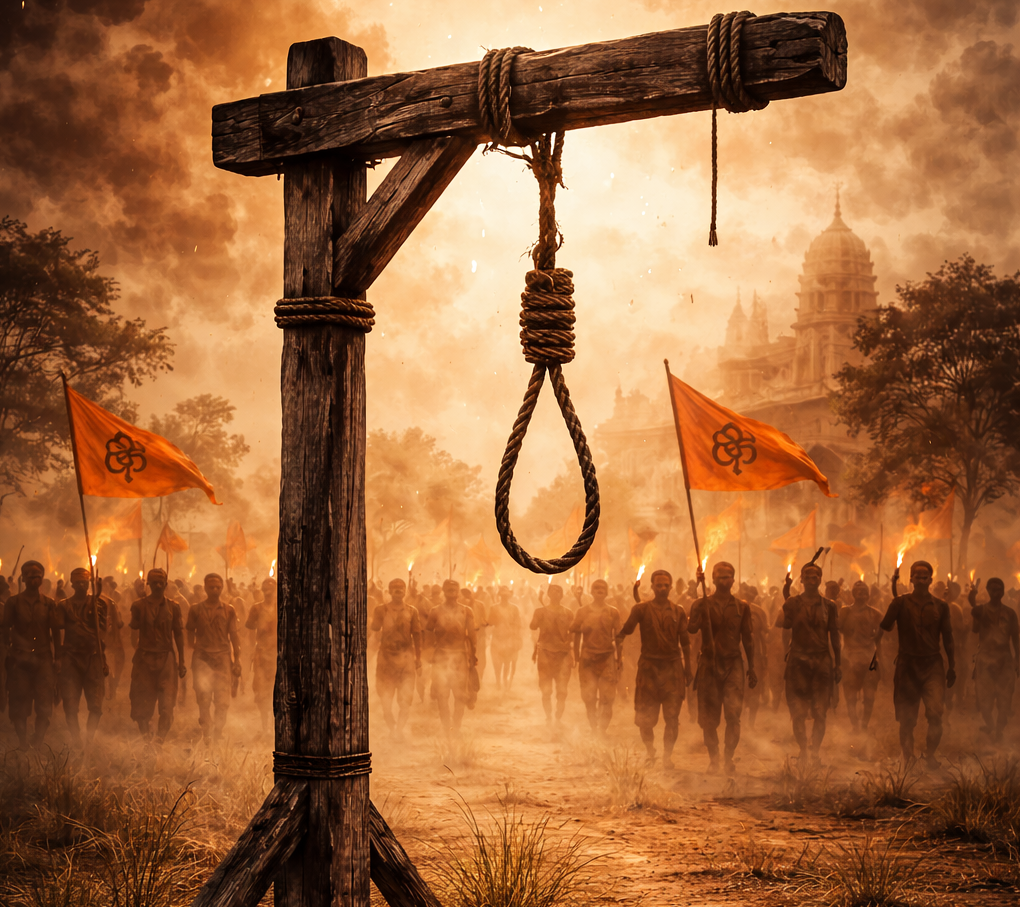
It is about the brutal mob lynching of Ram Narayan Baghel, a 31-year-old Dalit migrant worker from Chhattisgarh, in Kerala’s Palakkad district. On December 17, 2025, Ram Narayan was detained by locals in the Attapallam area near Walayar on suspicion of theft. What followed was an hours-long assault that left him with over 80 injuries across his body, including shattered ribs, a broken spine, and severe head trauma—the cause of death, as confirmed by the post-mortem conducted at Thrissur Government Medical College Hospital.
Dr. Hithesh Shankar, who performed the autopsy, described the violence as unprecedented in his experience of over 10,000 examinations: no part of the body was left uninjured, with marks from sticks, trampling, and dragging. The assault continued even after Ram Narayan was unconscious or dead. He had arrived in Kerala just days earlier, seeking work at the Kinfra Park in Kanjikode, but disliked the job and was planning to return home. New to the area, he got lost while heading to the railway station. His relative, Shashikant Baghel, emphasised that Ram Narayan had no criminal record, no mental health issues, and was a family man with two young children, aged eight and ten.
Circulating audio and video clips reveal the mob’s xenophobic frenzy: Ram Narayan was repeatedly questioned, “Are you a Bangladeshi?” In one clip, he weakly responds about his sisters back home, only for the mob to mock and continue the beating. This echoes the Sangh Parivar’s nationwide campaign portraying “Bangladeshi infiltrators” as threats, often conflated with anti-Muslim rhetoric.
Human rights activists have condemned the incident as a hate crime rooted in Islamophobia—defined academically as racism targeting expressions of Muslimness or perceived Muslimness. Ram Narayan, a Dalit, was not Muslim, yet he was misidentified as a ‘Bangladeshi Muslim infiltrator.‘ Activist Baburaj Bagawathy captured this tragedy poignantly on Facebook:
“He is not a human,
but a human who has been mistakenly perceived as a Muslim!
He is not an Indian citizen,
but an Indian citizen who has been misled into being seen as a Bangladeshi!
He is not a Dalit,
but a Dalit who has been misled into being perceived as a Muslim!
He is not a worker,
but a worker who has been mistakenly perceived as a Muslim!”
Five local men have been arrested and remanded, with reports indicating that four are associated with the BJP and RSS, and that some have prior cases involving political violence. Yet activists allege attempts to downplay the case as an ordinary theft-related assault rather than a mob lynching. The family, supported by protesters, refused to accept the body until the case was registered. Due to the constant interventions of the protest committee led by Abdul Jabbar (the brother of Ashraf, who was killed by a Hindu mob in Mangalore), the government was forced to accept all their demands. Immediate compensation of not less than ₹10 lakh will be provided. All legal protections under the Mob Lynching and Dalit Atrocities Act will apply in this case. Legal protection as per the Supreme Court’s order in the Tehseen Poonawalla case will also be ensured. (under relevant mob lynching provisions (including Section 103(2) of the Bharatiya Nyaya Sanhita and Supreme Court guidelines from Tehseen Poonawalla vs Union of India, 2018). The government has taken responsibility for bringing the body back to the country. How terrible is the situation when natural justice has to be achieved only through prolonged struggle and waiting under a ‘Left’ government.
This is not Kerala’s first mob lynching—the 2018 killing of tribal youth Madhu in Attappady remains fresh—but it is unprecedented in linking to anti-Bangladeshi/anti-Muslim narratives. Opposition leaders like V.D. Satheesan and AICC general secretary K.C. Venugopal have criticised the Left government’s handling, pointing to delays in police response (arriving hours later) and failure to curb hate propaganda.
The Left Front, long priding itself on secularism, has shown apathy. While quick to act on issues like parody songs in the Sabarimala-related controversies, it has remained silent on inflammatory statements—such as calls for extreme measures against Muslims, like Malayali writer and All India Radio programme producer K. R. Indira’s call for the sterilisation of Muslims. This tolerance has allowed Hindutva narratives to seep into Kerala society, culminating in this horrific manifestation at Walayar.
Meanwhile Kerala continues to brilliantly hide racism and Islamophobia behind a progressive image. The state’s collective conscience must reject Islamophobia, demand accountability, and ensure justice for Ram Narayan’s family. Failing this, such violence risks becoming normalised.
Author’s bio
Hamid TP is a Research Fellow at Al Jamia Al Islamiya (Al Jamia Research Fellow – ARF) and serves as the Editor of the Campus Alive publications. Previously, he served as the Director of Thanshiha Islamic Academy, Kozhikode.

Related Blogs

Of Those who Don’t get to be Cockroaches
Image credit: Photo taken by Shaheen Abdulla, July 2026. Photo used with permission. Since 2014, India has been governed by Hindutva ethnonationalism, intensifying decades of structural marginalization of Muslims through state-sanctioned impunity and systematic...

The Rebel Team: Football and Algeria’s Liberation
Image credit: Wikimedia: https://commons.wikimedia.org/wiki/File:Jubilee_FLN_soccer_team_1974.jpg (Mustapha Zitouni standing, 5th from the right; Rachid Mekhloufi sitting, 2nd from the right) History reminds us that, like literature and art, football can embody a...
Reflections on Islam, Muslimness and Decolonisation – I
*Yasin Aktay’s four-part series is a contribution to Critical Muslim Studies that critically engages with S. Sayyid’s Recalling the Caliphate as a means of reflecting on the contemporary manifestations of the Muslim Question.Image credit: photographs by Johanna Loock,...