

By Ahmet Said Aydil
Blog 145
6 November 2026
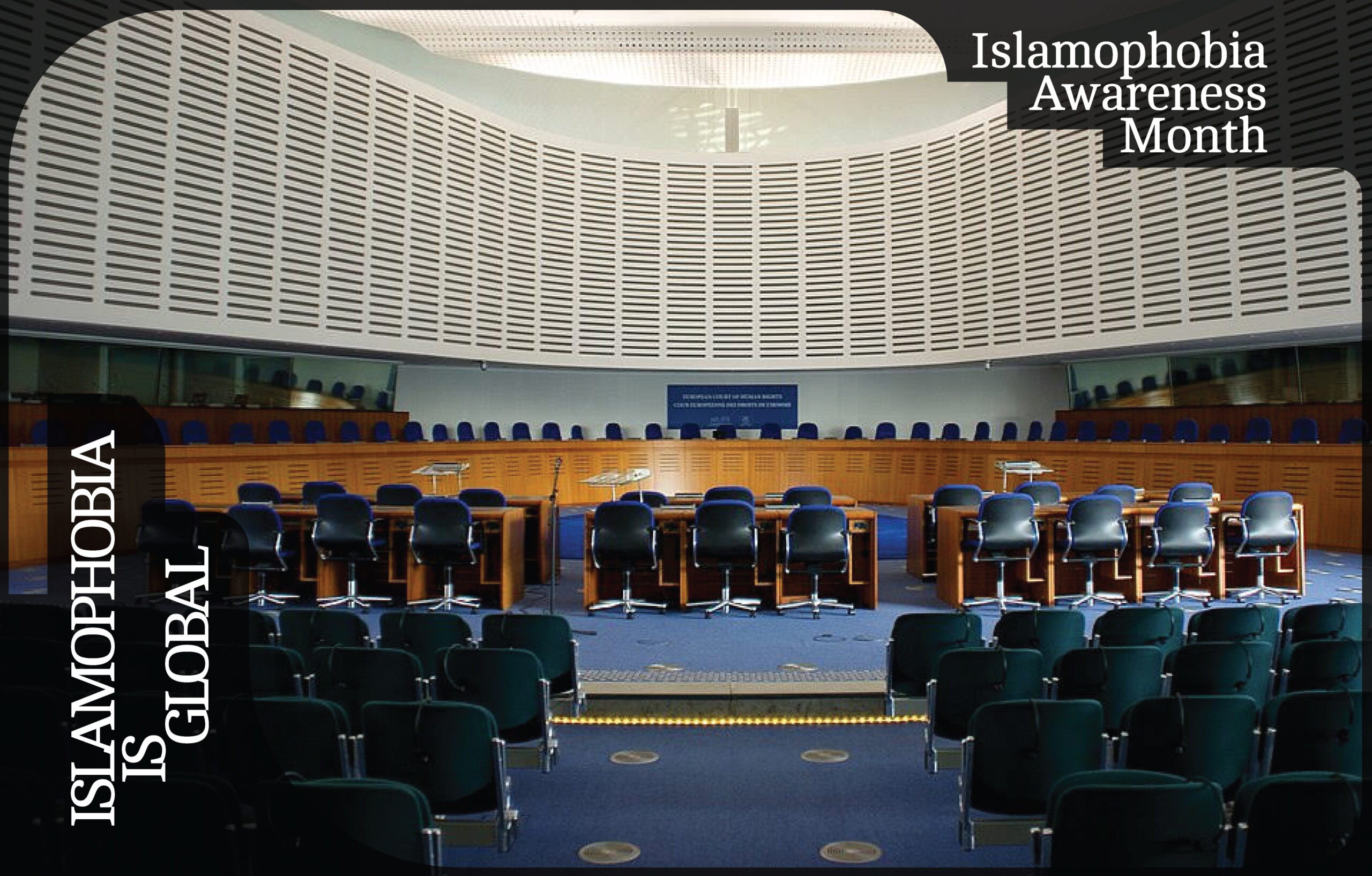
Image credit: Strasbourg – European Court of Human Rights (https://commons.wikimedia.org/wiki/File:Strasbourg-_European_Court_of_Human_Rights.jpg). CherryX per Wikimedia Commons, CC BY-SA 3.0.

The European Court of Human Rights is arguably the most successful human rights court in the world. Its judgments bind forty-six member states, and over seven decades it has shaped how rights are understood and applied across the continent. It has described itself as “the conscience of Europe.” The phrase captures a genuine self-understanding: that when national systems fail the individual, the Court stands as the final guardian of fundamental rights.
That claim must be taken seriously. Which means asking what the conscience of Europe has said in regard to the rights of the second largest religious community in the Council of Europe, a community present both as the majority population of several member states and as a minority navigating the legal and political structures of others.
In one of the early cases, Karaduman v. Turkey, (1993) a university graduate was denied her diploma photograph because she wore a headscarf. The Commission found no interference with the applicant’s freedom of religion. In Dahlab v. Switzerland, (decision date 2001), a primary school teacher was fired and her application declared inadmissible. The Court held that it is “difficult to reconcile the wearing of an Islamic headscarf with the message of tolerance, respect for others and, above all, equality and non-discrimination that all teachers in a democratic society should convey to their pupils” and that “it could not be denied outright that the wearing of a headscarf might have some kind of proselytising effect.” In Leyla Şahin v. Turkey, (2005) a Grand Chamber of sixteen judges to one found no violation when a fifth-year medical student was barred from her examinations due to her headscarf. The Court reasoned that the regulations constituted “a measure intended to preserve pluralism in the university” against “extremist political movements” seeking to “impose on society as a whole their religious symbols”, without a single concrete example of such pressure at Istanbul University. The headscarf, it held, “appeared to be imposed on women by a religious precept that was hard to reconcile with the principle of gender equality.”
In S.A.S v. France, (2014) a Muslim woman challenged France’s blanket face veil ban. The Court upheld the ban, accepting that “the barrier raised against others by a veil concealing the face is perceived by the respondent State as breaching the right of others to live in a space of socialisation which makes living together easier”, despite acknowledging that the legislative debate surrounding the ban had been marked by Islamophobia (para. 149). In Ebrahimian v. France, (2015), a hospital social worker’s contract was not renewed because she refused to remove her headscarf. The Court found no violation, accepting the neutrality assertion made by French authorities.
The Court made these claims without expert opinion, without academic reference, and without hearing from the communities affected. Despite repeated NGO submissions documenting the systematic exclusion of Muslim women from education and employment, the Court assessed each application in isolation. The most recent major headscarf case, Mikyas and Others v. Belgium in 2024, upholds restrictions in Flemish higher education while silently inheriting a framework it no longer explicitly cites. The language has softened. The analytical structure has not moved. Here the contrast with the 2011 case of Lautsi and Others v. Italy is very telling. When Italy’s mandatory display of crucifixes in state school classrooms was challenged, the Grand Chamber held that “a crucifix on a wall is an essentially passive symbol” that “cannot be deemed to have an influence on pupils comparable to that of didactic speech or participation in religious activities.”
The asymmetry is hard to miss. A teacher’s or student’s personal religious dress, one might argue, represents the plurality that exists within a state and its citizenry, whereas a state-mandated symbol fixed to every classroom wall projects a singular religious identity.
Overall, it was the Refah Partisi and Others v. Turkey case (2003) where the court produced its most damning (and widely cited) reasoning regarding Islam that persists to this day. With twenty-two percent of the vote in the last general election, Refah was the most popular party in Türkiye at the time of its dissolution in 1998, which was justified by reference to, among other things, its alleged plans to establish by force a legal pluralist system incorporating elements of sharia and its opposition to headscarf bans.
The Grand Chamber held that “sharia, which faithfully reflects the dogmas and divine rules laid down by religion, is stable and invariable” and that “it is difficult to declare one’s respect for democracy and human rights while at the same time supporting a regime based on sharia.”
It is important to add that Refah had never proposed sharia legislation and this was the only political party closure case from Türkiye, among many, where the court ruled in favor of dissolution. In the others, concerning socialist and pro-Kurdish parties, it (rightfully) found violations citing the importance of democratic pluralism. Judge Kovler in his concurring opinion found the statements on sharia, a legal tradition of 14 centuries unsubstantiated and “politico-ideological”.
Over time, the vocabulary developed at Strasbourg, on neutrality, sharia, the threat of headscarf’s visibility to women, has been reproduced in domestic legislation, judicial reasoning, and executive policy across Europe. The German Federal Constitutional Court’s 2020 ruling barring legal trainees from courtroom functions while wearing a headscarf rest on the “neutrality” framework Strasbourg developed and endorsed. When France bans the abaya in schools as a garment that “conspicuously manifests a religious affiliation,” it does so within the space the Court made available. When Islamophobic politicians argue that Islam is structurally incompatible with democratic values, they argue in terms the conscience of Europe established as legal doctrine.
European states developed, unevenly and often reluctantly, legal frameworks of racial and religious equality that formally extended civic membership to these communities. Muslims were, in the language of liberal multiculturalism, included. What three decades of Strasbourg jurisprudence documents are the terms of that inclusion. The Court did not simply fail to protect Muslim rights in individual cases. It took restrictions that originated in particular national contexts – French laïcité, Turkish laiklik, Flemish neutrality – and, rather than subjecting them to genuine European scrutiny, validated them and elevated them into Convention doctrine. A measure that might have remained a contested national policy, vulnerable to challenge within its own legal order, instead acquired the authority of the continent’s highest human rights court. Strasbourg characterized Muslim religious visibility as a threat to pluralism, Islamic governance as structurally incompatible with democracy, and the presence of Muslim identity in public institutions as a problem requiring management, and in doing so transformed local restrictions into a Europe-wide reference point. The boundaries of acceptable Muslim presence were drawn not by populist movements alone but by the body meant to guard against precisely such overreach, in reasoned judgments backed by the full authority of international law.
This can only be described as institutional Islamophobia. A clear pattern of differential treatment, embedded in authoritative legal doctrine, that has shaped the terms of Muslim life in Europe for three decades. When the conscience of Europe is invoked today, in a courtroom, a parliament to restrict Muslim life, it is worth asking whose conscience it has consistently been.
Author’s bio
Ahmet Said Aydil is a doctoral researcher at the Max Planck Institute for Social Anthropology and a PhD candidate at the Faculty of Law, Martin Luther University Halle-Wittenberg. His research focuses on human rights, international judicial authority, legitimacy, religious freedom, secularism, and law and society.

Related Blogs
After the War on Terror
Image credit: Pixabay (Free to use)Twenty-five years after 11 September 2001, the Global War on Terror (GWOT) appears, at first sight, to belong to another political moment. The occupations of Afghanistan and Iraq no longer organise Western political discourse in...

Of Those who Don’t get to be Cockroaches
Image credit: Photo taken by Shaheen Abdulla, July 2026. Photo used with permission. Since 2014, India has been governed by Hindutva ethnonationalism, intensifying decades of structural marginalization of Muslims through state-sanctioned impunity and systematic...

The Rebel Team: Football and Algeria’s Liberation
Image credit: Wikimedia: https://commons.wikimedia.org/wiki/File:Jubilee_FLN_soccer_team_1974.jpg (Mustapha Zitouni standing, 5th from the right; Rachid Mekhloufi sitting, 2nd from the right) History reminds us that, like literature and art, football can embody a...