

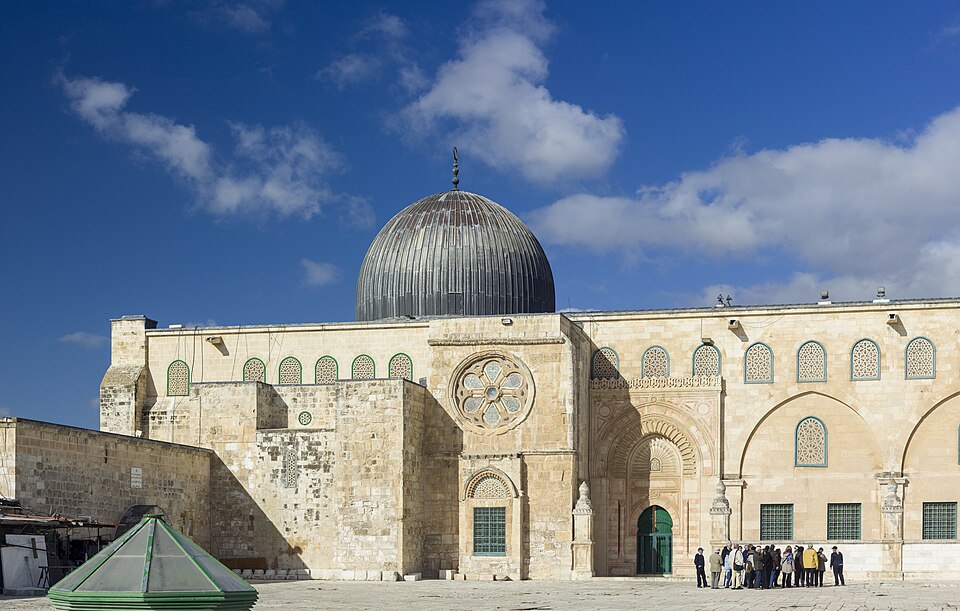
Image credit: Jerusalem 2013 Al-Aqsa mosque by Andrew Shiva. Wikimedia Commons. Accessed 15 April 2026. https://commons.wikimedia.org/wiki/File:Jerusalem-2013-Al-Aqsa_Mosque_04.jpg Licensed under https://creativecommons.org/licenses/by-sa/4.0/

The colonised man finds his liberation not in the moment the occupier opens the gate, but in the moment he recognises that the gate was never the occupiers to open. Colonialism does not merely take land; it takes the very terms by which existence is defined, which in this case decides who may enter, who must wait and who must be grateful. When Israeli occupation authorities announced on 9 April 2026 that the gates of Masjid Al-Aqsa would reopen after forty days of unprecedented closure, the world was invited to breathe a sigh of relief. All people of conscience, including Palestinians and Muslims across the world, should breathe nothing of the sort.
Forty Days of Erasure
The closure began on 28 February 2026, hours after Israel and the United States launched a military assault on Iran. Israeli occupation forces expelled worshippers from Al-Aqsa and the Ibrahimi Mosque in Hebron, declaring the closures preventive wartime measures. The pretext was security. The reality was something far more calculated.
For forty days, one of Islam’s holiest sites in Jerusalem, a 14-hectare sanctuary of prayer, belonging and sacred memory, was locked shut to the Muslim community that has worshipped there for over a millennium. This was the first Ramadan since Israel’s illegal seizure of East Jerusalem in 1967 that Friday and Eid prayers were not held at the Al-Aqsa. Palestinian Muslims in the occupied West Bank, for whom Ramadan typically represents the only season when Israel permits even limited access to Al-Aqsa, were denied entry entirely. Children who had never prayed at the Al-Aqsa grew older still having never done so. The elderly who had prayed there all their lives prayed instead on pavements and on roadsides, in the shadow of Israeli police.
Meanwhile, as journalist Lubna Masarwa reported from a ghost-town Old City, the same Israeli authorities who cited wartime emergency permitted synagogues to remain open. Restaurants in West Jerusalem stayed full. Anti-government demonstrations of hundreds were allowed to proceed. The selective application of “security” revealed precisely what it was designed to conceal – this was not protection. This was dispossession.
The Colonial Logic of the Reopening
The world must not mistake the conditional opening of Al-Aqsa for freedom. The reopening of Al-Aqsa is not a restoration. It is a demonstration of power and its terms make this unmistakable.
The announcement stated that the Al-Aqsa would open simultaneously to Muslim worshippers and to Israeli settler “incursion” groups. The Israeli ultranationalist movements whose stated aim is to destroy the buildings upon Al-Aqsa and replace it with a Jewish temple. The timing was chosen to coincide with the final day of the Hebrew Passover, ensuring that the settlers’ return would be filmed, celebrated and weaponised as a symbol of Israeli dominance. No exclusive return was offered to the Muslim community whose mosque was taken from them for forty days. The Islamic Waqf, the internationally recognised sole authority over Al-Aqsa, was informed rather than consulted.
Most strikingly, the Israeli Home Front Command declared that activities would resume from 6:00am, arrogating to the military the authority to set the hours of Masjid Al-Aqsa, over which it has no legitimate jurisdiction whatsoever. In fact, no Israeli body, military or judicial, possesses legal authority over when Al-Aqsa’s doors open. That this is happening openly, without any challenge from the international community, marks a profound and dangerous normalisation.
A Trajectory of Takeover
The closure of Al-Aqsa must not be seen in isolation. Each intrusion, attack and public provocation upon it must be seen in a broader architecture of domination. The forty-day closure and its choreographed reopening belong to exactly such an architecture.
Settler incursions into Al-Aqsa began in 2003. Fixed daily incursion timings were introduced in 2008, when settlers were allocated three hours. By 2026, those hours have gradually expanded to six and a half — from 6:30am to 11:30am, and again from 1:30pm to 3:00pm. This is the longest duration yet. The pattern is explicit. A steady expansion of settler time inside Al-Aqsa, and a corresponding compression of the conditions under which Muslims may worship in their own sacred space. The stated goal of the settler movements is a “time division”, but this from the experience of Ibrahimi Masjid in Hebron is but a prelude to full Israeli sovereignty control? over the site.
The figures within Israel’s government are not shy about these intentions. National Security Minister Itamar Ben Gvir, who entered Al-Aqsa during the closure while Muslim worshippers remained locked out, has been explicit. Finance Minister Bezalel Smotrich has called for Israeli sovereignty over the entire West Bank. Temple movement organisations openly call for the demolition of the Musallas upon Aqsa sanctuary and the construction of a Third Temple. Yehuda Glick, a prominent Temple Mount movement leader, built his career on daily incursions and the demand that “the Temple Mount” be placed under exclusive Jewish control. Haggi Yekutiel, another activist, declared, “We are going to build the Third Temple in every prayer we recite in the Temple Mount.”
The Supreme Court Ruling: A New Act of Aggression
Before the reopening, the Israeli Supreme Court rejected a petition by the Temple Organisations Union, requesting an urgent order enabling settler incursions into Al-Aqsa during Passover. The petition was rejected after the Home Front Command determined there was no “protected area” available for those attempting to carry out the incursions. The court did not reject the principle; it merely rejected the practicality.
This ruling, presented by some as a restraint on settler ambitions, must be read with colonial clarity. Three implications stand out.
First, by declining to intervene rather than actively rejecting the settlers’ claim, the court effectively returned authority over Al-Aqsa’s access to the Home Front Command and to Ben Gvir’s Ministry of National Security. The power to open or close the Al-Aqsa has been handed not to its rightful administrators, but to an Israeli military body and a far-right minister.
Second, the ruling is itself an act of aggression. For the Israeli Supreme Court to position itself as the body competent to adjudicate on the opening and closing of Al-Aqsa is to claim Israeli sovereignty over the site in the very act of ruling. Under international law, this authority belongs exclusively to the Jordanian Islamic Waqf.
Third, a dangerous equation is being entrenched. Muslim access to Al-Aqsa is being made conditional upon settler incursions. The sheltered spaces of the Marwani Musalla and the Qibli Musalla are framed as areas where Muslim worshippers can take refuge during settler activities in open courtyards. This is not accommodation. It is containment. The Al-Aqsa is being spatially reorganised to normalise a dual-access regime that has no legal or moral basis.
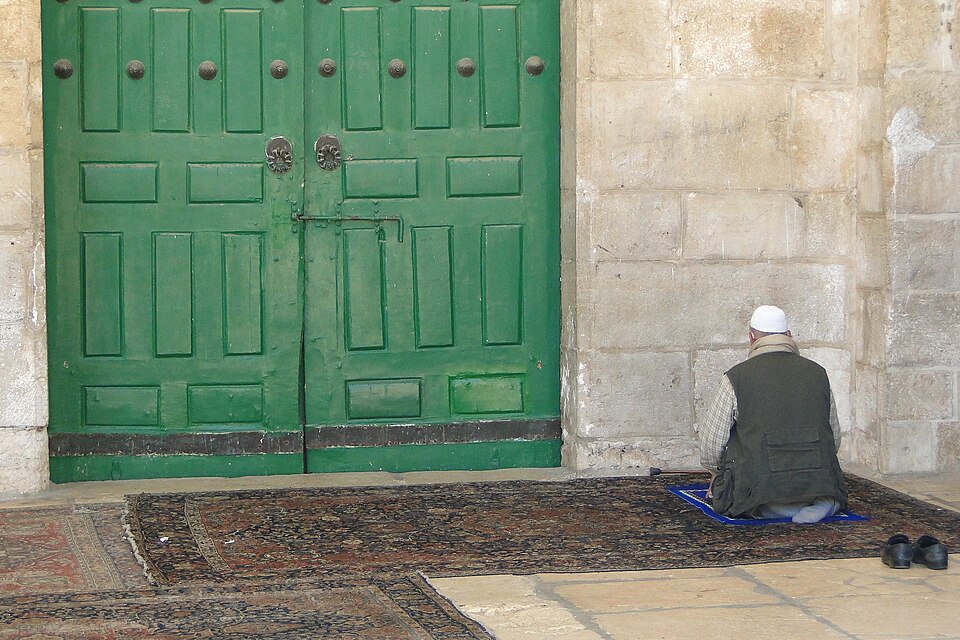
Image credit: At Prayer outside Al-Aqsa Mosque, Temple Mount, Old City, Jerusalem by Adam Jones. Wikimedia Commons. Accessed 15 April 2026. https://commons.wikimedia.org/wiki/File:At_Prayer_outside_Al-Aqsa_Mosque_-_Temple_Mount_-_Old_City_-_Jerusalem_(5684527684).jpg Licensed under https://creativecommons.org/licenses/by-sa/2.0/deed.en
.jpg)
The Closure as a rehearsal for a take over
The reopening of Al-Aqsa after forty days is not a return to normality. It is a managed concession, delivered on the occupier’s timeline, under the occupier’s conditions, in coordination with the occupier’s settler movements, and narrated according to the occupier’s preferred symbolism.
Palestinian lawyer Khaled Zabarqa has stated plainly that Israel’s primary aim is “to consolidate Israeli sovereignty and administration over Al-Aqsa, while transforming the mosque into a shared space between Jews and Muslims ahead of an official recognition of Jewish prayer areas in its courtyards.” This is the trajectory. The forty-day closure was not a deviation. It was a rehearsal.
Al-Aqsa is not a building. It is, as one Palestinian woman described it, “the sacred heart of Palestinian identity”, “a symbol of sumud — of resilience and the enduring struggle for liberation”, but above all it is heritage and part of Muslim faith. To those who would celebrate its reopening as a return to normality, there is no normality under occupation. There is only the steady advance of erasure and the daily choice to resist it.
The gates of Al-Aqsa have reopened. But the hand that holds the key is not the Waqf’s. Until it is, the struggle continues.
Author’s bio
Dr. Ismail Patel is the Chair of the UK-based NGO Friends of Al-Aqsa, and a Visiting Research Fellow at the University of Leeds.

Related Blogs

Of Those who Don’t get to be Cockroaches
Image credit: Photo taken by Shaheen Abdulla, July 2026. Photo used with permission. Since 2014, India has been governed by Hindutva ethnonationalism, intensifying decades of structural marginalization of Muslims through state-sanctioned impunity and systematic...

The Rebel Team: Football and Algeria’s Liberation
Image credit: Wikimedia: https://commons.wikimedia.org/wiki/File:Jubilee_FLN_soccer_team_1974.jpg (Mustapha Zitouni standing, 5th from the right; Rachid Mekhloufi sitting, 2nd from the right) History reminds us that, like literature and art, football can embody a...
Reflections on Islam, Muslimness and Decolonisation – I
*Yasin Aktay’s four-part series is a contribution to Critical Muslim Studies that critically engages with S. Sayyid’s Recalling the Caliphate as a means of reflecting on the contemporary manifestations of the Muslim Question.Image credit: photographs by Johanna Loock,...