

By Shvetal Vyas Pare
Blog 142
25 September 2026
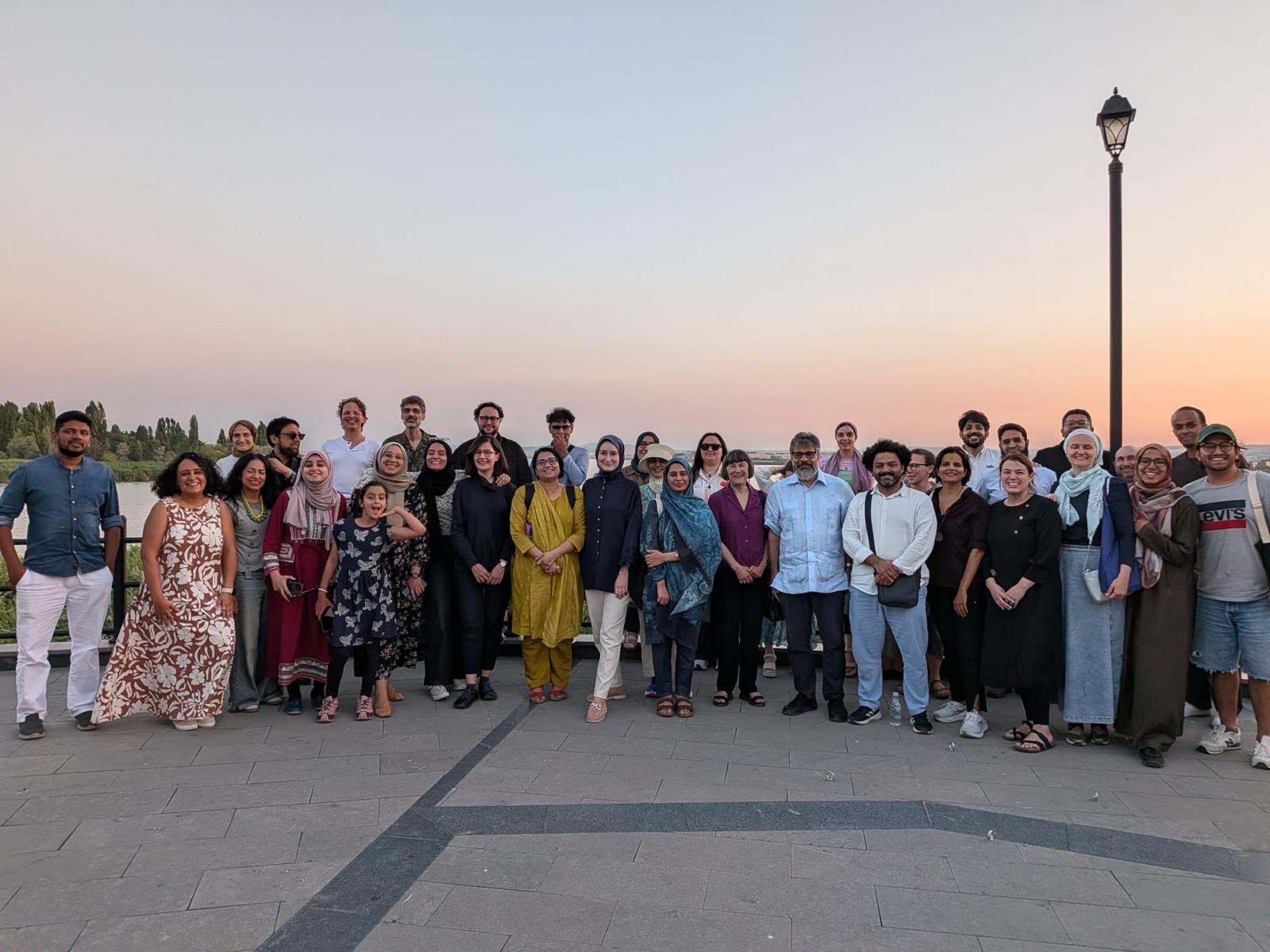
Image credit: Curtesy of the conference organising committee
The second Critical Muslim Studies Summer Programme on “Decolonisations and Emancipations” took place in Ankara, Türkiye, from July 17 to July 22. The Summer Programme was a critically rigorous, challenging and ultimately exhilarating experience. Over six days, there were 16 faculty-led sessions and four sessions built around student presentations and discussions.
The Summer Programme participants received readings for each session beforehand, and like all cohorts, we had the eager beavers and those who were doing the readings at the very last minute. For my part, it was like a return to university life, and the butterflies in my stomach when I had not completed all the readings for a session took me straight back to my student days! The overarching theme of the summer school was to reorient: not just ideas, concepts, arguments and theoretical frameworks but also our practices and ways of being in community.
The summer school opened with a consideration of the question “What is Critical Muslim Studies?” and key concepts that form the building blocks of Critical Muslim Studies (CMS) were interrogated through the following days. The first two sessions focused on understanding the concept of Muslimness as used by CMS and the key questions facing those who would research Muslim and non-Muslim worlds. The ideas of Orientalism and post-Orientalist understandings of the Islamicate came up, as did questions around continuing to research during an ongoing genocide and epistemicide. Sectarianism was also challenged as a concept developed by colonial epistemology, and we considered what research that goes beyond sectarianism could look like. A session on day three similarly traced the unfolding of the term ‘Muslim’ across different texts and registers, and the issues for which it functions as a marker in present-day Europe. What are the ways in which historiography and historical context frame the research question, so that the same set of people or research about them can variously be described as Muslim, Arab, Lebanese and so on? Another session similarly reoriented the concept of critique. It offered a genealogy of the term ‘critique’ through the scholarly work of Talal Asad and Saba Mahmood. This genealogical analysis was an excellent way to learn not just how to understand critique, but also how to carry out a genealogical analysis more generally, and how to bring it to our own research.
A CMS Summer Programme around Muslim identity in the contemporary world will definitely take into account the concept of the political. We examined the concepts of identity and resistance in a variety of ways. One key session focused on Palestine and offered a contextualisation of the ongoing conflict that did not rely on religious and/or colonial categories to explain it. Instead, it offered an analysis that foregrounded the role of colonialism and continued neoliberalism as well as the ways in which the idea of theology was manipulated to keep popular resistance in abeyance. But this was not the only session on Palestine. The second session on Palestine provided a thought-provoking argument around the representation of the violence in Palestine on social media, and raised critical questions around what it means to experience a genocide in multifarious ways through our senses while also continuing to exist in a world which may be relatively safer. On the last day, we had a session around Sufism and power. It reconfigured reductive understandings of Sufism as empty of political content. Instead, it contextualised Sufism in a long history of negotiating with the world and all its aspects, including the political. There was also a session on interreligious relations, which contextualised a long history of Muslim-Jewish relations that does not see them as essentially hostile to each other, but rather traditions that have always existed in communication with each other. Another session asked participants to rethink their notions of identity and interest, showing them the futility of defining identity in non-relational or essential ways. It was a fun session where participants at almost every table ended up challenging each other, and carefully built consensuses were the first to depart!
Another thread through the Summer Programme was to reorient ideas of knowledge. We examined historiography and its relationship to decolonial theory. How much does the shift of the starting point of colonialism to 1492, one of the foundational ideas of decolonial theory, help us in terms of conceptualising research questions, and what does it specifically obscure? The session on epistemology focussed on understanding Talal Asad’s argument about an Islamic discursive tradition, and what it would mean to take on board the idea of knowledge as grounded in a specific discursive tradition and deriving from it. The session also examined how current disciplinary frameworks, such as those in Islamic studies, continue to construct both disciplines and their epistemological foundations in specific ways. We also examined the universality of Muslim political concepts. Just as Christian/secular concepts are seen as freed from ideological content and universally applicable, can Muslim socio-political concepts be useful for researchers beyond looking at Muslim lives? The penultimate session of the Summer Programme, “Travelling Concepts”, helped bring together learning from across the different sessions by examining how concepts and ideas travel across disciplinary categories and understandings. Once one understands the concept of ‘race’ or ‘Orientalism’, for example, how is one to make it work in a field where the assumption is that it does not apply? Critical Muslim Studies is not only about Muslims, so how is one to take its categories and its epistemological commitments – such as its both complementary and contested relationship with decolonial theory – and make these categories travel to one’s own work? There was still a final roundtable to come, but in many ways this session was an excellent conclusion to the six days of research as well as a great starting point for thinking about taking all that we had learnt and centring it in our own work.
The reorienting at the Summer Programme, however, was not only restricted to the theoretical. We also had sessions where all members of the summer school actively engaged with each other’s research, and a sense of community was built through reciprocal engagement and scholarly generosity, through doing rather than through just words. On day one, an interactive ice-breaker activity helped students and faculty to get to know each other better. On day two, the final session was a participant Halaqa, where participants got to discuss their research projects, ideas, and takeaways from the Summer Programme so far with others at their tables. The conversations started in this session continued late into the night and kept going on over the next few days. The final session of day three featured 3-minute presentations by the students of the Summer Programme about their research projects, and one could see the influence of three days of in-depth thinking around conceptual frameworks in the ways they were already beginning to change the framings of their research projects. On day four we left the hotel to enjoy a guided tour of Ankara, which gave us a chance to explore the old city together. The voluble guide, who made confident (and confidently misguided) statements, generated much amusement. After a tour of the old castle, the history buffs visited the Museum of Anatolian Civilisation while the rest enjoyed the streets of the old city. The final session on day five again gave participants a chance to present their own research projects, this time in 10-minute research sessions. The participants who presented were different from those who had opted for the 3-minute presentations, and so a wider variety of students got to showcase their projects and ideas.
The grand concluding session of the summer programme took place in the beautiful National Library of Ankara, between Professor Salman Sayyid of the University of Leeds and Professor Hatem Bazian of the University of California, Berkeley. This was a public event that included not just the participants of the Summer Programme but a full hall consisting of over 300 audience members from different Turkish universities and the public sector. Professors Sayyid and Bazian could justly be called experts on Islamophobia, Critical Muslim Studies and Decolonial thought, and the conversation between them in a public space helped participants see how concerns of the Summer Programme may be translated into and affect public discourse. The theory discussed over the course of the previous few days does not exist in isolation from the real concerns of the present day, and the concluding session was a great reminder of that as people outside of the summer programme raised questions around Islamophobia, secularisation, the role of diaspora and the need to understand the global international order in a non-colonial way.
And just like that, we were done! The Summer Programme had come to a close, and it is time to revisit the readings, the notes we took, and the ideas we discussed in our thinking and our work. The Summer Programme laid an emphasis on ReOrienting, and it was indeed reorienting. Academia has a way of telling you what words mean, and if you are researching Muslim worlds, it orients you to ask your questions in certain fixed and specific ways. The summer programme offered a ReOrienting of words: critique, political, secular, Muslim and Muslimness, the Islamicate, Sufism, historiography, and the decolonial, making us trace the genealogies of these words anew. The ReOrienting of words led to a ReOrienting of worlds as well: the worlds of our research and the ways in which we formulated the questions that we asked. I cannot wait to be back next year to do a deep dive into the theory again, and keep engaging with new ways of thinking about how to do research.
Author’s bio
Dr. Shvetal Vyas Pare teaches in the department of Women’s and Gender Studies at Flinders University, South Australia. She is the Book Review editor of ReOrient: The Journal of Critical Muslim Studies and one of the editors of ReOrientations. Her areas of research expertise are anticolonial and anti-racism theory, Indian literature and film, and interdisciplinarity as method.

Related Blogs

The Rebel Team: Football and Algeria’s Liberation
Image credit: Wikimedia: https://commons.wikimedia.org/wiki/File:Jubilee_FLN_soccer_team_1974.jpg (Mustapha Zitouni standing, 5th from the right; Rachid Mekhloufi sitting, 2nd from the right) History reminds us that, like literature and art, football can embody a...
Reflections on Islam, Muslimness and Decolonisation – I
*Yasin Aktay’s four-part series is a contribution to Critical Muslim Studies that critically engages with S. Sayyid’s Recalling the Caliphate as a means of reflecting on the contemporary manifestations of the Muslim Question.Image credit: photographs by Johanna Loock,...
Reflections on Islam, Muslimness and Decolonisation – II
*Yasin Aktay’s four-part series is a contribution to Critical Muslim Studies that critically engages with S. Sayyid’s Recalling the Caliphate as a means of reflecting on the contemporary manifestations of the Muslim Question.Image credit: photographs by Johanna Loock,...