

The first news reports were hard to process; too horrible to be believed. Through tweets and texts and news alerts on the morning of Monday June 7, we learned that a Muslim family had been murdered on a residential street in the small city of London, Ontario. They had been out for a walk on the previous evening and had been targeted by a young white man. The police were calling it a hate crime. Five people had been attacked. Only the youngest child survived.
As we saw after the massacre in the Quebec City mosque, public discourse has – momentarily – acknowledged Islamophobic violence in Canada. Muslims, of course, are well aware of the long and deep persistence of Islamophobia. This week many Muslims have written and spoken about that and have tried to draw the limited attention span of the national media to the increasing danger posed to all racialized people from the rise of white supremacist hate groups.
While this moment will pass and the attention will shift away, perhaps we can take a beat to think about how these public acknowledgements form brief moments of rupture. The language of mourning death is so inseparable from religious belief and practice that it can’t be secularized. These moments, perhaps far more than any other, cannot be stripped and repackaged into the bland generic expressions of community identity that are more commonly expected within Canadian multiculturalism discourse.
Let’s look at the two public events following the killings: the public vigil on Tuesday, June 8 and the Janazah / funeral on June 12. In both these events the Muslim community took up public space in the national media in ways that deserve further analysis..
While the vigil was critiqued for giving too much space to politicians, particularly those undeserving given their previous opposition to any attempts to combat Islamophobia in Canada, it also included moments where the Muslim community responded in ways not expected even by community leadership. Who can forget the loud boos that greeted Ontario Premier Doug Ford? Each politician got to hear a very different response from the crowd. That response is probably a more accurate reflection of the community’s political views than any pollster could provide. They also heard the crowd’s enthusiastic roar when a link was made between the violence against Muslims in Canada and the violence against Palestinians under Israeli occupation. Let them think on that.
The vigil was led by a strong and brilliant Muslim woman, Nusaiba Al-Azem. Her own words and her very presence a challenge to all Islamophobic stereotypes against Muslim women all over Canada and the policies that deny women like her equality under the law in Quebec. As well, her restrained side-eyed shade was politically exquisite to watch.
The vigil contained Muslims speaking eloquently about grief and loss, about life and death, and about the anchoring of one’s being to a sustaining faith. Much of this was presented as is without attempts to make it specifically understood to non-Muslims. There were hadiths that were read and verses recited. The adhan was called and the beautiful extended Quranic recitation from the vigil was later used to close out that night’s broadcast of The National on CBC. I am not sure that I have ever heard such a long portion of the Quran recited on the news in Canada where it wasn’t being used as background sound in a news report to denote danger or generalized otherness. CBC’s own reporter, Ginella Massa made this point about hearing the adhan and how while the sound brings comfort to Muslims, it is often used as a prelude to visuals of violence.
A few days after the vigil, the Janazah / funeral was shown on all the news networks uninterrupted and unmediated. Large portions were not translated, including a speech by someone who spoke in Urdu only. The entire Dhur prayer and the Janazah prayer were shown with no commentary on the CBC. The speeches given before the prayer were very much grounded in Islamic language and symbolism. The Afzaal family were referred to as martyrs. People were reminded that according to Islamic belief, they were yet living. Almost every speaker referenced the certainty of the next life and the return of each soul to Allah and the hope of each soul for eternity in Jannah. None of the speakers used language that was secular or intended primarily for a non-Muslim audience.
The Janazah was critiqued for only having one woman speaker and for draping the coffins in Canadian flags. In every Janazah that I have been to, the coffin is draped in a beautiful tapestry embroidered with the Shahadah or other ayat from the Qur’an. The choice to adorn the coffins with the Canadian flag was likely a political decision made to defy the very Islamophobia that led to these violent murders and that daily denies Muslims a place of belonging in Canada. However, this Janazah took place mere weeks from discovering the remains of 215 indigenous children in unmarked graves next to a residential school on the traditional lands of the Tk’emlúps te Secwépemc First Nation. The use of the Canadian flag as a symbol to assert belonging, when that flag is being critiqued as a symbol of genocide, reveals the need of further analysis into how Muslims can claim belonging on unceded land and in a decolonial relationship with indigenous people on these lands. And yet, for many who watched this Janazah those coffins will be remembered for an assertion of the right to be seen as Canadian.
These media moments will, undoubtedly, receive an Islamophobic backlash. I noted that CBC had not allowed comments on their YouTube page for the broadcast of the Janazah. At the core of how Islamophobia functions is that it targets Muslims who are visible and who take up public space. This is why Muslims whose religious identity is more visible, especially women, are more likely to be targets of Islamophobia. The pressure on Muslims, communicated through microaggressions and policy alike, is to erase, minimize, and secularize their identity. In turn, when our community leadership, particularly local mosque leaders, deal with the media or with politicians, they tend to cater to that discourse. Many of us will know the cringe-inducing nature of how mosque leaders greet and cater to a visiting politician before an election.
I mention this to make a point of how these two events set a very different tone. I would argue that they deserve further research as moments of rupture in a dominant public discourse that leaves little room for a Muslim religious identity that refuses to be reduced into the secularized performance role that multiculturalism discourse assigns to all who seek recognition within it.
The Afzaal family were murdered by a hateful white supremacist ideology of resentment and entitlement. Nothing that happens now can change that. Nothing can ever reverse that loss. Hate crimes are an attack on a collective identity. They harm us all, though in very different ways.
Let these moments in which the Muslim community took up public space be remembered as acts of collective resistance. Let them serve as examples of how we collectively fought back against that hateful ideology that would erase our very presence.
Inna Lillahi wa inna ilayhi raji’un. From God we come and to God we Return.

Related Blogs

25 Years of the WoT: Who Speaks for Islam?
Image credit: https://pixabay.com/photos/war-soldiers-parachutes-469503/ (free to use)When confronted with the question of who speaks for Islam, public debate routinely devolves into a search for authentic representation: Which scholar, movement, or state institution...
ReOrienting Words and Worlds
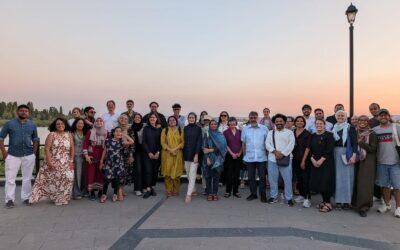
The second Critical Muslim Studies Summer Programme on “Decolonisations and Emancipations” took place in Ankara, Türkiye, from July 17 to July 22. The Summer Programme was a critically rigorous, challenging and ultimately exhilarating experience. Over six days, there were 16 faculty-led sessions and four sessions built around student presentations and discussions.
After the War on Terror
Image credit: Pixabay (Free to use)Twenty-five years after 11 September 2001, the Global War on Terror (GWOT) appears, at first sight, to belong to another political moment. The occupations of Afghanistan and Iraq no longer organise Western political discourse in...