
Islamophobia as a Remedy to the Panic of the Ruling Classes and the State
*This blog post is based on the a talk given at the 1st International Critical Muslim Studies Conference in September 2022.

by Houria Bouteldja
Blog 70
17 February 2023
Decoloniality | Islamophobia | State Racism
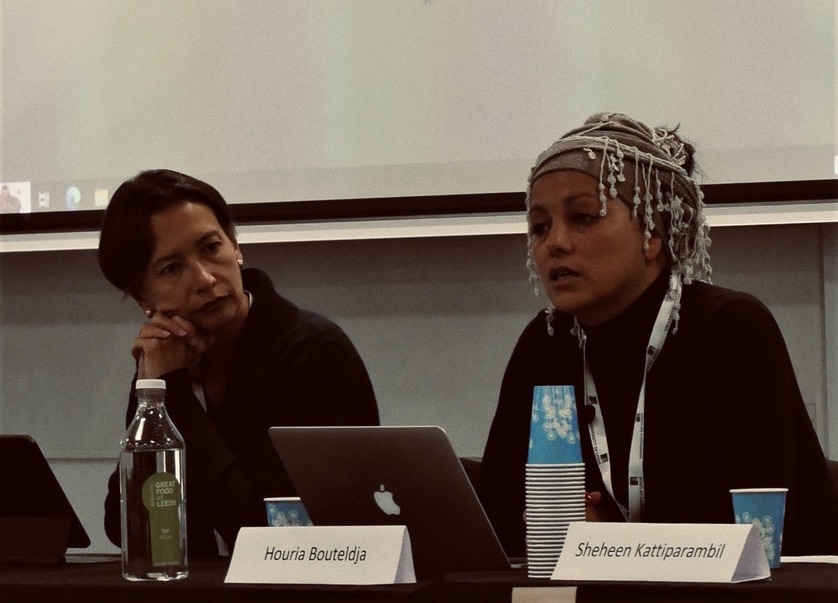
I would like to thank the ReOrient project for this invitation, which I will try to honour as much as possible through this intervention as a French decolonial activist, and not simply as an academic. The analysis I propose here on the uses of Islamophobia concerns only France (even if, in certain aspects, it may overlap with situations on the scale of all Western states). This analysis also assesses a fairly recent period, in which we have seen the emergence of two major political phenomena in France: political anti-racism, of which I am a part, and the Yellow Vest movement. If I highlight these two movements, it is because the first represents a social force under construction (that of non-white populations), and the second represents the awakening of the white proletariat (outside of organization in unions or political parties). Because I am convinced that we must concentrate our efforts on an alliance of these popular strata, it is important to stress in the following lines their importance in the recomposition of the French left, which almost succeeded up to the second round of presidential elections in a country where the far right thrives on the verge of power.
Given the unleashing of liberal forces on a global scale, in Europe and in France, and the recolonization of the world in a competitive context which threatens Western hegemony while amplifying its imperialist aggression;
Given the absence of utopian alternatives on these different scales, despite the rise of popular protests in the four corners of the world;
Given a world health crisis, whose economic effects have been devastating, and whose bill has mounted to high cost;
Given the insurrection of the Yellow Vests, which has targeted the State and its police force, with a tendency towards leftism which has made authorities tremble;
Given the presidential campaign which miraculously was played out on the left and not on the far right as expected;
Given the evolution of the F.I., the party of Jean-Luc Mélenchon, towards radicalization in its leftism and towards a dalliance with the decolonial movement, shown in moments such as:
- Support for the Gilets Jaunes and for the railway workers’ strikes,
- Support for victims of police violence and their families, including participation in the march against Islamophobia on 10 November 2019, as well as Mélenchon’s statement on the creolization of France breaking, timidly but significantly, with universalist and national-republican traditions of which he is one of the proponents;
Given the anti-racist wave that swept through the great liberal democracies following the death of George Floyd, targeting both their police and their colonial slave symbols;
Given the terrifying threat which a convergence of those interpellated as “rednecks” and “barbarians” can pose to power;
Given the potential for what is discursively constituted as diffuse or organized “jihadist terrorism”, which weighs heavily on Western societies and on France in particular;
The puzzle to be solved, for Macron and the ultra-liberal party he represents, is as follows: How can one keep power and methodically pursue a questioning of the historical compromise between Capital and Labour, to the benefit of the former, in a climate where social anger is exacerbating, primarily aimed at the government’s liberal policies and the institutions of the state?
This reveals what he fears most: the erosion of the racial pact. As long as the pressures of liberal forces unravel the social compact, the more the rulers will rely on the strength of the racial pact as a means of continuing to bind the fate of the white working world to the bourgeois state. And when this very racial pact withers (through convergence of the natives, rising social movement against the police, and deepening understanding within the left of the Islamophobic phenomenon and structural racism), the authorities panic and have only one choice: to reinforce the racial pact. This is one of the cardinal functions of the notion of secularism, a meaning which has been filled according to the ideological needs of the colonial counter-revolution. It is effectively a process of replacing the principle of “justice”, a major demand of any social movement, with that of “secularism”, which is anything but innocent. This is one of the most significant ideological deceptions of the ruling classes, carried forth to re-weave solidarities between white people and the many interests of the state, at the expense of a social and political bloc opposed to the ruling bloc.
But resistance exists. It is enough to look at dissolved Muslim organizations (CCIF, BarakaCity) to understand that it is not the danger they are fantasized to represent but their autonomy and independence from institutions and their lack of allegiance to power which poses a problem.
Given the weaknesses in the self-organization of non-white populations during this period, the role of the FI and Mélenchon is crucial. The latter is the point of junction between white liberal forces and anti-liberal forces; he is also the point of junction between white republican forces whose project is entirely based on the reproduction of the racial pact, and anti-racist forces. From this point of view, Mélenchon occupies a space which is both strategic and highly sensitive. It is at the FI that all such perpendicular winds meet. This is why the terrible assassination of Samuel Paty became an opportunity for the extreme right and the government to make Mélenchon, and his party, pay a price. It was necessary to make him regret his participation in the march against Islamophobia of November 10, 2019 and thus his decolonial turn. In other words, it was necessary to make him give up on undoing the knot of race, the knot of the alliance between the state and big capital, the knot of the alliance between the white proletariat and the Western bourgeoisies against the peoples of the South or their own domestic South. In short, this turn had to be reintegrated into the fold of “national identity” at all costs. But this did not happen.
In the face of the Mélenchon hypothesis – who narrowly missed the second round of the presidential elections – far from outlining the contours of a recomposition on the basis of citizen solidarity and moderate anti-racism, the terrorist threat serves as an instrument of adjustment on the national-republican line to reinstate the racist consensus at the expense of class solidarity. It is a guarantee that the white political forces of the left will fall back on their historical and structural chauvinism, guided by their (immediate) racial self-interest. This is what the calls for national unity, which the F.I. has resisted by breaking with the deadly logics of the racial pact, are all about.
The left, reinvented by political anti-racism and the Yellow Vests, stood firm.
They broke with the Islamophobic consensus. After the murder of Samuel Paty, despite the violence of Islamophobic propaganda, they not only maintained a consistently anti-racist stance, but never regretted participating in the November 2019 march against Islamophobia. Moreover, in their program, they chose to include a repeal of the “separatism” law.
They broke with the identity consensus by introducing the idea of “creolization” in society. While this concept is debatable, in that it partly euphemizes issues of race, it has the merit of proposing an anti-racist alternative to the theory of the “great replacement”.
They broke with the security consensus, first by refusing to join the police demonstration in front of the National Assembly, which the ecologists and the Communist Party attended.
They broke with the repressive policy against migrants by proposing to naturalise undocumented migrants.
They broke with the omnipotence of Europe by declaring that Mélenchon wanted to question the European treaties, and to extract public debt from the control of the financial markets.
They broke, partially, with the imperialist consensus by promising to deploy an “alter-globalist diplomacy” and by advocating an exit from NATO in order to de-Westernize France’s international position.
The break with the neo-republican consensus is not a revolutionary break. It is not a decolonial rupture, as one would dream. But this rupture, however reformist it may be, is a clear break with the racist and liberal unleashing of the most reactionary forces in the country. What I would like to emphasize here is that this force, on the verge of power, would never have been able to see the light of day without the fierce resistance of Muslims and the determined fight against Islamophobia. And when one knows the French left and its deep chauvinism, its Eurocentrism, and its Islamophobia camouflaged in a progressive mask, one understands that this is a real miracle. The fight against Islamophobia on a national or international level remains, however, a priority in the agenda of the struggle.
Author’s bio
Houria Bouteldja is a founding member of le Parti des Indigènes de la république, decolonial political member based in France. She wrote numerous theoretical strategical articles on decolonial feminism, racism, autonomy and political alliances as well as articles on Zionism and state philosemitism. She is the author with Sadri Khiari of “Nous sommes les indigènes de la république” (Editions Amsterdam) and “Whites, Jews and Us, towards a politics of revolutionary love”(Semiotext(e)). She recently resigned from the party but she is still a decolonial activist.

Related Blogs

Reflections on Islam, Muslimness and Decolonisation – III
*Yasin Aktay’s four-part series is a contribution to Critical Muslim Studies that critically engages with S. Sayyid’s Recalling the Caliphate as a means of reflecting on the contemporary manifestations of the Muslim Question.Image credit: photographs by Johanna Loock,...

Reflections on Islam, Muslimness and Decolonisation – IV
*Yasin Aktay’s four-part series is a contribution to Critical Muslim Studies that critically engages with S. Sayyid’s Recalling the Caliphate as a means of reflecting on the contemporary manifestations of the Muslim Question.Image credit: photographs by Johanna Loock,...

India’s Dominance is Ruining Cricket Internationally
*A version of this blog was previously published under the same title in the Sunday Times.Image credit: Cricket ball on field, free to use from pexels: https://www.pexels.com/photo/red-cricket-ball-on-lush-green-grass-field-34563722/. World cricket is in crisis...