
*Yasin Aktay’s four-part series is a contribution to Critical Muslim Studies that critically engages with S. Sayyid’s Recalling the Caliphate as a means of reflecting on the contemporary manifestations of the Muslim Question.

By Yasin Aktay
Blog 138
26 June 2026
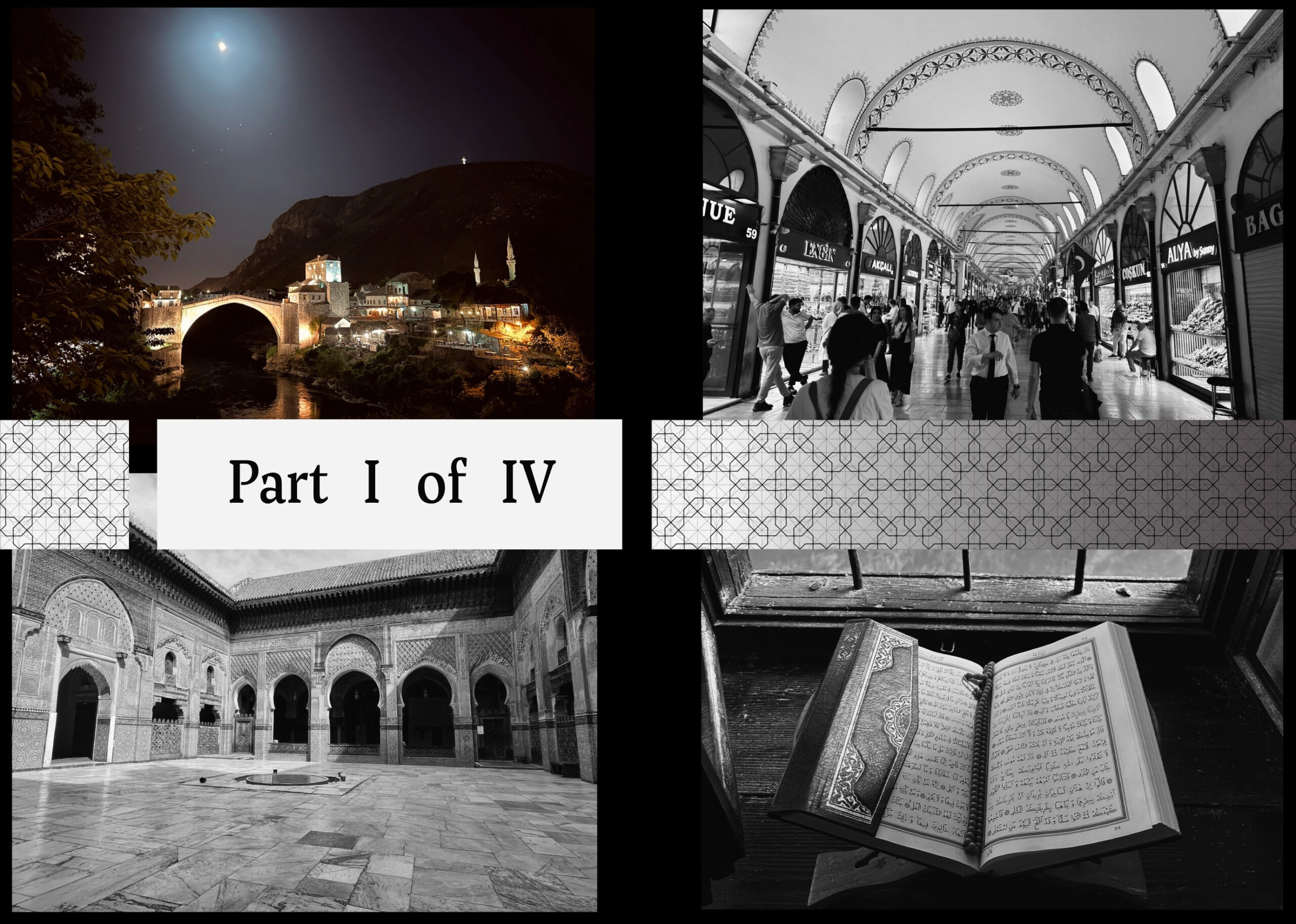
Image credit: photographs by Johanna Loock, design by Mona Makinejad
Introduction
Recalling the Caliphate by Salman Sayyid deserves to be regarded as one of the most significant works written in recent years on Islamism, decolonization, Western-centrism, and Muslim subjectivity. For Sayyid does not merely discuss the idea of the caliphate or the political trajectory of Islamism in this book; rather he seeks to understand, at a much deeper level, the ways in which the modern world order has rendered Muslims ahistorical and nameless, and yet how Muslims continue, despite everything, to exist as a visible global subject.
For this reason, the questions discussed throughout the book are not ordinary political questions such as “Will the caliphate return?”, “Was Islamism successful?”, or “Has political Islam collapsed?” The real question that concerns Sayyid is this: what does it mean to be Muslim within the contemporary Western-centered global order? And more importantly, how can Muslims once again become political subjects through their own names, their own languages, and their own historical memory?
One of the book’s greatest strengths lies precisely in the fact that it approaches this question not merely at the level of political theory, but together with discussions of language, hermeneutics, secularization, epistemology, culture, and identity. According to Sayyid, the modern colonial order did not merely occupy lands; it also occupied names, concepts, and entire worlds of meaning. Muslims lost not only political power, but also, to a large extent, the language through which they could narrate their own defeat.
This is why the question of “names” occupies such a central place in the book. As Sayyid suggests, naming is not simply the act of identifying objects; it is the act of constructing a world. While the modern Western-centered order presented its own historical experience as the universal history of humanity, non-Western societies were coded as ahistorical, irrational, and incomplete. Muslims were therefore not merely defeated; they were also deprived of the ability to narrate their own story.
Sayyid’s striking observation that “people become ahistorical not because they lack a past, but because they cannot narrate themselves into the future” acquires its full significance precisely here. For the issue is not nostalgia for the past, but the possibility of subjectivity in the future. The caliphate, therefore, is not for Sayyid a nostalgic longing for an empire. Rather, it is an attempt to rethink the lost political unity and historical consciousness of a fragmented Muslim body.
Another major issue addressed throughout the book concerns the nature of Islamism itself. Sayyid rejects the reduction of Islamism to a merely reactive ideology born in response to Western colonialism. In his view, Islamism represents not only the political demand for Muslim independence, but also an attempt to restore Islam as the central source of meaning within social order. Islamism, therefore, becomes an effort to produce an alternative vision of the world against the naming regime imposed by modernity itself.
At this point, one of Sayyid’s most powerful interventions emerges in his critique of the West’s claim to universality. He demonstrates how concepts such as liberalism, secularism, democracy, and modernity, despite originating from highly particular Western historical experiences, are nevertheless presented as universal forms of truth. His critiques of secularization are especially striking, since he argues that secularization is not merely a neutral historical process, but one of the principal ideological instruments through which the West presents itself as humanity’s final form.
Here the decolonial dimension of the book becomes more visible. Sayyid’s concern is not limited to criticizing Orientalism. Going beyond the critique of Orientalism, he investigates how Muslim subjectivity can once again speak and exist within the contemporary world. This is why the book repeatedly returns to questions of language, naming, representation, and epistemology. References to Martin Heidegger’s famous statement that “language is the house of Being” become meaningful within this framework. The alienation of Muslims from their own languages, concepts, and memories is treated as one of the deepest forms of colonization itself.
Another issue occupying an important place in the book is the centrality of the Qur’an in the construction of Muslim subjectivity. What sustains Muslim existence is not merely political organization, but the living relationship established with the Qur’an itself. Sayyid’s hermeneutical discussions become especially important at this point. Rather than producing fragmentation within the ummah, the plurality of Qur’anic readings creates a multiplicity of meaning that binds different experiences together. This is why one of the book’s most powerful metaphors is the following: “The Qur’an is the needle, and our readings are the threads that stitch the ummah together.”
Ultimately, Recalling the Caliphate becomes far more than a book about the caliphate. It turns into a comprehensive inquiry into Muslim existence against the epistemological structure of the modern world order. The crisis of Muslims today is explained not merely through political failures, but more profoundly through the loss of names, languages, histories, and claims to truth. Accordingly, the reconstruction of Muslim subjectivity is understood not simply as the pursuit of political power, but as a struggle over meaning, language, and memory itself.
To Those Who Whistle While Passing Through the Graveyard
Discourses proclaiming the end of Islamism often resemble the whistling of someone passing through a graveyard, trying to cope with their own fear. This is especially true for those who openly display Islamophobic attitudes. It is a form of self-consolation, a way of reassuring oneself that there is nothing to fear. Yet despite this reassurance, Islam and Muslims continue to remain objects of fear and hatred.
What is striking, however, is that even among those who have had some vague or partial experience with Islamism, similar tones of consolation and relief emerge in confessional narratives about its alleged demise. This is particularly visible among those who want to associate this “end” with failure. After all, once a movement has already been declared bankrupt, no one can seriously question the historical responsibilities of those who participated in it.
But we have entered the matter too abruptly. Let us step back for a moment. In a recent series of essays, I had argued that the real question regarding those who describe the end of political Islam as a failure is this: what exactly did they expect Islamism to succeed in achieving? Indeed, by what standards of fairness or justice could one attribute “success” or “failure” to Muslims who today live under occupation across the world, who are subjected to coups, oppression, and every conceivable form of violence in their own countries, who remain both the nightmare of global hegemonic powers and at the same time the perpetual victims produced by that very fear?
Of course, discourses about the “end” or “continuation” of Islamism are deeply tied to individual perceptions and emotions. The basic principles of symbolic interactionism operate here in their clearest form. First, our perceptions regarding concepts, institutions, individuals, or ideas are shaped by our experiences with them. Second, as our experiences change, our perceptions also continue to change.
A phenomenon, concept, or movement such as Islamism inevitably exists through countless lived experiences and therefore generates highly diverse perceptions. In one sense, this might suggest that Islamism has no objective existence independent of this totality of experiences and perceptions.
And yet Islam and Islamism undeniably possess a concrete historical significance in today’s world, and individual experiences cannot be completely detached from that significance. People may interpret and feel this historical reality differently through their own personal experiences, but they cannot remain entirely disconnected from the role Islam currently plays in the world.
Without understanding what Islam means in today’s global order, conclusions about Islamism remain suspended in abstraction. Individually, every Muslim may continue practicing Islam and living as a Muslim while possessing a personally satisfying answer to the question of what Islam means for them. However, even in its most depoliticized form, Muslim existence today still carries within it the potential for conflict with the role assigned to Muslims by the prevailing global order.
Not every Muslim may feel this tension with equal intensity, but in a world that has become so interconnected and globalized, failing to feel it at all increasingly becomes the exception. Moreover, even the mere existence of those who do not consciously feel this tension is itself perceived by the existing world order as carrying the latent potential of that same conflict.
In fact, within a world order that for the last century has effectively been built upon the project of eliminating Islam from public existence, the continued survival of Islam, and especially its survival as such a visible, active, and historically effective force, is itself a scandal from the perspective of the epistemological and hegemonic claims of that order. For a century ago, the world order that was being established had no real place for Islam. Muslims could only be tolerated insofar as they abandoned Islam’s political claims and social manifestations, in other words, insofar as they ceased to exist meaningfully as Muslims at all.
The condition of Muslims being deprived of political agency was not the result of some natural sociological decline, degeneration, laziness, or voluntary preference on their part. It was the consequence of severe colonial interventions imposed upon them. And those who carried out that intervention have remained committed to preserving its outcomes to this day.
From the perspective of the forces that engineered this intervention, every contemporary manifestation of Islam, every instance in which Muslims continue to carry their Islamic identity with pride in the world, represents a failure of their project. Yet this cannot simply be reduced to “failure” in a straightforward sense. There is also a deeper psychological dimension involved, something akin to the fear of ghosts or spectres. The fear provoked by the rumor, or even the imagined reappearance, of someone who was presumed dead or killed. Much of Islamophobia is connected to precisely this psychological condition.
The continued existence of Islam in any form, even without possessing political success, already constitutes a scandal for a Eurocentric hegemonic project. A successful Islamic political model would be an even greater scandal. That is why the only relatively tolerable image of Islam, from such a perspective, is an Islam represented by weak-willed, fatalistic Muslims who conform to orientalist fantasies and produce no disappointment for them.
In fact, all these reflections were intended merely as an introduction to discussing Salman Sayyid’s book Recalling the Caliphate.
Author’s bio
Yasin Aktay is a Professor of Sociology in the Faculty of Humanities and Social Sciences at Ankara Yıldırım Beyazıt University. He is the editor-in-Chief of Tezkire Journal. Additionally, Aktay is a former Deputy Chairman of the AK Party and a former Member of Parliament.

Related Blogs

Of Those who Don’t get to be Cockroaches
Image credit: Photo taken by Shaheen Abdulla, July 2026. Photo used with permission. Since 2014, India has been governed by Hindutva ethnonationalism, intensifying decades of structural marginalization of Muslims through state-sanctioned impunity and systematic...

The Rebel Team: Football and Algeria’s Liberation
Image credit: Wikimedia: https://commons.wikimedia.org/wiki/File:Jubilee_FLN_soccer_team_1974.jpg (Mustapha Zitouni standing, 5th from the right; Rachid Mekhloufi sitting, 2nd from the right) History reminds us that, like literature and art, football can embody a...
Reflections on Islam, Muslimness and Decolonisation – I
*Yasin Aktay’s four-part series is a contribution to Critical Muslim Studies that critically engages with S. Sayyid’s Recalling the Caliphate as a means of reflecting on the contemporary manifestations of the Muslim Question.Image credit: photographs by Johanna Loock,...