
*Yasin Aktay’s four-part series is a contribution to Critical Muslim Studies that critically engages with S. Sayyid’s Recalling the Caliphate as a means of reflecting on the contemporary manifestations of the Muslim Question.

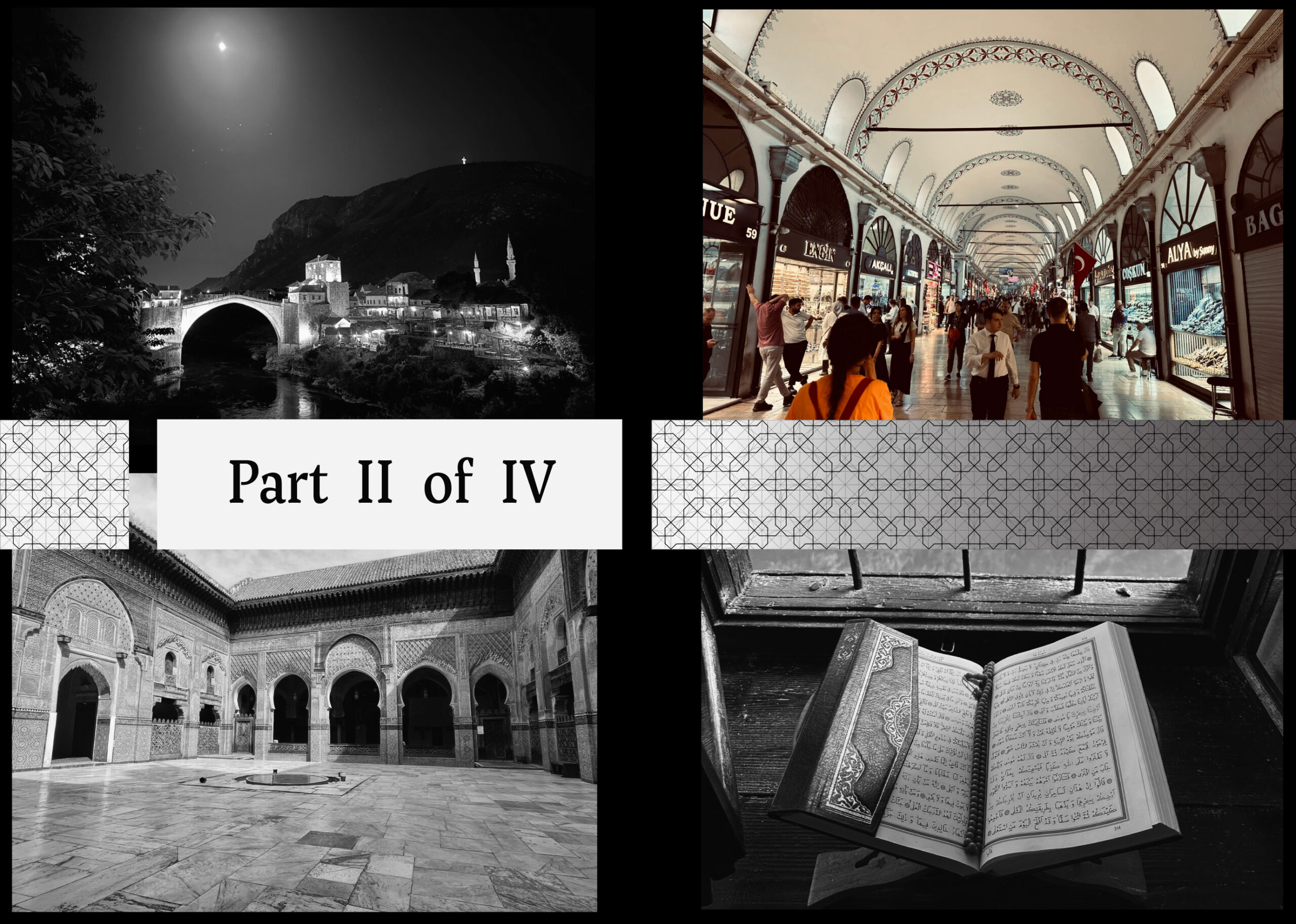
Image credit: photographs by Johanna Loock, design by Mona Makinejad
“Even If a Verse Descended from Heaven”
“From the perspective of the still-prevailing Western-centric hegemonic project, the continued existence of Islam in one form or another, regardless of whether it possesses any political success, is itself a failure, a scandal.”
Salman Sayyid makes this observation in his book Recalling the Caliphate. We already knew Sayyid from another work, A Fundamental Fear. When people ask whether any genuine manifesto-like texts have recently been written on behalf of Islamism, Sayyid’s writings are among the rare examples that come to mind. Admittedly, they are not manifestos in the classical sense of texts written in the 1950s, 60s, or 70s aimed primarily at awakening Muslims themselves, works such as Milestones by Sayyid Qutb, Four Basic Quranic Terms by Abul A’la Maududi, What Did the World Lose by the Decline of Muslims? by Abul Hasan Ali Nadwi, The Jahiliyyah of the Twentieth Century by Muhammad Qutb, or Essays on Thinking as a Muslim by Rasim Özdenören.
Sayyid is instead an intellectual shaped within the very cultural and intellectual environment in which Western hegemony expresses itself in its strongest form. He completed his doctorate under the famous post-Marxist theorist Ernesto Laclau, and today he follows the dominant intellectual debates of the West at the highest and most contemporary level. From within that very intellectual universe, he observes how Islam is perceived and responds to it from a Muslim standpoint.
He is a powerful critic of Orientalism, but he does not remain trapped within critique alone. Rather, he seeks to discover, articulate, and even embody what a Muslim identity means in today’s world. Through all his writings, he tries to understand and interpret the struggles carried out against Islam within Western contexts, while simultaneously formulating the political stance a Muslim might adopt in response.
For Sayyid, the caliphate has nothing to do with what he calls the “warlords of the Euphrates”, that is, داعش (DAESH/ISIS), nor with the caricature into which it has been transformed through “certain political ambitions and orchestrated intrigues” in places such as Jakarta, Abuja, Islamabad, and Khartoum. Rather, he invokes the caliphate in order to understand, or remind us of, the political and existential void created by the destruction of the Muslim body politic roughly a century ago, a void felt both by Muslims around the world and by the hegemonic world order itself.
In truth, Muslims today are not merely fighting their own struggles, nor are they visible simply because they happen to be struggling. Islam and Muslims remain constantly on the global agenda because they keep alive the possibility that the West, despite its universalist claims, may in fact be merely one local and historically contingent culture among many others. In this sense, Islam unsettles the West by preserving the possibility of Western “ordinariness,” while simultaneously reminding the world of other cultures condemned to disappearance under Western hegemony. This is why Islamophobia does not affect Muslims alone. As various statements by Donald Trump have openly demonstrated, it metaphorically links together Mexicans, Black people, and Chinese people within the same chain of civilizational anxiety.
Contrary to popular assumptions, Islam does not disturb the Western-centered worldview merely because of violence or terrorist acts rejected even by the overwhelming majority of Muslims. Rather, it unsettles that worldview at a philosophical level by challenging its deepest assumptions. Islamophobia, therefore, is not simply the negative representation of Islam or Muslims; it is an attempt to discipline Muslims according to a Western horizon and to deny Muslim autonomy altogether.
It is at precisely this point that we must ask why Muslims have become the metaphor for everything Eurocentrism seeks to erase. At the same time, Islamism manifests itself differently across the Muslim world, and from this diversity arises the relativist accusation often directed at Muslims: the claim that there is no central truth, no unified validity behind these fragmented experiences.
So which of these experiences represents the “true Islam”? Which experience should be taken as authoritative, or should any be taken as such at all? After all, such diversity might itself be interpreted as evidence that no authentic or universally valid experience exists.
For Salman Sayyid, however, the answer to these questions is not difficult. Who exactly are those who demand perfection from Muslims? Why do they demand it, and according to what philosophy of humanity? The expectation of perfection is itself hostile to Muslim political existence. Politics, by definition, is a human activity. What grants it legitimacy is not that verses descend from heaven upon it, nor that its followers are angels or pure beings like angels. Indeed, even if verses descended from heaven and miracles were displayed, there would still be no guarantee that people would recognize and believe in their authenticity. Moreover, the standards of purity, innocence, or saintliness by which Muslims are judged cannot be determined by their adversaries.
For Sayyid, one of the most difficult aspects of Islamism concerns precisely its relationship to power. He refers especially to the widespread view, even among some Muslims, that wherever Islamists have gained power, they have failed to resist its corrupting effects. According to the implication of this argument, Islamists ought to remain permanent critics of power rather than its holders.
We ourselves witnessed a similar discourse in Turkey, when the funeral prayer (sala) of Islamism was announced on the grounds that Islamists had finally come to power.
Yet whether Muslims attain political power or not has never determined the lifespan of Islamism. Islamism has passed through countless states: opposition, persecution, exile, governance, internal conflict, liminality, and many others. Islamists never promised that they would remain forever outside power. In fact, every form of political critique contains, at its core, a demand for power.
There is certainly no reason to sanctify power. Yet the feeling of helplessness regarding the possibility of attaining power often expresses itself as a radical and cynical hostility toward power itself, a typical psychological condition to which Muslims, and even Islamists, may sometimes fall prey.
Let us continue reflecting with the reminders offered by Sayyid.
We Must Remember / Names and Our Reality
Naming is not simply the act of assigning neutral signs or codes to objects; it is the beginning of constructing an entire world. In this sense, acts of naming are never neutral. They cannot be. In fact, even language itself, in its most basic form, is never neutral. The conceptual binaries embedded at the deepest level of language are subject to hierarchical structures, and these structures in turn reproduce themselves within the realm of reality. That is why the perception of the world and reality differs between those who speak German, English, French, Arabic, Kurdish, or Turkish. This is not merely a difference that can be casually dismissed as “cultural variation.” Although language is indeed one of the most fundamental components of culture, it is also, in itself, the dwelling place of being, and not every dwelling provides the same comfort to its inhabitants in every respect.
Starting from this fundamental insight, which Salman Sayyid reminds us of in his book Recalling the Caliphate, a major part of the operation carried out in the post-Caliphate world, one increasingly subjected to de-Islamization, consisted precisely in alienating Muslims from their own language. Muslims were not even allowed to narrate or name the history of their own defeat.
Muslims, whose political body had been targeted and buried in history, could not even recite a prayer over their own funeral, because the victors narrated this process to them in whatever language and terms they desired. In the historical narrative imposed through their own acts of naming, Arabs were portrayed as traitors to the Turks, while Turks were portrayed as colonizers of the Arabs.
Of course, that was not the reality of the past. Yet once history became enclosed within a Western-centered historical consciousness, Muslims, with all their colors and diversity, were rendered ahistorical.
It is precisely at this point that Sayyid states: “People become ahistorical not because they lack a past, but because they are unable to narrate themselves into the future.” But then the question emerges: who will narrate oneself into the future? For that, one requires a political subject. The very subject that Sayyid seeks to name and theorize is precisely this: the Muslim.
The fact that the West refers only to its own experiences as “history,” while dismissing the experiences of other peoples as insignificant and repetitive events, is not simply a refusal to acknowledge other political subjects, it is the result of a desire to erase them altogether. Peoples without history are either nameless, meaning they are not regarded as real peoples at all, or they have been named by others. Great defeats can indeed erase even a sufficiently powerful and deeply rooted name. After the destruction of Nineveh in 614 BCE, the Assyrians gradually disappeared from collective memory following their great defeat. Even if Assyrians continued to exist biologically, once their name disappeared, they themselves effectively disappeared as well.
In fact, what took place after 1918, in terms of its ultimate objective, amounted to nothing less than an attempt to erase the very name of Islam. The final Crusade conducted against Islam throughout history had advanced toward its ultimate goal, and the war ended only because, from their perspective, it had produced a feeling of absolute victory. The aim was to neutralize Islam together with its naming function itself. All the policies implemented across the Islamic world after the war were directed toward achieving this purpose. For the Western hegemony intoxicated by the illusion of Enlightenment, the “Islamic problem” appeared to have largely entered the path of resolution.
Precisely for this reason, the continued circulation of the word “Islam” today, and the fact that Muslims remain present in the world in one way or another, has become a scandal from the perspective of the Western hegemony that had declared its absolute victory a century ago. Sayyid attempts to reveal the nature of this scandal by descending to the deepest foundations of the Western-centered worldview.
Islam is the knot that ties together the many threads composing the ummah in all its richly woven diversity. The name “Islam” not only gathers Muslims together and binds them to one another; its meaning simultaneously determines who Muslims have been in the past, who they are in the present, and what Muslims ought to become.
At the same time, it would be incorrect to claim that Islamism, the inherently political expression of this reality, is simply a substitute for Islam or for the name “Muslim.” Yet it is equally misguided to argue that Islamism represents a distortion of Islam. Such claims merely reflect estrangement from this historical reading and amount to an unproductive exercise.
Islamism is, more properly, a cluster of political projects seeking to place Islam at the center of social order. In particular, against an order formed through the naming practices of a Western-centered world, Islam constitutes the only voice, the only language, capable of displacing that centrality. Islamists have successfully and strikingly carried a Muslim subjectivity into the contemporary world. From the perspective of a world divided between the West and the non-West, the act of Muslims carrying the name of Islam into the world has a destabilizing effect upon the colonial order. In this sense, Islam, with all the forms, postures, and modes of existence signified by its name, declares a genuine alternative defined by its own name.
In his attempt to explore the possibilities of constructing a Muslim subjectivity, Sayyid’s decision to begin with a chapter titled “Names” is therefore both highly meaningful and entirely appropriate. For our placement and rootedness in the world begins with names. Ultimately, as the Qur’an states in Surah Yusuf: “What you worship apart from Him are nothing but names you yourselves have named”, that is, names to which people have attributed an imagined reality even though they possess no real existence in themselves (12:40).
Meanwhile, are there not those who compare what Muslims do, once they have achieved some degree of progress in their struggle for place and belonging in this world, to Kemalism itself? In Turkey, this line of reasoning has become yet another source of anxiety and inferiority directed against Islamism. Sayyid also has a few words to say on this matter:
“To claim that Islamists are the same as Kemalists merely because they employ similar concepts, rhetoric, or practices, as part of the operations carried out by the Western-centered world within the Islamic world, is not only an empirical exaggeration, but also a problem of inadequate conceptual theorization.”
This inadequacy is deeply connected to missing the essence of the matter itself, to failing to understand the importance of names. Why and how this happens requires not even prolonged reflection, but simply remembrance.
Language as the Most Dangerous Possession Given to Humanity
To begin an attempt at constructing a Muslim subjectivity through the question of “names” is both highly meaningful and deeply appropriate. Martin Heidegger once said that language is the house of Being. Being discloses itself through language, is understood by means of language, and there is no reality outside language. Yet this does not mean that language can simply be treated as an instrument fully under our control.
It is precisely this quality of language that gives it the characteristic that Heidegger, citing a line from Friedrich Hölderlin, described as “the most dangerous possession given to humanity.” For although language is something given to human beings, it is not immune from human intervention, instrumentalization, and manipulation.
Beyond the language that is given, human beings also possess the capacity to name. Through acts of naming, they establish hierarchies in the world, hierarchies in which servants become enslaved to one another, or in which people reduce themselves to servitude before others. Language thereby begins to function as a distortion of reality itself, erecting a thick ideological wall around the house of human existence. What emerges is a reality, or an illusion of reality, constructed by “a word that grows immense when it leaves people’s mouths,” as expressed in the Qur’an (Surah al-Kahf, verse 5).
Thus language, as the most dangerous possession granted to humanity, fulfills its function in its most dangerous form. In accordance with its dual nature, it establishes unjust hierarchies among people; it names, defines, conceptualizes, and through all these processes constructs a world in which judgments are made regarding who is superior, who is right, and whose claims are considered valid. As language moves away from the primordial naming granted by God, it also distances human perceptions of reality from their authentic form and subjects them to distortion.
The struggle of Muslims to secure a place and a homeland in this world therefore depends, to some extent, on their ability to recover that authentic language, to rediscover the simplicity capable of showing the world as it truly is. This is an operation of critical purification: an attempt to restore a world distorted by language back to its original condition, so that reality may once again become visible as it actually is.
By this, however, I do not mean the frequently repeated slogan that “we must speak our own language.” One should appreciate that such a phrase is far from simple and can even become problematic in certain contexts. Ultimately, those who possess a message for the world do not speak in a language that only they themselves can understand. On the contrary, they must find a way to articulate their message in the language of their audience. Otherwise, communication is impossible even in practical terms. That is why messengers were sent to every people in the language of that people, indeed, from among themselves, familiar with their language, culture, humor, anxieties, sorrows, and joys.
This does not mean, however, that one must accept every concern of people as a legitimate concern. Some of humanity’s anxieties may themselves have become their very hell rather than their cure. Consider many of the obsessions of modern humanity today: these anxieties have turned into narcotics that numb people and dangerous habits that drive them toward disaster. Yet even in order to say this, one must first understand people properly. That is why we sometimes need to acknowledge that the expression “speaking through our own concepts” can be exaggerated. Anyone who truly has something meaningful to say must speak the language of the audience addressed; it serves neither wisdom nor effectiveness to indulge in intellectual caprice while waiting for one’s audience to learn one’s own language first.
With all these sensitivities in mind, constructing a Muslim subjectivity requires a strong deconstructive and critical perspective toward both the language we ourselves speak and the language spoken against us. In Recalling the Caliphate, Salman Sayyid begins precisely with “names” in his search for such a subjectivity. Under headings such as Liberalism, Secularism, Relativism, Democracy, Futurism, Diaspora, Caliphate, Order, Hermeneutics, and Ethics, he undertakes a mode of analysis he calls “Critical Muslim Studies.”
For example, under the heading of liberalism, he examines the strategies through which an extremely particular and limited Western philosophy and lifestyle are elevated to the status of scientific universality and imposed upon the entire world.
Liberalism, symbolized by the Twin Towers of the World Trade Center, constructed almost like a new Tower of Babel in pursuit of a universal linguistic unity that would eliminate all human differences, also proclaimed the “end of history.” In these towers there is no place for politics, because everyone, before a supposedly universalized reason, has already been compelled to adapt to scientific truth and to history itself; everyone now speaks the same language. Yet politics exists precisely where difference exists.
In this context, one more clearly understands what the various “dialogue” initiatives carried out in the name of universal ideals were actually concealing, namely, the forgetting of the entire imperialist and colonial past and present of the West. Sayyid develops these critiques through an interview given by former Iranian President Mohammad Khatami to CNN, in which Khatami invoked Alexis de Tocqueville against American politics itself. Sayyid separately analyzes what this comparison means for Muslims and what it means for Americans who were far from pleased by such comparisons. In doing so, he produces an extraordinarily valuable and fascinating exercise in political hermeneutics.
The destruction of the Tower of Babel and the subsequent diversification of human languages also gave rise to our human plurality, and therefore to politics itself. The desire to eliminate these differences has never truly been concealed within Western history. Yet this same desire also reveals the essence of totalitarian attempts aimed at erasing human diversity altogether.
The red cards raised in the West against Islam or against other cultures, in the name of science, civilization, history (Geist), or universality, demonstrate how liberalism, under the banner of freedom, is itself afflicted by a form of despotism. At the same time, Islam’s irreducible and uncontainable presence in the face of these red cards destabilizes Western-centeredness not merely at the level of isolated acts of violence, but at a philosophical level as well.
It is precisely for this reason that the discourse of the “clash of civilizations” represents an attempt to cope with the destabilizing effects produced by the disintegration of this Western-centered worldview.
Author’s bio
Yasin Aktay is a Professor of Sociology in the Faculty of Humanities and Social Sciences at Ankara Yıldırım Beyazıt University. He is the editor-in-Chief of Tezkire Journal. Additionally, Aktay is a former Deputy Chairman of the AK Party and a former Member of Parliament.

Related Blogs

Of Those who Don’t get to be Cockroaches
Image credit: Photo taken by Shaheen Abdulla, July 2026. Photo used with permission. Since 2014, India has been governed by Hindutva ethnonationalism, intensifying decades of structural marginalization of Muslims through state-sanctioned impunity and systematic...

The Rebel Team: Football and Algeria’s Liberation
Image credit: Wikimedia: https://commons.wikimedia.org/wiki/File:Jubilee_FLN_soccer_team_1974.jpg (Mustapha Zitouni standing, 5th from the right; Rachid Mekhloufi sitting, 2nd from the right) History reminds us that, like literature and art, football can embody a...
Reflections on Islam, Muslimness and Decolonisation – I
*Yasin Aktay’s four-part series is a contribution to Critical Muslim Studies that critically engages with S. Sayyid’s Recalling the Caliphate as a means of reflecting on the contemporary manifestations of the Muslim Question.Image credit: photographs by Johanna Loock,...