
*Yasin Aktay’s four-part series is a contribution to Critical Muslim Studies that critically engages with S. Sayyid’s Recalling the Caliphate as a means of reflecting on the contemporary manifestations of the Muslim Question.

By Yasin Aktay
Blog 136
26 June 2026
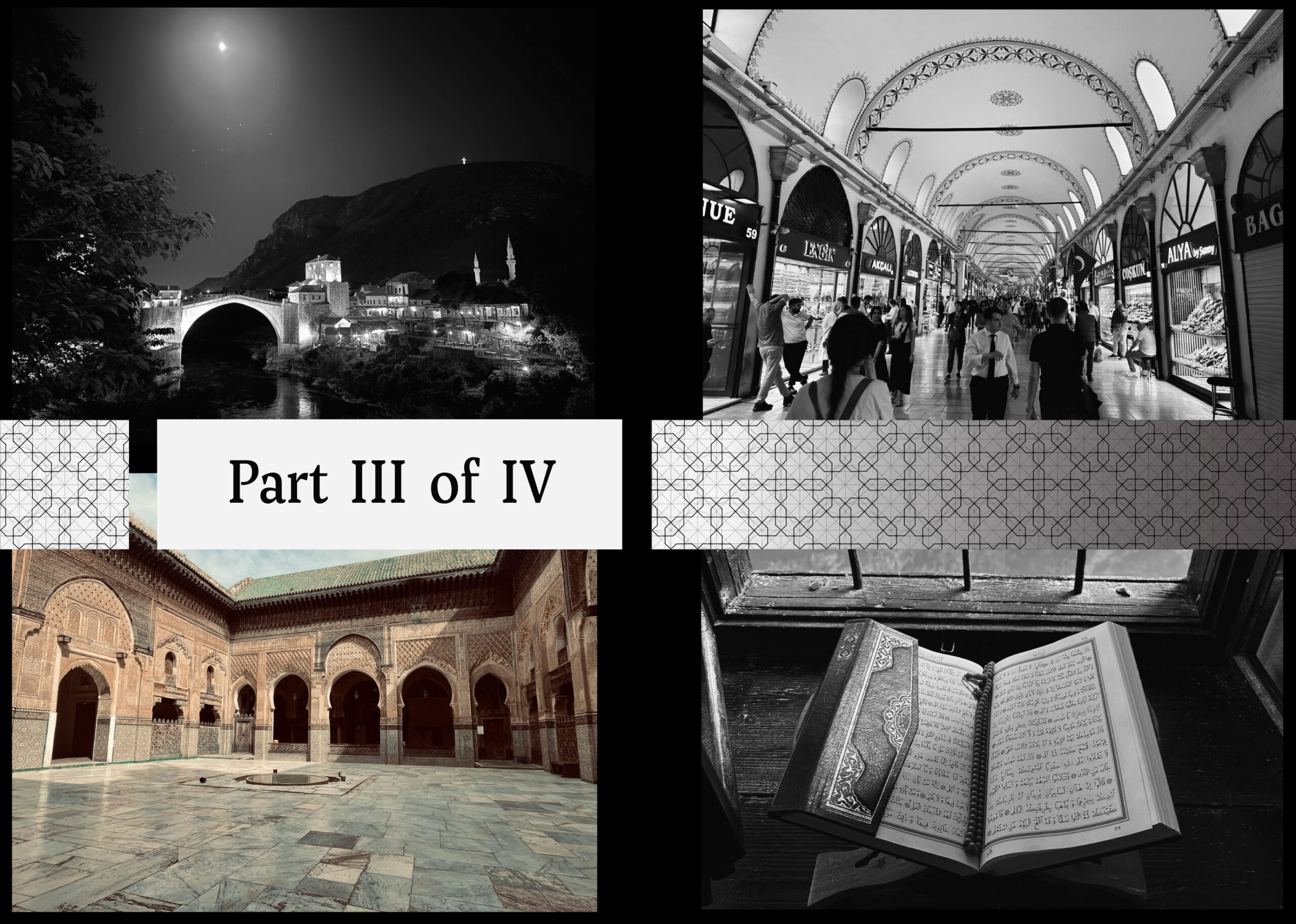
Image credit: photographs by Johanna Loock, design by Mona Makinejad
Jahiliyya
We are at a point where all the wealth and property we have accumulated suddenly lose all meaning, or rather, where they finally reveal their true meaning.
Remember what we were saying only a few months ago about Syrians and refugees who knocked on our doors:
“Are we obligated to take care of them? Why should we bear their burden while our own children are hungry? Because of the Syrians, we can no longer even walk the streets of Aksaray,” and so on.
During the days of corona, how drastically the meaning of those questions, those debates, and that indifference changed. Once the comfort, possessions, and property that we considered exclusively ours, and which had acted as veils over our eyes, were pulled away, truth suddenly appeared in broad daylight.
Many people found Sayyid Qutb’s characterization of modern humanity’s indifference toward God and toward other human beings as “jahiliyya” to be excessively radical. Because of this conceptualization, he was accused of takfirism and of adopting an uncompromisingly exclusionary attitude toward people holding different ideas and beliefs. Yet Qutb was in fact pointing, from precisely the perspective of truth itself to a condition of indifference, negligence, heedlessness, and misguidance into which people can collectively fall from time to time.
By speaking of a condition of jahiliyya into which even Muslims themselves could fall, what he actually intended was not takfir, but rather a warning to Muslims not to trust merely in the fact that they already belong to Islam. In this way, he was showing that turning Islam into an acquired right, or reducing it to an ethnic belonging, was contrary to the spirit of Islam itself. In other words, even if your name is “Muslim,” this does not guarantee your salvation. Being Muslim is a responsibility whose price must be paid every day and every moment through vigilance.
What truly matters is to live in a constant state of awareness, because life itself is a continual test. Human beings possess egos, psychological tendencies, ambitions, greed, arrogance, and complexes that are always ready to seduce them and drag them into heedlessness and deviation.
In fact, what Sayyid Qutb was doing was not entirely different from what Yunus Emre was expressing in his own language:
“Knowledge is to know knowledge, Knowledge is to know yourself. If you do not know yourself, What is the value of all your learning? Do not say ‘I have read and learned,’ Do not say ‘I have worshipped greatly.’ If you do not know the Truth, It is all vain wandering.”
To the extent that a person does not know himself, he swims in different levels of jahiliyya. When one does not know oneself, one also fails to know one’s Lord.
Indeed, all great philosophers, in one way or another, characterize those who remain indifferent to the truth they have discovered as people of forgetfulness, heedlessness, or ignorance. The intellectual line beginning with Friedrich Nietzsche and Martin Heidegger, which accuses the entire Western tradition of being submerged in a “logocentric metaphysics,” constitutes one of the dominant currents today within hermeneutic, post-structuralist, and postmodern philosophies in the West. Heidegger argues that the entirety of Western philosophy after Socrates has fallen into complete heedlessness and deviation because it forgot Being and failed to give it its due. Nor does he stop there; he even says that he does not wish to hear another word from people shaped by that philosophical tradition. Yet no one accuses either him or thinkers such as Hans-Georg Gadamer, Jacques Derrida, Richard Rorty, Félix Guattari, Gilles Deleuze, or John D. Caputo, who carried these philosophical currents to even more radical conclusions, of takfirism or fanaticism.
Of course, this is a separate issue and one that could sustain much further discussion. Let us instead return to the jahiliyya that we have now begun to recognize in ourselves. Let us admit that today, nearly all of us have become far more aware of our own indifference regarding our lives, and we have come closer to acknowledging how this indifference plunged us into a condition of jahiliyya.
Of course, as Qutb himself did not intend, not every form of jahiliyya amounts to unbelief. Yet jahiliyya means living in this world without taking the Hereafter into account, living as though one will never die, driven by ambition, greed, hostility, and desire.
Jahiliyya is when those in need knock on your door asking for a share of what you possess, and you look down upon them with contempt and humiliation because you truly believe that what you own belongs solely to you, and because you regard the suffering of others as entirely separate from your own.
Jahiliyya is becoming enslaved to other human beings in order to accumulate even more wealth and property than you could ever spend in your lifetime.
Jahiliyya is bending and bowing before people who are no different from you, mere servants created like you by God, for the sake of a few trivial worldly benefits.
Jahiliyya is arrogantly asserting superiority over people who, like you, are servants created by God, and attempting to enslave or exploit them.
Jahiliyya is forgetting, ignoring, or pretending not to know that the resources of the world created by God are sufficient for all human beings.
Jahiliyya is forgetting that God’s earth, blessings, and possibilities are vast enough, and instead consenting to humiliation, becoming accustomed to degradation, and imagining oneself imprisoned and condemned within a constricted world.
To reformulate Muhammad Qutb’s expression, the jahiliyya of the twentieth and twenty-first centuries consists in boasting about the science and technology one has produced, imagining through that technology that one can almost challenge God Himself, while remaining heedless of the possibility that the very world and technologies one has constructed with one’s own hands may bring about one’s own destruction. It means spending immense wealth to build weapons and military industries capable of killing one’s enemies thousands of times over, while overlooking what a tiny virus might be capable of doing within the world one has arrogantly called “global.”
Jahiliyya is precisely this condition of forgetfulness, forgetting what Almighty God showed to Pharaoh through Moses, to Nimrod through Abraham, and to all humanity through Jesus and Muhammad.
The Universality Claim of Secularism as a Western Narrative
One of the most important characteristics said to define the world described as “postmodern” was the supposed disappearance of the great causes and grand narratives, the meta-narratives, in its terminology, to which people would collectively devote themselves and in whose name they would mobilize. Concepts such as freedom, equality, socialism, the Enlightenment, and justice, which had played enormous roles throughout the nineteenth and twentieth centuries, were expected to lose their power. Humanity would instead remain alone with smaller, more local, fragmented, and multiplied stories.
This was not necessarily an ideal or aspiration of postmodern thinkers; it was presented as a diagnosis. Yet even as a diagnosis, it now appears to have been remarkably premature. For the history of humanity’s creation of new idols does not seem likely to come to an end anytime soon. Meta-narratives are ultimately natural products of humanity’s inclination to construct virtual realities and persuade others to believe in them. As long as human beings exist, the process by which they manufacture their own idols and seek followers for them will not cease.
Indeed, even in the so-called postmodern era, the narrative of “bringing democracy” to underdeveloped regions suffering under dictatorships continued to function effectively as a means through which Western hegemony sustained its own overarching narrative. Was democracy not supposedly “brought” to Afghanistan and Iraq in the name of this grand narrative? No substantial argument was even required to persuade people of this new story. Amid the dust and smoke of the September 11 attacks, the United States and its allies managed to convince people of virtually any narrative under the emotionally legitimizing mode of mourning and outrage.
We must admit that almost no one adequately questioned how the United States and its allies, after supposedly planting democracy in Iraq, managed instead to harvest terrorism there. Subsequently, the so-called “Islamic terrorism” upon which the United States and the broader Western alliance grounded their security narrative repeatedly emerged precisely in those regions to which they had allegedly brought democracy, thereby supplying the justification needed for their continued wars. Of course, one must also recognize that the persuasiveness and legitimacy of such grand narratives are directly linked to the ability to impose accomplished facts through material power itself.
Perhaps one of the most powerful grand narratives sustained through this practical force is the narrative of secularization itself. Secularism is one of the central components through which the West defines itself in today’s world and upon which it bases its claims to universality. As a concept identified almost entirely with the West, secularization simultaneously positions itself as the opposite of Islam.
Accordingly, every step taken toward secularization as a supposedly universal value is implicitly treated as another step toward the absolute victory of Western hegemony, that is, of modernity itself. In The Development of Secularism in Turkey, the famous work by Niyazi Berkes, it is well known that modernization is conceptually equated with Westernization, and Westernization in turn is effectively equated with secularization.
Conversely, every manifestation, symbol, or appearance associated with Islam is portrayed as an objection to secularization’s claim of universality, an awkward exception, even a scandal.
According to the analyses of Salman Sayyid, secularization discourse deploys another subsidiary strategy in order to weaken this resistance: namely, foregrounding movements, tendencies, and ideas emerging from within Islam itself, as well as from other cultures capable of resisting secularization, that appear compatible with secularist assumptions. In this way, although secularism remains fundamentally a Western construct, its claim to universality is reinforced.
Indeed, certain complaints voiced by Muslims themselves regarding the “need” for Muslim secularization often end up supporting these claims. Such discourses universalize secularization to the point where it appears capable of manifesting itself naturally within Islam or Muslim societies themselves.
Yet one of the most visible features of secularization as a powerful narrative of Western hegemony is precisely its claim to universality. This claim is “proven” both by demonstrating that secular tendencies allegedly exist in every culture and society, and by presenting secularization as the final destination of an inevitable evolutionary trajectory toward which all humanity is moving. According to this assumption, even Muslims, who today appear to stand as obstacles before this supposedly inevitable evolutionary path, will eventually become secularized.
The enormous book A Secular Age, published in 2007 by the well-known philosopher Charles Taylor and awarded the Templeton Prize, remains deeply faithful to this narrative. Taylor attempts to show how all cultures and faiths contain within themselves a latent secular reason that eventually emerges. In fact, Taylor may even be considered a devout Catholic intellectual who has devoted his work to the construction of a multicultural and peaceful world. Yet the narrative of the universality of secularization, which he powerfully advances through all his philosophical efforts, ultimately becomes one more example of the grand narratives that postmodernism had once claimed were finished.
Confronting this narrative constitutes an important step in Salman Sayyid’s search, in Recalling the Caliphate, for the construction of a Muslim subjectivity.
Perhaps one way to philosophically destabilize this narrative is by asking a few questions. For example: does the existence of traces of secularization in ancient times truly indicate its universality, or might it instead indicate that it is an exceedingly archaic disposition?
Or again: if tendencies corresponding to secularization can be found in all cultures, does this necessarily prove its universality, or might it instead suggest that secularism itself is an incoherent amalgam incapable of fully encompassing or excluding its supposed opposites? Let us proceed from this point.
Secularization: Humanity’s Most Primitive Ideology
We had previously asked whether the fact that traces of secularization can be found in the earliest periods of human history is really evidence of its universality, or rather evidence of its profoundly archaic character. From our perspective, this was a question whose answer was already implicit within it. As one of the flagship ideologies of Western hegemony, secularization is presented to us in a highly ornamented philosophical form. It is portrayed as a higher stage in humanity’s progress and evolution, and as the final scene toward which all developments in world history are ultimately moving.
Of course, there are those who believe in this story. But the reality of the matter, and the obvious answer to our question, is that all the meanings attributed to secularization actually correspond to some of the most primordial and natural tendencies of humanity. In that sense, perhaps secularization truly is universal, but universal in the same way that unbelief, jahiliyya, or humanity’s tendency to become immersed in worldly desires are universal.
Viewed from this perspective, universality is not in itself a positive value. For evil, no less than goodness, also possesses a universal prevalence and validity. The moment human beings fall into the delusion that they can deceive God, forget the Hereafter, and permanently anchor themselves within worldly existence, secularization has already begun, and its history is by no means new. This tendency, this inclination, this mode of being goes back as far as Cain, who imagined he could deceive God with corrupted offerings from his crops.
To present secularization as a uniquely modern discovery and as a sign of humanity’s attained level of consciousness and knowledge is itself merely a new manifestation of humanity’s most ancient pride and self-deception. Indeed, the fact that this is an illusion is already made abundantly clear by the reality that the claims of secularization are far from being universally realized.
In truth, the story that humanity evolves progressively from religiosity toward secularity appears, in light of both history and present reality, to be an extremely fantastical fiction. Throughout history humanity has continuously experienced movements back and forth between religiosity and secularity, and continues to do so. There has never been a one-way, irreversible movement in this regard. We can observe such fluctuations within the history of a single society, within global historical developments, or even within the life trajectory of an individual. Inclinations toward worldliness, anxieties regarding death and the afterlife, and forms of religiosity do not maintain the same weight continuously within the life of a society, a civilization, or a person.
Indeed, despite all the philosophical praise directed toward secularization today, developments in the opposite direction continue to undermine its claims. From this perspective, rather than witnessing the emergence of the “Secular Age” that is so often proclaimed, we instead see an age increasingly immersed in religiosity. The world is becoming more and more consumed by forms of religious fanaticism.
Across the European continent itself, where the strongest examples of secularism first appeared, right-wing conservative parties continue to gain popularity. This rise simultaneously strengthens the influence of religious identity, even if not always in direct proportion to genuine religiosity. On the other hand, the fact that the creation and security of Israel, whose sole reference point is the Torah, has effectively taken the entire framework of global international politics hostage demonstrates how disconnected the narrative of secularization is from the actual realities of the world.
Today, the course of international relations is shaped by religious motivations more than at perhaps any other point in history. It may be argued that the connection between these religious motivations and more genuinely spiritual concerns is not as strong or authentic as it appears. Undoubtedly, this is another issue altogether. There can be no universally accepted objective authority capable of determining which forms of religious behavior, feeling, or posture are truly authentic. Indeed, religiosity today easily forms hybrid combinations with ethnic identities and nationalisms, and such combinations may themselves be viewed as deviations from authentic faith. Yet even this situation does not strengthen the secularization thesis; on the contrary, it weakens it.
Within the inner world of the individual as well, religion, religiosity, and concern for the afterlife constantly ebb and flow. From this perspective, pessimistic discourses concerning the “worldliness” or secularization of Muslims end up serving the narrative that secularization represents an evolutionary stage, while simultaneously overlooking one of the most fundamental realities of human existence. Human beings are exposed to countless influences, and these influences constantly compel them toward transformation. No narrative can fully predetermine all the experiences human beings may encounter in this world. A single wave can radically alter a person’s condition and transform the entire psychological atmosphere of societies.
Have we not witnessed enough developments that rendered absurd all the states of self-sufficiency and arrogance into which modern humanity had fallen?
And how long could humanity continue to maintain those arrogant states once confronted by such realities? Indeed, it did not. At the very peak of those attitudes of self-sufficiency, a tiny virus suddenly arrived and placed humanity into an entirely different condition. In such a state, where the playful and fleeting nature of worldly existence became visible with complete clarity within human perception, how could secularization still appear as some higher evolutionary stage of human development?
Author’s bio
Yasin Aktay is a Professor of Sociology in the Faculty of Humanities and Social Sciences at Ankara Yıldırım Beyazıt University. He is the editor-in-Chief of Tezkire Journal. Additionally, Aktay is a former Deputy Chairman of the AK Party and a former Member of Parliament.

Related Blogs

Reflections on Islam, Muslimness and Decolonisation – II
*Yasin Aktay’s four-part series is a contribution to Critical Muslim Studies that critically engages with S. Sayyid’s Recalling the Caliphate as a means of reflecting on the contemporary manifestations of the Muslim Question.Image credit: photographs by Johanna Loock,...

Reflections on Islam, Muslimness and Decolonisation – III
*Yasin Aktay’s four-part series is a contribution to Critical Muslim Studies that critically engages with S. Sayyid’s Recalling the Caliphate as a means of reflecting on the contemporary manifestations of the Muslim Question.Image credit: photographs by Johanna Loock,...

Reflections on Islam, Muslimness and Decolonisation – IV
*Yasin Aktay’s four-part series is a contribution to Critical Muslim Studies that critically engages with S. Sayyid’s Recalling the Caliphate as a means of reflecting on the contemporary manifestations of the Muslim Question.Image credit: photographs by Johanna Loock,...