

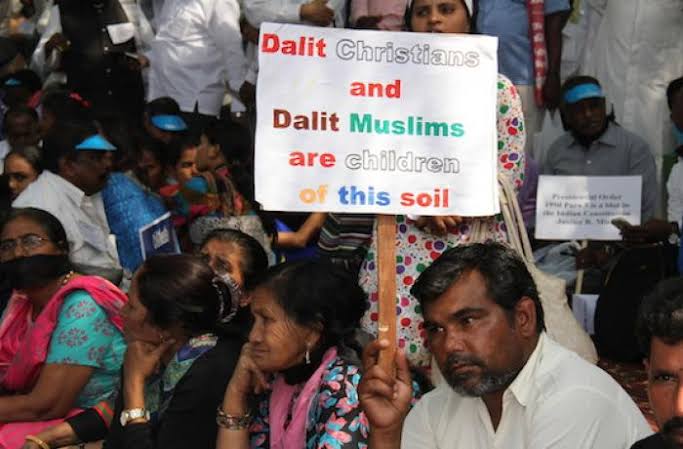
Image credit: maktoobmedia.com
Far from being outdated modes of self/group identifications, both caste and religion continue to hold significant sway in the sociopolitical life of modern South Asia. This piece looks at how ‘Dalit Muslims’ or the ex-untouchable converts to Islam problematize dominant narratives of caste and religion in India. The word ‘Dalit’ is etymologically derived from Sanskrit and literally means ‘broken’ or ‘crushed’; it was first used by 19th century educationist and anti-caste activist, Jotiba Phule to refer to the ‘untouchables’ or those which existed outside the ideal-typical four-fold Hindu caste division and were historically confined to ritually ‘unclean’ and menial tasks. Its continued application to these groups has been contested at different points in time; nevertheless, it acquired widespread and increasing political salience especially since the 1970s when it began to be used in a decidedly anti-caste connotation. Despite the outlawing of untouchability in post-Independence India, Dalits continue to face atrocities in contemporary India.
The centuries-long exclusion and oppression of the pariah or ex-untouchable groups was sought to be ameliorated through an elaborate yet complex affirmative action regime in the post-colonial period (the origins of such a system can roughly be traced to the colonial period). The term ‘Scheduled Caste’ –brought in usage by the Government of India Act of 1935- became the official category to denote ex-untouchable groups. One of the chief benefits made available to this section was a system of reservations of seats/posts in various public bodies and institutions. While this category initially only encompassed Hindu Dalits, the Presidential Order designating them as such was modified twice to include Dalits practicing Sikhism (1956) and Buddhism (1990); this effectively ended up excluding both Dalit Muslims and Dalit Christians from its ambit. The justification behind this was that since Christians and Muslims did not ritually practice untouchability, the ex-untouchable converts within both communities were not entitled to the ‘Scheduled Caste’ status and its benefits. Currently, both these subsets fall within another larger category of affirmative action recipients – the more heterogenous and numerous Other Backward Classes.
As I hinted before, this configuration of religion and caste-based identity was simulatenously partly influenced by and a departure from the colonial period. For example, the colonial state was open to accounting for the caste composition of Indian society, including that of the Muslim community through its decenial census; in the post-colonial era, this aspect of the census was done away with. An overall caste count of the population began to be seen as inimical to national unity. On the other hand, caste began to be seen largely as a Hindu structure while the Muslim caste structure was mostly glossed over. The crystallization of the Hindu-Muslim identity-based binary – also the product of the late colonial period’s practicies of enumeration and classification – became predominantly overarching in the postcolonial period as well. A byproduct of this was that the Muslim community began to be viewed as a religiously and culturally homogenous minority with the Muslim Personal Law becoming the cornerstone of their cultural identity.
It is perhaps easy to see how the figure of the Dalit Muslim challenges the aforementioned regime of caste and religion based identities. The political articulations and activism of the Dalit Muslims problematizes a monolithic understanding of the Muslim minority community and unsettles the divisions between religion and caste based boundaries that are predominant in postcolonial India. Lower-caste Muslim activists claim that in order to escape caste-based oppression, various lower-caste groups, including those from the then ‘untouchable’ ones, converted to Islam when it arrived in the subcontinent, many centuries ago. They contend that despite this conversion, the marginalized and inferior status of these groups persisted. Therefore, the bulk of the contemporary lower-caste Muslim population in India are descendants of some of the first groups to have adopted Islam in the subcontinent. While scholarly literature has observed the continuation of lower-caste status of certain groups despite the conversion to Islam, they have cast doubt on the clarity of such motives regarding religious conversion; in this vein, it has been argued that Muslim intellectuals’ initial introduction of Islam to those living in the subcontinent focused more on its monotheism rather than its emphasis on equality (https://jan.ucc.nau.edu/sj6/eatonapproachconversion.pdf). Nevertheless, religious conversions were often seen as routes for lower-caste groups to escape the oppression/subjugation that emanated from the Hindu caste order. Because there is no official definition or significant awareness of the term ‘Dalit Muslims’, lower-caste Muslim organizations have come up with two points in defining them – the occupation and names of the various caste groups. This means that one can identify Dalit Muslims through their names and their occupations, which is similar to their Hindu counterparts.
The denial of the previously discussed Scheduled Caste status to Dalit Muslims and Dalit Christians has caused significant debates within activist and academic circles. There are various ramifications of this state-led debarrment; some have argued that ‘The tension between religious conversion and state welfare practices designed to ameliorate caste inequality provides a lens for an understanding of how territorialized models of religion have been encoded within secular state practices.’ Firstly, it acts as a material penalty to those Dalit converts who wish to convert to either Islam or Christianity and acts as a deterrent to the same . This also impedes their religious freedoms and disallows them from choosing a faith of their choice. Additionally, this arrangement also overlooks the sociological existence of the caste hierarchy and practices of untouchability within the Muslim community.
While the Dalit Muslims’ pursuit for the Scheduled Caste status for themselves remains quite bleak in contemporary India, there is another area of concern for lower-caste Muslim activists where its impact has been somewhat notable – the agenda of mainstream Muslim politics itself. Lower-caste Muslim political activism has been highly critical of mainstream Muslim sociopolitical and religious organizations in India. It has often claimed that these bodies do not raise important questions regarding caste-based stratification within the Muslim community in India . However, recent developments in the stance of some of these bodies suggest that there have been changes in that area. For example, the Jamaat-e-Islami of India and the Jamiat Ulama-e-Hind have demanded the Scheduled Caste status for Dalit Muslims, with the latter filing a petition in the Indian Supreme Court in this regard. While mere demands to this effect do not necessarily translate to greater representation of lower-caste Muslims within these bodies, it does signal a shift within mainstream Muslim politics. It remains to be seen whether this sees a greater substantive interaction between both lower-caste Muslim activist associations and mainstream Muslim organizations.
Author’s bio
Salwa Yahya is a Post-Doctoral Fellow at the Moturi Satyanarayana Centre for Advanced Study in Humanities and Social Sciences, Krea University, India. She holds a PhD in Political Science from the Freie Universität, Berlin (2023). Her research interests include political theory, identity politics and civil society and research methodology.

Related Blogs
Reflections on Islam, Muslimness and Decolonisation – II
*Yasin Aktay’s four-part series is a contribution to Critical Muslim Studies that critically engages with S. Sayyid’s Recalling the Caliphate as a means of reflecting on the contemporary manifestations of the Muslim Question.Image credit: photographs by Johanna Loock,...

Reflections on Islam, Muslimness and Decolonisation – III
*Yasin Aktay’s four-part series is a contribution to Critical Muslim Studies that critically engages with S. Sayyid’s Recalling the Caliphate as a means of reflecting on the contemporary manifestations of the Muslim Question.Image credit: photographs by Johanna Loock,...

Reflections on Islam, Muslimness and Decolonisation – IV
*Yasin Aktay’s four-part series is a contribution to Critical Muslim Studies that critically engages with S. Sayyid’s Recalling the Caliphate as a means of reflecting on the contemporary manifestations of the Muslim Question.Image credit: photographs by Johanna Loock,...