


On May 23, 2024, in a highly polarised session of the General Assembly, the United Nations formally declared July 11 as the International Day of Reflection and Commemoration of the 1995 Genocide in Srebrenica. At long last, the Bosnian genocide was receiving the international attention and recognition that its survivors had long called for.
The UN Resolution codifying this memorial day (A/RES/78/282) passed with 84 votes in favour, 19 countries voting against and (astoundingly) 68 countries abstaining. Much might be said regarding the voting patterns of the countries involved (to provide one rather light-hearted example, the USA and Iran finally finding something to agree on and voting together in favour). However, for the purposes of this blog, I wish to highlight the voting patterns taken by those countries which we might describe as falling within the “Orthodox Christian World” (in which I include both “Eastern” and “Oriental” Orthodoxy). This focus is due to the involvement of Republika Srpska and the complicity of Serbia and the Serbian Orthodox Church in the massacres of Bosnian Muslims.
There were a number of Orthodox countries that voted in favour of the Resolution: Bulgaria, Moldova, Montenegro, North Macedonia, Romania, and Ukraine. Despite the doubtless pain of seeing their compatriots in faith involved in the shedding of innocent blood, these countries chose not to hide this fact but rather to vote in support of justice, in a true display of “Never Again”. Meanwhile, on the opposing side, other Orthodox countries chose to vote against the Resolution. Serbia itself fell into this group – in some ways, this is sadly not surprising, given both historical Serbian chauvinism and more recent dehumanising rhetoric against Bosnians, as well as ongoing genocide denial by both Serbia and the Serb-majority Republika Srpska within Bosnia. Additionally, Russia, Belarus, and Eritrea also voted against the resolution.
However, I was most troubled by those Orthodox countries that abstained – where others were raising a voice against genocide, they chose to stay silent. One of the most marked of these was Armenia – a nation which has itself suffered from genocide, yet chose to cower in denouncing it elsewhere. Armenia was not alone in abstaining, being joined by Georgia, Ethiopia, Cyprus, and Greece. Revealingly, Evangelos Sekeris, the Greek envoy to the UN, justified his nation’s abstention on the grounds that it might “undermine efforts for regional reconciliation and the European future of the Western Balkans (emphasis mine)”. Insisting that Greece recognises the severity of the Bosnian Genocide, Sekeris nonetheless maintained that the principal priority for Bosnia and Herzegovina should be joining the EU.
Just four days after the passing of this UN Resolution, I was privileged to be able to visit the Srebrenica Memorial Centre at Potočari, just north of the actual town of Srebrenica. There, we were shown the exact location where Bosnian refugees had sought refuge with UN peacekeeping forces, and from where, in a betrayal of the UN’s promise of safety, they were sent away into the arms of Serb forces. Our guides were actual survivors of the ensuing genocide, detailing to us how they had lost family members and friends during their long walk from Srebrenica to safety in Tuzla. They told us how the Serbs had justified their horrifying actions through Orthodox Christian supremacist rhetoric supported by pseudoscientific theories concerning the supposed “genetic inferiority” of Bosnians.
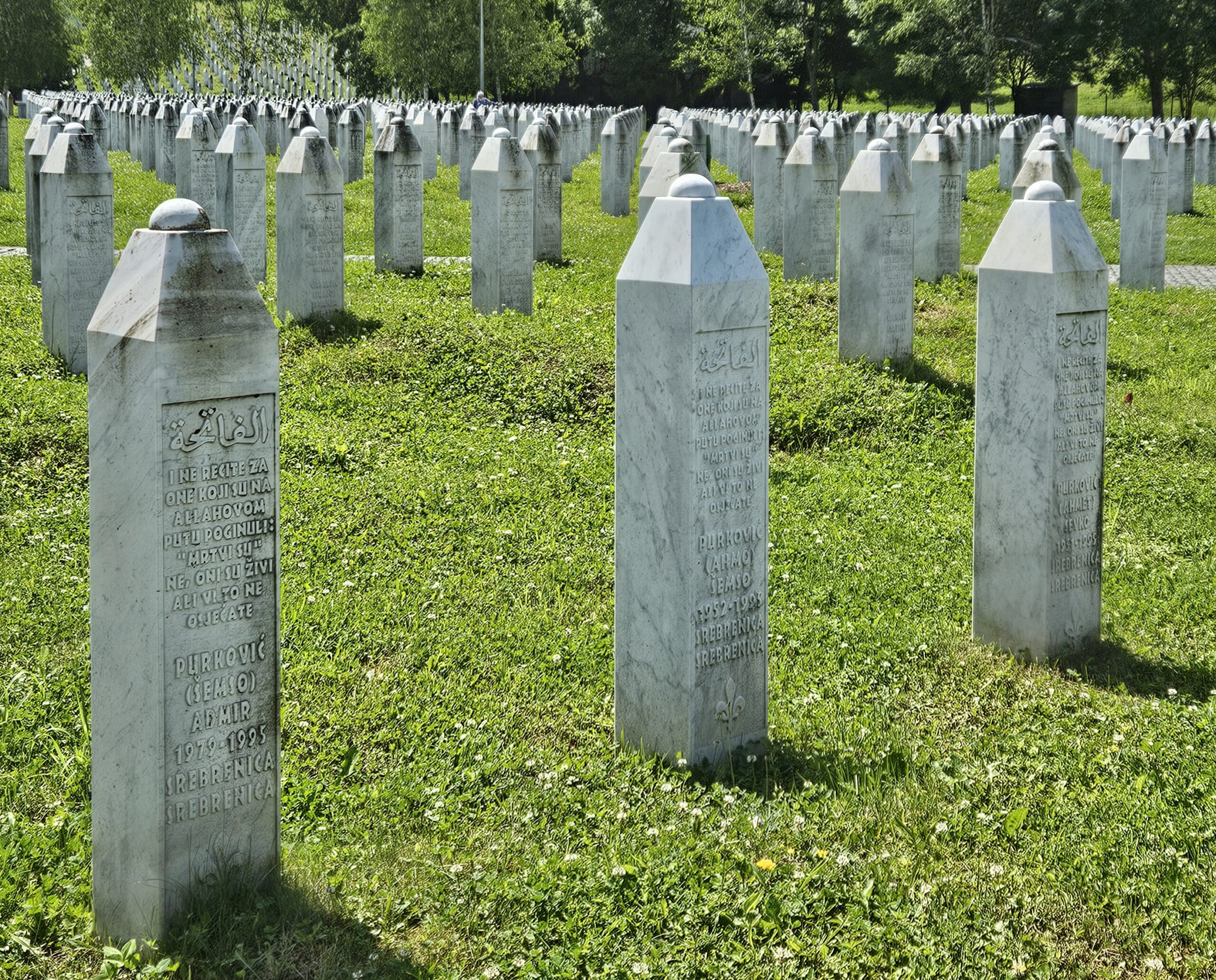
As I made my way through the cemetery outside the Memorial Centre, walking past hundreds and hundreds of gravestones, I pondered the scale and sheer depravity of what had transpired on these very grounds. I reflected upon the ideologies that had to be harnessed in order to propel the acts of violence: racism, Islamophobia, nationalism, chauvinism, white supremacism, and Eurocentrism (in the form of privileging Europeanness as a white, Christian identity).
It was then that I realised what it was that I was gazing upon: more than a cemetery, this was a monument to Modernity. By “Modernity”, I do not mean those religious discourses often collectively referred to as “modernism”. My use of the concept echoes its employment by decolonial scholarship. (To fully unpack it is beyond the scope of this blog, but I refer the interested reader to a piece by the late Enrique Dussel.)
Srebrenica serves as a testament to what can happen when Modernity festers and reaches full maturity. It is Modernity’s linkages to Eurocentrism and racial hierarchies that put its adherents on the path to genocide and mass destruction of human life. Far from a mere drive towards “progress”, Modernity’s “darker side” brings racism and racial thinking wherever it goes. It is this aspect of Modernity that earns the Bosnian Genocide a place among the many genocides of Modernity, from the Taino Genocide to the Trail of Tears, from the Circassian Genocide to the Armenian Genocide, from the Shoah to the Nakba, from Rwanda to Sudan.
My concern is that the Orthodox Church has allowed itself to be poisoned by Modernity. The events of Bosnia exemplify that racial thinking and white supremacism have seeped into the Orthodox vision for itself and its future. While the Orthodox Church has made attempts to push back against this tide (most notably, the 1872 Council of Constantinople condemned racism), it has not gone nearly far enough. This failure has caused the Church to become complicit in the genocide of Bosnians.
This complicity takes on a number of forms. It begins with the Serbian Orthodox Church providing outright support to Serb forces during the Bosnian War, blessing soldiers and endorsing campaigns of culturicide and genocide. It continues with the Orthodox heroification of Serb leader Radovan Karadžić, including the bestowing to Karadžić in 1993 of the Order of St. Dennis of Zante by a Greek Orthodox order. It further continues in the active participation of both Greek and Russian volunteers on the side of the Serbs during the Bosnian War. And finally, it continues in the downplaying or outright denial of the Bosnian genocide in Republika Srpska, Serbia, and Russia – and in the tacit lack of political support from Greece, Armenia, and other Orthodox countries in supporting initiatives for justice.
This silence of the Orthodox Christian body exists in tension with Scriptural prescriptions. In the Tanakh (Old Testament), God tells the Prophet Ezekiel that he has been made “a watchman” over the people of Israel. Ezekiel is tasked with giving warning to Israel, alerting the wicked and the righteous alike of sin. Furthermore, Ezekiel is warned that God will hold him accountable if he fails to provide warning (Ezekiel 3: 17-21). As an Orthodox believer, I read this passage as prescriptive for Christians as well, in line with Christ’s command to be “salt of the earth” (Matthew 5:13). It is in this vein that I feel that it is my duty to call out my spiritual brethren.
Now is the time to interrogate and reject the nationalist and chauvinist mythologies that we have told ourselves about the Orthodox place in the world. If we sincerely believe that Orthodox practice requires us to believe in our own racial and national supremacy, then we have strayed far from the example of Christ. We must reject, again and again, the heresies of Eurocentrism, of chauvinism, and of racism. Otherwise, our silence will condemn us at the End, as the Son of Man denounces us for our inaction (Matthew 25:31-46).
Author’s bio
Nik Zych is a young scholar of Eastern European origin. He is currently undertaking a PhD at the University of Leeds, using decolonial discourse theory to analyse Islamophobia in Russia. His wider research interests include Islamophobia in Eastern Europe, global racisms (including Islamophobia and antisemitism), decoloniality, and Critical Muslim Studies.

Related Blogs
Reflections on Islam, Muslimness and Decolonisation – II
*Yasin Aktay’s four-part series is a contribution to Critical Muslim Studies that critically engages with S. Sayyid’s Recalling the Caliphate as a means of reflecting on the contemporary manifestations of the Muslim Question.Image credit: photographs by Johanna Loock,...

Reflections on Islam, Muslimness and Decolonisation – III
*Yasin Aktay’s four-part series is a contribution to Critical Muslim Studies that critically engages with S. Sayyid’s Recalling the Caliphate as a means of reflecting on the contemporary manifestations of the Muslim Question.Image credit: photographs by Johanna Loock,...

Reflections on Islam, Muslimness and Decolonisation – IV
*Yasin Aktay’s four-part series is a contribution to Critical Muslim Studies that critically engages with S. Sayyid’s Recalling the Caliphate as a means of reflecting on the contemporary manifestations of the Muslim Question.Image credit: photographs by Johanna Loock,...