

A policeman presses his knee on the neck of a young man, a person of colour lying on the ground and struggling to breathe. To unbalance the man, the police officer had pulled the man’s head back and rammed his knee into the man’s stomach. Once floored, a second police officer had pushed the man’s legs and feet to the ground. The knee on his neck gradually weakens the man’s resistance. Every now and then he taps the pavement with his free hand. Soon more police officers arrive.
Contrary to possible assumptions, what I describe actually took place on 11 June 2021 in Bern, Switzerland. Unsurprisingly, some journalists connected the incident to the recent killing of George Floyd by a policeman in Minneapolis (25 May 2020) and thus to racist police violence more generally. Yet, one of them who had been a chance witness of the incident in Bern, strongly rejected the pertinence of such association. He requested to strictly separate police interventions in Switzerland from police violence in the U.S. due to the incommensurability of both. Instead of reviewing details of what happened, I take the journalist’s demand for a clear distinction as an impetus to discuss how the claim of incommensurability impedes a discourse on systemic racist violence.
If assuming that words gain their meaning through their relationships with other words and by their use in different situations (Ludwig Wittgenstein), one should also consider the significance of relations and constellations for making sense of events. The fact that George Floyd (and others) have been killed by the same method which was applied by the police in Bern allows to contextualise the event in Bern and consider the incident an assault epitomising systemic racism. This link may not function as evidence, but it does raise awareness of a problem and offers a means of interpretation which the journalist is preventing. Against the impediment of incommensurability claims, I propose to explore benefits of linking contemporary issues which may appear local and isolated, to possible antecedents and global structures of racism and coloniality. While comparison might be the most obvious tool to do this, I suggest with reference to David Theo Goldberg that it may be comparison itself which leads efforts to widen debates on racism into a cul-de-sac since all it takes to reject comparability is pointing to disparities. Against the impasse of comparativism, Goldberg introduces the concept of relationality.
On 11 June 2021, A. E. (27) was stopped by the police at 7 a.m. on his way to the railway station as “he staggered and almost walked into a pole”. When he did not get into the police car on his own, a scuffle ensued which culminated in the police officer pressing his knee on A. E.’s neck as two of the witnessing journalists, Naomi Jones and Dölf Barben, reported in local daily newspapers. Once the police officer had released the knee-on-neck hold, A. E. was stood up, but it seemed that he would collapse if not supported. Finally, the two police officers manoeuvred the man into the van. According to the journalists, it was “a mixture of pushing, throwing, and dropping”. The man’s head got hit and he remained motionless in the car.
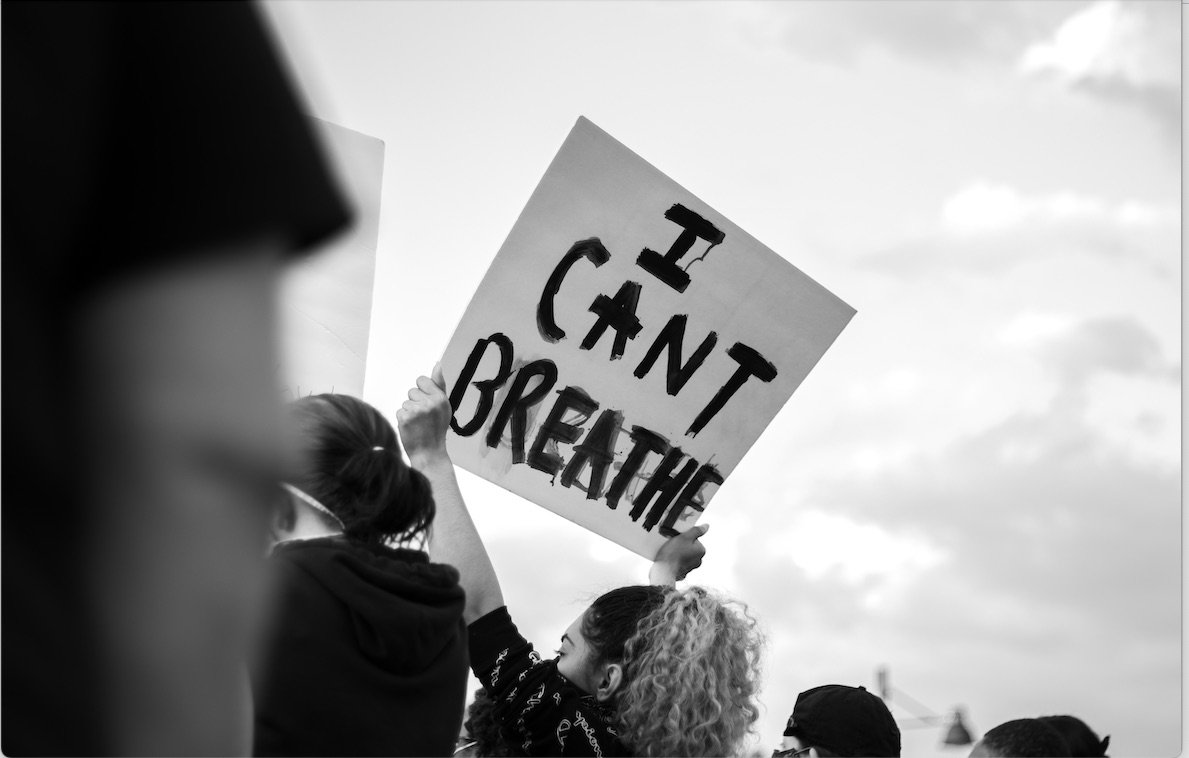
One week later, A. E., interviewed by Naomi Jones, said that when the officer kneeled on his neck, he “could not breathe” and thought he “was dying”. This statement implies that A.E. himself did not just perceive the attack as an individual experience but related it to the killing of Eric Garner (2014), George Floyd (2020), and a series of other victims who died after uttering the words “I can’t breathe”. Several authors shared this association. Thereby, they expanded the frame of reference, de-localised, and de-exceptionalised the incident in Bern and thus suggested seeing it as a moment of systemic racism. However, the journalist and witness Dölf Barben claimed that
[…] despite this visual parallel, it is inadmissible and highly misguided to try to place the two cases on the same line or even compare them. The dimensions are different. There, it was a matter of life and death in a large US city where racism and a high propensity for violence are widespread among police officers. Here, it is about minor injuries and an incident in a Swiss city where social tensions are kept within narrow limits. (my translation)
Barben sustained his argument of an essential disparity between a police officer kneeling on the neck of George Floyd and another one on that of A. E. by contrasting elements of dimension, context, and outcome. Thus, he reproduced an established strategy which disconnects supposedly individual violent acts from global structures of racism and colonialism by pointing out differences. As a consequence, the consideration of the Bern assault as belonging to a structural problem was to be averted.
In contrast to Barben who confined entities of comparison – and then incommensurability – to national borders, Goldberg proposes that what is commonly perceived as a local phenomenon is “almost always tied to extra- and trans-territorial conceptions and expressions” and influenced by what has been “tried and tested elsewhere” (p. 1273). However, arguments pointing to structural similarities between racist conditions separated by spatial or temporal distance are often rejected either as overrating specific circumstances, or as trivialising or even denying the past. Instead, I argue that it is the indiscriminate disconnection of different occurrences and the assertion of their incommensurability which leads to trivialisation.
In Switzerland, the evocation of racism, colonialism, and global hierarchies is often rejected by evoking the country’s declared neutrality and supposedly insignificant role in colonial exploitation. The formal non-involvement of Switzerland still seems to facilitate an amnesia of its compliance and complicity with and benefitting from colonial structures (through mercenaries, merchandise traffic, and slave trade). It appears as if different standards were applied for dealing with issues of colonialism and racism. In that way, until recently, it largely remained unchallenged to have a coffee at the “Colonial Bar” or eat “Heads of M****” (small chocolate-covered cakes filled with foamy sugar).
The normalisation of loaded or derogatory terms creates an impression of innocuousness which masks the devastating reality of colonialism to which they are tied. By contrast, persisting signs of coloniality in Switzerland have to be read as indicators of a colonial matrix that concerns not only the obviously colonial powers. Through relationality elements of the suppressed colonial history can be revealed. The globalisation of the Black Lives Matter movement since 2020, for instance, has contributed exactly to uncovering racism, selective police violence, and colonial structures all over the world.
In that vein, Goldberg shows how critical work on race indeed links individual racist incidents to the global colonial condition as setting the tone. A relational account which connects instead of contrasting and comparing, can reveal how “state formations, histories, logics of oppression and exploitation are linked” and how “new formations look to older modes of repression” (p. 1277). Goldberg clarifies that when links are created between Gaza and the Warsaw Ghetto or between the genocide of the Herero and Nama in German South West Africa and the annihilation of the Jews by Nazi Germany, the claim is not that one is “just like” the other (as in a comparativist account). Rather, connections show that antecedents provide a model for “how to regulate the Palestinian refugee camps” or how to “first exploit their labour and then exterminate them” (pp. 1276-7). A relational account “enables one to see how the colonial shaped the contemporary, planted racisms’ roots in place, designed their social conditions and cemented its structural arrangements” (p. 1280).
A difficulty of this approach is that relational arguments are in their turn often reduced to comparativism and countered by statements of incommensurability. The journalist Barben, for instance, subjects all arguments to the logic of comparison when he states that “it is inadmissible and highly misguided to try to place the two cases on the same line or even compare them”. This reduction blocks the way for connections that are not based on analogy and thus cannot simply be rejected by pointing to disanalogy.
In contrast to Barben’s refusal to accept transnational connections, a relational analysis of the police assault in Bern shows how contemporary racism is not limited to the Anglo-Saxon part of the world, race being a “floating signifier” which initiates the spreading of racial violence under different, even seemingly incomparable circumstances (see Stuart Hall, “Race, the Floating Signifier”). A. E.’s statement “I could not breath. I thought I was dying.” makes the floating of the signifier tangible.
Given the far-reaching impact of the floating signifier, I consider it crucial to understand examples such as the police attack in Bern or the perpetuation of loaded terms which may appear as unintentional exceptions or singular failures of individuals (or are presented as such) as part of a global system of racism and coloniality. Relationality precisely allows to highlight this connection and uncover the network of structures whose legacy maintains and reinforces a hierarchical and racist relationship between the West and the Rest. Increased visibility allows us to fight this system.

Related Blogs

Reflections on Islam, Muslimness and Decolonisation – III
*Yasin Aktay’s four-part series is a contribution to Critical Muslim Studies that critically engages with S. Sayyid’s Recalling the Caliphate as a means of reflecting on the contemporary manifestations of the Muslim Question.Image credit: photographs by Johanna Loock,...

Reflections on Islam, Muslimness and Decolonisation – IV
*Yasin Aktay’s four-part series is a contribution to Critical Muslim Studies that critically engages with S. Sayyid’s Recalling the Caliphate as a means of reflecting on the contemporary manifestations of the Muslim Question.Image credit: photographs by Johanna Loock,...

India’s Dominance is Ruining Cricket Internationally
*A version of this blog was previously published under the same title in the Sunday Times.Image credit: Cricket ball on field, free to use from pexels: https://www.pexels.com/photo/red-cricket-ball-on-lush-green-grass-field-34563722/. World cricket is in crisis...